Jungle Room Part Three: Wrapping up the story, and a legacy

This entry is post 21 of 21 in the ongoing series Isabel Cooper

Isabel Cooper and the Jungle Room A three-part sub-series on the guest room that Isabel Cooper painted for Dorothy Putnam in 1925

Painting murals was soon to become another professional skill and means of income for Isabel Cooper. It’s tempting to give credit to Dorothy Putnam and Eleanor the Snake for this. But even before she completed the Jungle Room at Dorothy’s Rye, New York house, Isabel was hearing from the head of the American Museum of Natural History, Henry Fairfield Osborn, whom she called “the dear old president of the American Museum.” Isabel wrote Charles Mahaffie that Osborn had asked her to “go abroad and study mural painting and do some of the walls of the new buildings of the museum…”1)Letter IC to CDM, July 22, 1925.

She continued, “it doesn’t seem any good for me to say that I don’t feel properly talented for such an enterprise.” Before long, Osborn got her to paint the murals, though she did not go first abroad to study mural painting.2)Letter IC to CDM, July 22, 1925.

The following year, she became a mural painter for commissions won by muralist Ezra Winter, for several prominent public buildings, including the Birmingham, Alabama central library and Cornell University’s student union. For more on her work with Ezra Winter, see this post.

A coda for Eleanor, the Jungle Room, and the Rye Putnam mansion

A house, likely with at least some of the bones of the 1925 Putnam home, still stands at 349 Locust Avenue, in Rye.3)Paul Hicks, “Amelia Earhart’s Time in Rye, Part II,” Rye Record, November 12, 2024, https://ryerecord.com/amelia-earharts-rye-part-ii/

That house today is worth, according to realty websites, almost five million dollars.4)Redfin.com estimated value, June 2026. But it no longer includes the Jungle Room and Undersea Room.

I have found no further record of the decorative painting work by Cooper and Donald Blanding in the Rye house. Likely, Isabel and Donald’s murals are long gone, painted over, or lost to removed and relocated walls.

More on what became of the Putnam Rye house and the two painted rooms may be found here.

Isabel Cooper’s retirement from paid art

Marrying Charles Mahaffie in August 1928 (more on Charles is found here.) led to Isabel no longer doing artistic work for pay. And she made a complete retirement of it. She was 36 years old, and would be moving to Washington, DC. For a short time, she completed promised illustration work for the Encyclopedia Britannica, but she took no more gigs.

She would now have a wholly different life. Isabel embraced the change. She swapped exploration for engaging with DC society, the wife of a government official. She made, in her way, an adventure of that.

Isabel’s Legacy as an artist and a mythologized forebear

Isabel Cooper Mahaffie died in January 1984 at 93 years. She had, at the time, 7 grandchildren and four great grandchildren. (She now has seventeen great grandchildren and two great great grandchildren.) Many of her seven grandchildren spent time with her and remember her wit, intelligence, stories, and style. A grand niece likewise remembers her well, having made of Isabel a mentor as she came of age in the 1970s.

Only a few of us still remember her vividly. But for all of her descendants, she is an iconic figure, with stories, paintings, shared memories, and images worthy of becoming, for some, tattooed body art.

We owe her thanks for urging all of us on to our enthusiasms, to take on life, to adventure, to go places. Her legacy in all that is powerful and will continue.

Isabel’s scientific art was so distinctive that at least one of her grandchildren and four of her great grandchildren have versions of it in tattoos. I think she would find this delightful and hysterical.

Forearm tattoo of a from based on an illustration by Isabel Cooper, 1920s
A great granddaughter’s tattoo honors Isabel Cooper’s art (2023)5)Photo courtesy of Skye Mahaffie

For a complete list of posts on this site about Isabel Cooper, see the series here.

References[+]

Jungle Room Part Two: “Painting up Dorothy’s House”

This entry is post 20 of 21 in the ongoing series Isabel Cooper

A three-part sub-series on the guest room that Isabel Cooper painted for Dorothy Putnam in 1925

In the late winter and into the spring of 1925, Isabel Cooper was committed to travel as a staff artist on naturalist William Beebe’s Arcturus Expedition. (Stories from that expedition are earlier in the series on Isabel Cooper on this website. See: here, for more.)

Isabel’s friend Dorothy Putnam joined for part of the Arcturus Expedition as it reached the Panama Canal Zone. The two had time together at leisure when the Arcturus readied for its onward in the Canal Zone. Dorothy had already gotten Isabel to agree to paint a Jungle Room in her new house.

It is likely that in their time together on the expedition, they further discussed the Jungle Room. The passage below creates what a conversation like that could have been like.

__________

Cristóbal, Panama Canal Zone, March 27, 1925

Isabel and Dorothy spent the day out in Cristóbal, in the Canal Zone, sightseeing, doing a little shopping, and laughing.

Footsore from their meanderings, by mid-afternoon, they dropped at last into canvas chairs on the terrace of the Hotel Washington. The afternoon was hot, but the trade winds kept off the worst of it. They ordered cocktails.

They had shopped on the plaza, and talked of whether they’d get George and Charles each a Panama hat. They worked over the logistics of getting the hats home in tact. Now they sat, relaxed, facing Limón Bay, under the shade of a large umbrella.

“Is that our ship, down there?” Dorothy asked pointing toward the harbor. She had just arrived the day before to join the expedition, and had yet to board the expedition ship.

The Arcturus was moored on the bay, below them. A large white steam yacht, it stood out amongst the smaller vessels and US Navy gray ships in the harbor.

“That’s her, home sweet home,” Isabel said, her laugh suggesting mixed views of shipboard life.

The Arcturus was a good ship, well-fitted for the scientific work. Isabel had worked aboard her for five weeks already, as they explored the Sargasso Sea in the middle Atlantic. But the vessel was overstuffed with gear and supplies.

“Wonderful!” Dorothy said. “I’m quite mad about this trip. I’m glad for a break from Rye. I know I’ll so enjoy the work and of course, spending this time with you.”

Isabel smiled and said, “Well I’m delighted to have you with me. We will have a marvelous time.”

The waiter brought them two sweating tumblers. Lime squashes, with vodka for Dorothy, and rum for Isabel. They raised their glasses and grinned at each other. They sipped the drinks.

“Well this is perfect. You and I having a chance to catch up before we all get down to work,” Dorothy said.

“Yes, things get feverish when we are in the thick of the work. The Director has too many ideas.”

Dorothy snorted a laugh.

They both knew William Beebe, the expedition director, well. He was kind, mercurial, generous, demanding, supportive, and exasperating, all rolled up together. It helped to joke about him. Calling him The Director, was part of the ongoing mockery of his staff. Dorothy knew him socially and through Isabel’s tales of his ways during their years of working together in the tropics.

“Enough about that silly man. I want to talk about my Jungle Room,” Dorothy said, her blue eyes twinkling. There was mischief in her smile. 

“I want you to put a great big snake in it.”

“A snake?” Isabel said. “What sort of snake?”

She had thought out her design for the Jungle Room, and made a few sketches already. For Isabel, it should be a lush, colorful, immersive scene, palm fronds and flowers, dappled shade, maybe a few birds. The snake idea immediately made her think of Adam and Eve. A snake in paradise.

“Like that boa constrictor you and the ladies captured a few years ago. Oh, it will be delightful. An enormous boa,” Dorothy said, flinging her arms wide.

Isabel’s eyes narrowed. This didn’t fit the way she’d hoped to paint the room. A bit of a joke amidst the lovely scene she could create.

“Oh, I’m not sure that will work so well,” she said.

“Silly, of course it will. It will delight our guests. We’ll call her Eleanor. She should be ever so big.” She spread her arms wide, again.

“Eleanor the boa constrictor,” Isabel said. There was no stopping Dorothy when she set her mind on something. And it was Dorothy’s house, of course.

Isabel had an inkling this was a way Dorothy was getting one over on George, too. The two tussled over lots of things, with Dorothy seeing that she didn’t yield to all of George’s decisions over their lives.

“Oh, of course dear, you shall have your boa constrictor,” she said.

She didn’t mind getting one over on George herself. She was fond of George. George deserved some of the credit for her meeting Charles. But George was a bit full of himself.

As if reading her thoughts, Dorothy said, “It’ll poke George too, he’s so stuffy sometimes.” 

By the time she wrote Charles that night, her enthusiasm for the Jungle Room, snake and all, had returned. Up late writing to him, as was her habit, she told Charles:1)IC to CDM, February 27, 1925 I am looking forward to the jolly month I shall spend painting up Dorothy’s house, the unsuspecting bit of space that doesn’t know that it is going to have four walls around it, much less a lot of wild looking forest trees painted on the walls. It will be a lark. She’d figure out the snake part along the way. Eleanor, of all names, to give it!

__________

Isabel’s art had a certain spark and personality

Painting the giant boa, Eleanor, for Dorothy’s jungle room, probably didn’t fit Isabel’s vision or her sensibilities about interior decoration. She seem to see room decoration in the way she saw her animal art. But it also was no difficulty for her to do.

If you look at the animal paintings made by Isabel, even those done for entirely scientific purposes, you recognize that her creatures have a personalities. Her job was supposed to be much more clinical: to capture species-specific markings for classification and expedition record-keeping. She transcended that, while doing such a superb job at it that she quickly became essential to William Beebe’s efforts to study tropical seas and jungles.

An illustration she made of frigate birds in the Cocos and Galapagos Islands, illustrate this.

Frigate birds, painted by Isabel Cooper, Cocos Islands, 1925. Each one has a distinct personality

But she had it in her repertoire to give the Jungle Room its key inhabitant. She would add the boa that Dorothy wanted.

The Jungle Room comes into being

In mid-summer of 1925, after she returned from the Arcturus Expedition, Isabel got to work on the Jungle Room. It would have its resident snake, too. Isabel, trained in interior decoration, didn’t necessarily think of it room design as including the charming animals she sometimes painted with their distinct personalities.

She wrote Charles on July 8th,2)IC to CDM, July 8, 1925 “I am starting the mural horror shortly, as I can be sure I won’t have chills at [Dorothy’s] house.” She did not want to be a house guest and companion to Dorothy in the throes of malarial fever, which she had suffered off and on since her first year in the tropics.

Isabel was still in Rye, working on the mural, in mid-August “trying to finish the blooming wall.”3)IC to CDM, August 16, 1925. At some point, Charles made a visit and had a look. Though he was a law-trained bureaucrat, a regulator of railroad finance, and about as far from the arts and design as a man could be, he apparently weighed in on the design and gave pointers.

At the end of August, she wrote Charles:

The forest is coming along. I have fixed the horrid place which you objected to. Also the leggy looking flowers. But Dorothy has requested a little livestock, so I have caused a large boa-constrictor named Eleanor to appear among the ferns well back of the bed, so no one need ever see her. I think it is inartistic and rather dangerous, but Dorothy loves it, for its rarity. I suppose, or devilishness….4)IC to CDM, August 27, 1925

Dorothy’s “livestock” was the boa constrictor she was to call Eleanor. Isabel was reluctant to add the snake to her fully-imagined design, but didn’t want to disappoint her friend.

Isabel had comprehensive experience painting snakes. For more on that, visit here.

We can imagine that day when Dorothy came in to see the work:

“Absolutely stunning,” Dorothy said, gazing all around, her bright, warm smile taking it all in. “Oh but where’s my snake?” 

“Just here,” Isabel would have said, sheepishly pointing to the space along the baseboards, behind the headboard.

“Touche!” Dorothy surely said, “I’ve got my snake, but you’ve had your way too, you clever girl!”

Imagining what the Jungle Room looked like

No pictures that I know of survive of Isabel’s Jungle Room. Several magazine and pictorial features described the room over the years.

Coincidentally, on the same day that Charles and Isabel traveled to Rye to be introduced by their mutual friends, George and Dorothy Putnam, the Midweek Pictorial (of the New York Times) published a story on the Putnam’s Rye home:5)Midweek Pictorial, December 24, 1924, p. 14.

The Jungle Room’s: walls picture a vivid jungle scene, with trailing vines and plants and flowers and gay-colored birds perched here and there and a huge python winding about the base board, partially hidden, fortunately, for ‘screamish’ guests, by the bed. The snake’s name is Eleanor, by the way…6)Midweek Pictorial, December 24, 1924, p. 14.

Isabel, in her time in the tropics, made watercolors of tropical foliage, and entwined roots, among other motifs. Her three-panel screen, submitted to the Architectural League of New York 1926 Exhibition, suggests what her jungle details might have looked like. A photo of it is below.

A three-panel screen design by Isabel Cooper, 19267)Year Book of the Architectural League of New York, and Catalogue of the Annual Exhibition. United States, Secretary of the Architectural league of New York, 1926.

Isabel also took photographs from time to time, perhaps to remember a scene to paint later. The photo below is in her scrap book pages relating to her time in British Guiana. It probably inspired her 1926 Architectural League entry labeled “jungle roots”. It could also have inspired her design for the Jungle Room.

Photo by Isabel Cooper from the jungles of British Guiana, circa early 1920s. From Cooper’s scrapbook pages about her time there.

Another profile of the Putnam home in Better Homes & Gardens, in 1937, said:8)Elizabeth MacRae Boykin, “Amelia Earhart at Home,” Better Homes & Gardens, February 1937, pp. 239–40.

Visitors to the house were often shown the Jungle Room, where lushly painted scenes of plants, birds, and flowers seemed to hum—not with actual birdsong but with the idea of birdsong, as if even the discreetly included python named Eleanor, coiled gracefully among the painted foliage, might lift her head and, in a moment of grace, whistle a tune.

As noted, the “python” this and several other articles described, was in fact a boa constrictor. British Guiana, now Guyana, has no pythons, which are native to Asia and Africa.

While we have no pictures of Eleanor and don’t know which species of boa she was, Isabel captured several varieties in her work with the Department of Tropical Research expeditions to British Guiana (now Guyana) in the 1920s.

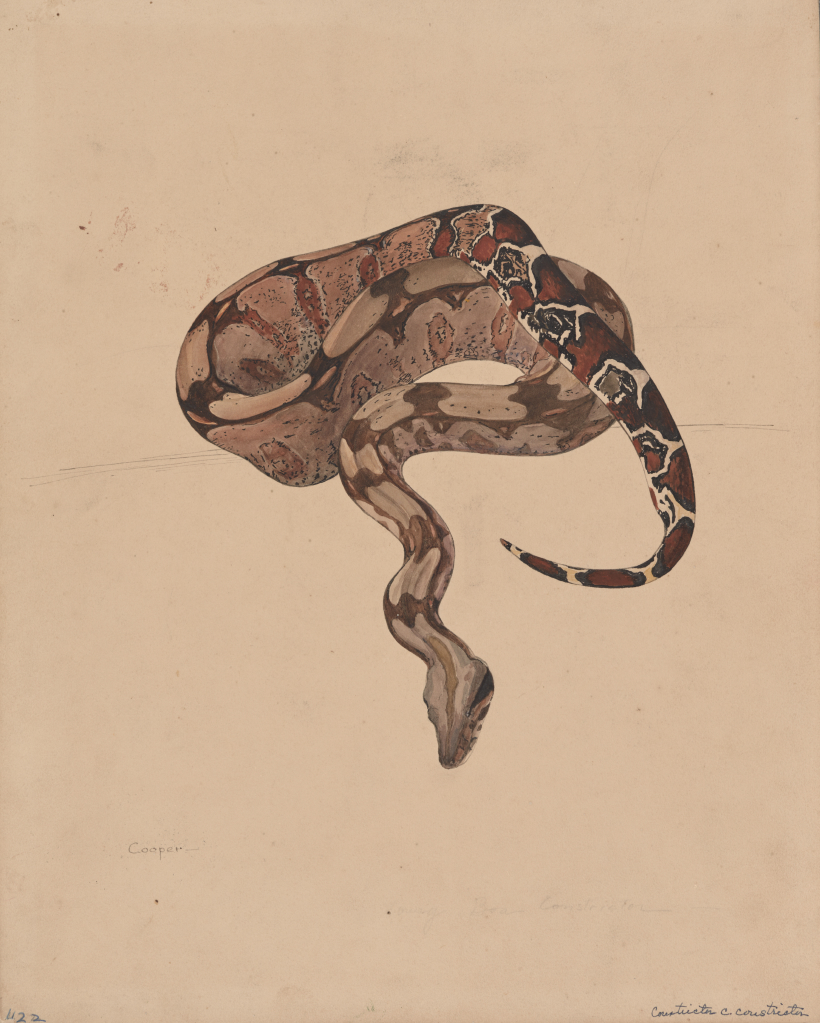
To read a bit more about Isabel and snakes, visit this page. Below are some of her paintings of boas from her work with the New York Zoological Society’s Department of Tropical Research in the 1910s and 1920s. Her art and that of other department artists are in the digital archive of the Wildlife Conservation Society, and are available here.

Spotted boa, painted by Isabel Cooper9)New York Zoological Society, Department of Tropical Research. British Guiana (now Guyana), March 5, 1921. Digitized by the Wildlife Conservation Society, available at https://wcs.access.preservica.com/archive.
Small boa constrictor, painted by Isabel Cooper10)New York Zoological Society, Department of Tropical Research. British Guiana (now Guyana), July 15, 1922. Digitized by the Wildlife Conservation Society, available at https://wcs.access.preservica.com/archive.

But painting a fanciful jungle room may have given Isabel permission to make a fanciful snake, and thus it could be a composite of the snakes she knew from her work.

Two birds and a pair of fish

Other creatures lived in Isabel’s jungle. There were two grey birds, and the Jungle Room had a couple of fish. The fish were named Finn and Haddie.11)“Mrs. W. H. Burghardt Receives Description of Putnam Home at Rye, New York,” Statesman Journal (Salem, Oregon), January 24, 1926 Since the big snake had a name, Dorothy probably decided to also offer names to the interviewer for the two fish. Finn and Haddie was an easy-reach option.

Finnan Haddie was a traditional cold-smoked haddock, sold in fish shops. Cartoons and humor of the time also used Finn and Haddie as names for a humorous pair of characters.

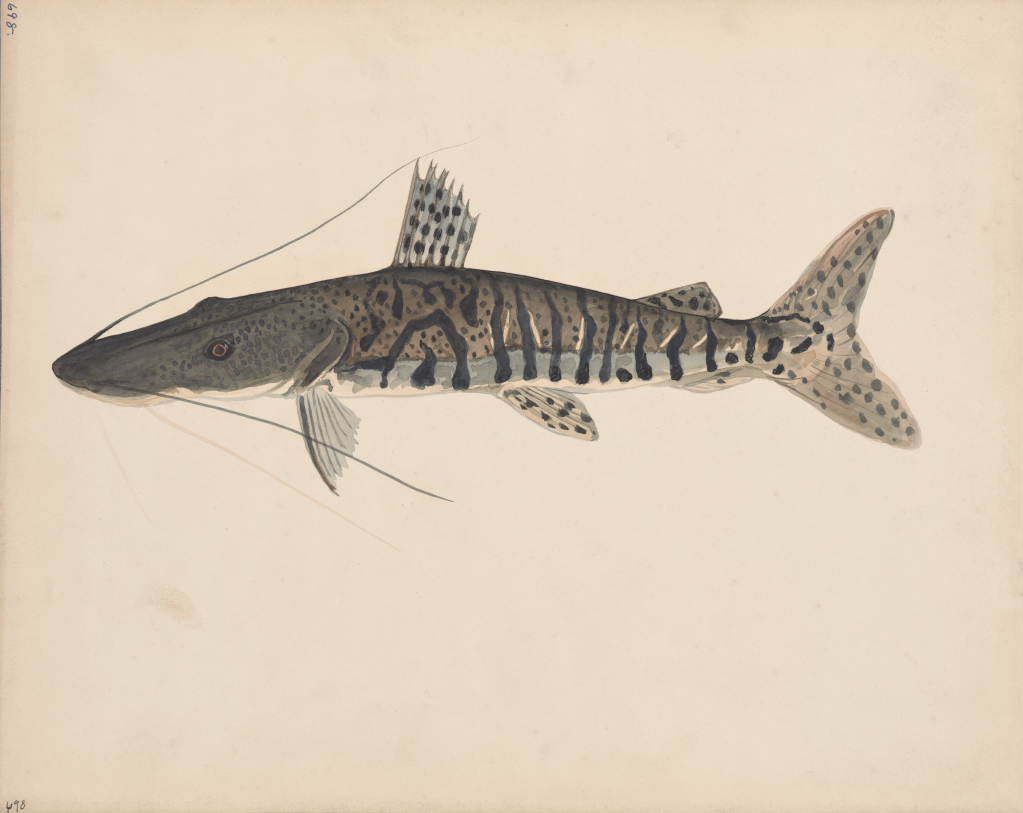
Isabel painted hundreds of fish for her work with the New York Zoological Society’s Department of Tropical Research. Some examples are below.

Pseudoplatystoma fasciatus, painted by Isabel Cooper12)New York Zoological Society, Department of Tropical Research. British Guiana (now Guyana), March 16, 1924. Digitized by the Wildlife Conservation Society, available at https://wcs.access.preservica.com/archive.
Cichla ocellaris, painted by Isabel Cooper13)New York Zoological Society, Department of Tropical Research. British Guiana (now Guyana), April 26, 1924. Digitized by the Wildlife Conservation Society, available at https://wcs.access.preservica.com/archive.

For a further sense of what the Jungle Room might have been like, we also have the example of Don Blanding’s Undersea Room. It was the other themed guest room at the Putnam house. It shows the full, four-wall, and at least in the case of Blanding’s room, ceiling treatment.

The undersea room at the Putnam house, painted by Don Blanding. This suggests how Isabel approached painting her Jungle Room. No pictures of the Jungle Room appear to still exist.14)Elizabeth MacRae Boykin, “Amelia Earhart at Home,” Better Homes & Gardens, February 1937, pp. 239–40.

For a little more on Blanding and the undersea room, visit here.

Part Three rounds out this series with a look at what became of the Jungle Room and the legacy for Isabel and the rest of us.

References[+]

Jungle Room Part One: Isabel Cooper and a Snake Named Eleanor

This entry is post 19 of 21 in the ongoing series Isabel Cooper

A three-part sub-series on the guest room that Isabel Cooper painted for Dorothy Putnam in 1925

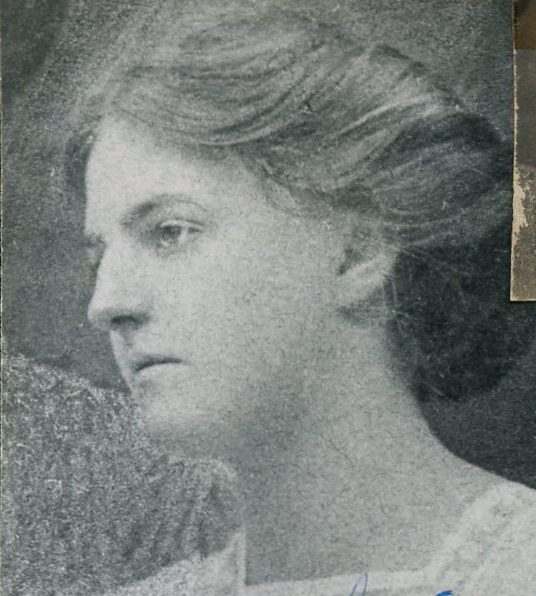
Isabel Cooper in the late 1920s

Locust Avenue, Rye, New York, November 2, 1925

Isabel read late into the night in the silent house. Dorothy and George Putnam’s home in Rye was her refuge from the racket and bustle of Manhattan. It was a fine weekend, and she hadn’t had any bouts of fever, the lingering effects of the malaria she’d contracted in British Guiana. Those could strike at will, ruining an evening out or a weekend plan.

She picked up her book. Charles, who she hoped to marry, had urged her to read H. G. Wells’ new novel, Christina Alberta’s Father, so she had packed it with half a dozen other books for her sojourn on Locust Avenue in Rye.

Drawing of the main living room of Rocknoll, the home of George P. Putnam and Dorothy B. Putnam, built in Rye, New York, in 1925
A sketch Isabel made for Charles of the main living room at the Putnam Rye house, from Christmas 1926

This time, she hadn’t come up to Rye for a weekend of socializing with the Putnams and all their their visitors and friends. And she hadn’t come to relax with her best friend Dorothy.

Dorothy and George were away. George was traveling somewhere on business, and Dorothy was off, according to her note, on a “spree”. And the servants had the night off. So Isabel offered to look after Junie, Dorothy and George’s 4-and-a-half-year-old son.

Junie, was, Isabel told Charles, a delectable, though perfectly naughty little boy. But he hadn’t given her any trouble that afternoon. She’d read a story to him and put him to bed. She had time then to play the Putnam’s Steinway, with no listeners to inhibit her.

Now she sat in the Morris chair by the mica-shaded reading lamp in the Jungle Room, the guest room she had custom decorated for Dorothy. She put on only the single lamp, so she could ignore Eleanor, the boa constrictor, whom she had painted on the wall at Dorothy’s insistence.

Eleanor hadn’t fit her vision for the room, but Dorothy was a persuasive friend, probably the most persuasive woman she knew. Isabel painted the boa low on the wall behind the headboard of the guest bed, so that visitors wouldn’t have to contemplate her too much.

Her reading lamp quieted Eleanor and dimmed to shadowy background the the fronds and roots and birds and frogs that decorated the room.

She read late into the evening, as was her habit. Eleanor, the boa, stayed hidden from view behind the bed, twined along the baseboards.


About Isabel Ruth Cooper

Isabel Ruth Cooper (1892–1984, later Isabel Cooper Mahaffie), was this author’s grandmother. She was an professional artist who, later in her life, retired from paid work to paint landscapes and still lifes. [Yes, the plural of still life is still lifes.]

As a young, single woman, she’d made a lucrative career in art. That paid work came to include mural painting and decoration, in addition to the scientific illustration she became noted for.

A recent blog post here explored Isabel’s work as a mural painter in the studio of the muralist Ezra Winter.

But Isabel had an earlier history of work in design and interior decoration, and before she did mural painting professionally, she painted at least one room-sized mural, the Putnam’s Jungle Room. That mural featured an enormous boa constrictor named Eleanor.

The tale of Eleanor the Boa, while it seems but a fun side journey for Isabel, brings new threads of her story as an artist together.

Isabel spent a year at Bryn Mawr College outside Philadelphia when she was seventeen. Her guardian Aunt Mary P. Cooper paid the tuition and expenses, and may well have chosen the college. Isabel enjoyed Bryn Mawr, but was not cut out for, at least at that young age, an academic life.

Isabel at 17, in 1909. She entered Bryn Mawr College that Fall

Any of us who knew her would have trouble putting “coed” and “Isabel Cooper” in the same sentence. The school work didn’t catch her interest. And, as she told a later interviewer, instead of buckling down in her studies, she was “eternally sketching.”1)John Monk Saunders, “Jungle Creatures ‘Sit’ for Her in Their Own Back Yards,” American Illustrated Magazine. United States, Crowell-Collier Publishing Company, February 1926.

Isabel left Bryn Mawr at the end of her freshman year. She returned to New York City. It became clear that art was calling her.

In New York, Isabel turned to advancing her art education on her terms, or as far as she could bend things with her supervising guardian Aunt Mary. (In November 1913, just after she turned 21, Isabel secured her legal emancipation from her Aunt Mary’s guardianship. That story is here.)

Isabel would go forth on her own terms from then on. She was interested in everything from fine art painting to myriad more practical and applied arts. Isabel told an interviewer that she “took every art course offered.”2)John Monk Saunders, “Jungle Creatures ‘Sit’ for Her in Their Own Back Yards,” American Illustrated Magazine. United States, Crowell-Collier Publishing Company, February 1926.

She studied at the Art Students League in New York City, and took classes at Columbia Teacher’s College from 1910 to 1913. Columbia directories and Bryn Mawr alumni listings show her at Columbia Teachers College studying house decoration and fine arts, and also practical arts. She also took architecture classes and seems to have been keenly interested in that subject.

She gravitated toward design and decoration, and began to work in interior design by the late 1910s, perhaps as a surer way to make a living. A 1913 Bryn Mawr College listing notes her as “Student, Department of House Decoration and Fine Arts, Teachers’ College, New York City, 1910–12;” but also as working as an “Interior and House Decorator, 1912–13.3)Bryn Mawr College Calendar, 1913. Bryn Mawr, Pennsylvania: Bryn Mawr College, 1913. p. 190. This makes it clear she was working as well as attending classes. She was paying her own way in life, and needed income.

Making a profession of art and decoration

Paid and unpaid, Isabel tried all different arts: drawing from life, rug and tapestry design, clay sculpture, pottery, metalwork, interior decoration, and stage costumes.4)John Monk Saunders, “Jungle Creatures ‘Sit’ for Her in Their Own Back Yards,” American Magazine, February 1926, Vol. 101, p. 26.

She was good at interior design. It’s likely she worked in the early 1910s for Anton Hellmann, who had a interior decoration practice and school at the Benedict Studios on Washington Square in New York City.5)The Upholsterer, June 1916, Vol. 55, p. 83. She gave the Benedict Studios as her mailing address for several years.

By 1917, Isabel was pursuing work as a scientific artist and in interior decoration at the same time. Because the scientific illustration took place during the dry season, and when she was in the tropics, she then toggled to interior design and other artistic work when she was back in New York City. And the two art forms fueled and inspired each other.

Isabel was explicit about how she drew on nature to inspire her art. Submissions she made to the Architectural League of New York’s 1926 exhibition show her blending in natural themes and details:6)Year Book of the Architectural League of New York, and Catalogue of the Annual Exhibition. United States, Secretary of the Architectural league of New York, 1926.

Isabel Cooper’s entries in the 1926 Architectural League Exhibition7)Year Book of the Architectural League of New York, and Catalogue of the Annual Exhibition, Index of Exhibits, United States, Secretary of the Architectural league of New York, 1926.

Moving away from decoration

But Isabel had mixed feelings about decoration. She found interior decorating too commercially demanding.8)John Monk Saunders, “Jungle Creatures ‘Sit’ for Her in Their Own Back Yards,” American Magazine, February 1926, Vol. 101, p. 26. She found additional illustration work and also wrote magazine articles for further income.

Part Two is about how the jungle-themed room she painted for Dorothy Putnam came about and what it might have looked like

References[+]

Isabel Cooper’s work with the muralist Ezra Winter

This entry is post 18 of 21 in the ongoing series Isabel Cooper

As a boy, I spent a lot of time with my grandmother, Isabel Cooper. She was fascinating. Before marrying, she lived an independent, adventurous life, too rare for women born in the 1890s.

Among hundreds of stories I heard, she told me about her time working “above the ceiling” in Grand Central Terminal in New York City.

Grand Central interior, with its ceiling depicting constellations1)By Sracer357 – Own work, CC BY-SA 3.0, https://commons.wikimedia.org/w/index.php?curid=21753225

Isabel was a painter, an atelier-trained artist who had worked in scientific illustration and decorative arts. In the late 1920s, she took a job working for the mural painter, Ezra Winter. His studio was in Grand Central Terminal.

Winter designed large-format murals for public spaces, and had a team of artists executing his designs. His murals are at Radio City Music Hall, and the US Chamber of Commerce and the Library of Congress reading room in Washington, DC, among other places.

In her eighties, Isabel relished remembering her time at the studio. A favorite story was about a “funny little man” who darted through the studio from time to time. He would cross the artists’ work area, and pop through a small door at the other end. One day, one of the artists stopped him and asked what he was up to. “Why I’m the star lighter,” he said.

In the early 1930s, an un-named correspondent wrote The New Yorker and told the same story. I wonder if it was Isabel.2)Morris Bishop, Charles Cooke, and Robert M. Coates, “Twinkle, Twinkle,” Talk of the Town, The New Yorker, December 23, 1933, pp. 9-10.

In the 1920s, Grand Central Terminal had a map of the heavens painted on its barrel-vaulted ceiling above the main concourse. Sixty ten-watt light bulbs lit the prominent stars in the constellations it depicted. (A restored version of the night-sky ceiling is still there. Through a design error, the entire sky view is the reverse of the actual night sky.)

Somebody had to change burned-out light bulbs. Isabel’s “funny little man” had the job. There are still lights in the ceiling; the bulbs are now LEDs.

Note: Isabel’s stories often involved funny little men.

Working for Ezra Winter

By the late 1920s, Ezra Winter was getting big commissions for murals in public buildings, bank lobbies, and elsewhere, and was growing his staff. He was close friends with naturalist and scientific expedition leader William Beebe, for whom Isabel had long worked on expeditions to South America. She must have known of Ezra Winter through that connection. He offered Isabel work in his studio.

By 1926, when she went to work for Winter, Isabel had met Charles D. Mahaffie, her future husband. My guess is she no longer wanted to leave the country for months at a time on William Beebe’s scientific expeditions, which she had done since 1917.

Work in New York City best suited her new situation, Charles, who lived in Washington, DC, was only a train ride away.

Ezra Winter, undated photo3)National Park Service, https://www.nps.gov/people/ezra-winter.htm

Winter’s studio, where he employed a dozen or more artists, was high above the concourse in Grand Central Terminal, though not quite “above the ceiling”.

His attic space was large and had tall, arched windows that let in plenty of light. It had high ceilings that fit canvases of 20 by 40 feet. It sat near the level of the vaulted ceiling of the station, with its painted sky.

A cutaway diagram of Grand Central, showing the space (top right) where Ezra Winter had his studio4)By New York Central Railroad (No author, publisher, or copyright listed) – “The Gateway to a Continent; Grand Central Zone”GRAND CENTRAL TERMINAL, NEW YORK.Pictorial profile of Grand Central Terminal, the office buildings, apartment buildings, and hotels within the Grand Central Zone which is located from 42nd Street to 51st Street between Madison and Lexington Avenues in New York City. 36pp. 4to (New York, 1939). First Edition.The Cooper Collection of Transportation History (private collection), Public Domain, https://commons.wikimedia.org/w/index.php?curid=47214055

The right kind of artists mattered to Ezra Winter

In a speech to the Mural Painters Society in 1932 or 19335)Typescript of the speech, Ezra Winter Collection, Archive of American Art, Smithsonian Institution, p. 22., Winter talked about how he operated his studio. He commented that union painters tended to have work that was too standardized or too stylized. But, he said:

Among the non-union assistants which I did use in my studio I have always found them so individualized in the character of their work that I could depend on them to do only certain things the way I wished to have them done.

What I am trying to bring out is that artists are all so highly and intensely individual and it is so good and healthy for them to be that way that any attempt at standardization of their work or their time or any outside control is bound to be a hindrance and a handicap to their work.

Isabel’s work for William Beebe, executing scientific illustrations of animals, showed spark and wit. Her animals had personality (see her rendering of a king vulture, below). Winter had probably already seen her work and noticed its qualities when he sought to bring her into his operation. Beebe also had reported on how hard Isabel worked during his expeditions.6)Review of various expedition journals at the William Beebe archive, Princeton University Special Collections He may have recommended her to Ezra Winter as a talented and efficient staffer.

An illustration of a king vulture by Isabel Cooper7)from the author’s collection

The Ezra Winter studio payroll records at the Archive of American Art span 1933-36, which is a period after Isabel no longer worked for him. They show he paid his staff artists between $25 to $60 per week.8)Review of unpublished records in the Ezra Winter Collection, Archive of American Art, Smithsonian Institution. But Isabel wrote in a letter to Charles Mahaffie (see below) that she “worked on time” for Ezra Winter, and was able to mix work for him with other projects. She earned $1,200 at Winter’s studio in 1927, as reflected in her tax return.9)Tax document in the author’s family archives. I don’t have records to show how many weeks of 1927 she worked in the studio.

That year, she also earned $900 from the Encyclopedia Britannica for illustration work, $2100 from the American Museum of Natural History, (for her murals and diagrams for their exhibits), and $1400 for miscellaneous decorating commissions. Her income in 1927 was $6,000. That equates to an estimated $113,859 in 2026.10)using the calculator here: https://smartasset.com/investing/inflation-calculator

A “haven for giddy frolic”

A biographical series of articles by Jessica Helfand on Ezra Winter in the Design Observer relate that Winter and the naturalist William Beebe were close pals. They used Winter’s Grand Central studio for parties.

With his pals Bill (William Chadbourne, a lawyer) and Will (the zoologist William Beebe) Winter soon transformed his studio into a haven for giddy frolic. The parties became a palpable means of escape for the serious painter — a place to dance and dress up, to flirt and cavort and forget, for a few hours, about all the pressing obligations that otherwise circumscribed his days. These soirées proved a kind of temporary escape, a respite from ordinary life to the extraordinary world of make-believe.11)Jessica Helfand, “Ezra Winter Project, Chapter Six,” Design Observer, June 1, 2012, https://designobserver.com/ezra-winter-project-chapter-six/

Winter’s studio, and his fame, brought lots of people to visit, including for regular costume parties. The landlord, owner of The New York Central Railroad, took issue with Winter’s use of the space for parties and for his use of it as an apartment. He denied having more than the rare party there, and claimed he only slept in the studio over night occasionally when he worked late. But even the gossip columns noted he had an apartment there.12)From various newspaper gossip items and articles, and a review of the Winter archive at the Smithsonian Institution.

For key commissions, Winter turned to Isabel

Section of Ezra Winter mural US LOC Reading Room13)Highsmith, Carol M, photographer. North Reading Room, west wall. Detail of mural by Ezra Winter illustrating the characters in the Canterbury Tales by Geoffrey Chaucer. Library of Congress John Adams Building, Washington, D.C. Photograph. Retrieved from the Library of Congress, www.loc.gov/item/2007687083/

Isabel proved her skills to Winter. He gave her work to do developing his concepts for mural scenes from his rough sketches through final painting and installation.

Among the projects where she did substantial work were the Willard Straight Hall at Cornell University, Ithaca, New York, and the Birmingham Public Library, Birmingham, Alabama.

Isabel and colleagues developed Winter’s sketched designs for those installations into complete murals. He trusted key staff, including Isabel, to flesh them out into complete murals. Below is a scene she worked at Cornell based on Winter’s instructions. She described the Cornell assignment in a letter to Charles Mahaffie in 1926:

You are perhaps wondering just what the dickens I do. Well, this morning, for instance, the inarticulate creature showed me a vast expanse of blankness, about ten feet square, and said to sketch up full-size an intelligent-looking Chinaman, a pile of treasure, and a black tiger, and ease them gently into each other with some inoffensive-looking shrubbery etc. Idea of the group: ‘wisdom and wealth.14)Letter from Isabel Cooper to Charles D. Mahaffie, March 1, 1926

Mural by Ezra Winter, executed by Isabel Cooper, at Willard Straight Hall, Cornell University15)postcard in author’s collection

More in Isabel’s words about this work and Ezra Winter, excerpted below, comes from letters she wrote to Charles between 1925 and 1926. They give a flavor of what she thought of the work, and of Winter.

________________________________

Isabel Cooper writing about Ezra Winter and her work for him, 1925-1926

Isabel lived in Manhattan (and also traveled with the William Beebe expedition for about seven months in 1926). She exchanged several letters a week with the man she married a few years later, Charles D. Mahaffie, who lived in Washington, DC.

Below are quotes from Isabel’s letters to Charles Mahaffie that are about Ezra Winter.

December 1, 1925

Tonight I am going to the ‘varnishing’ of the Centennial Exhibition of the Academy with my favorite mural painter, a lanky, vague, artistic, and amazingly capable creature.

Later that night Isabel added:

An assorted crew floated back to the capable mural-painter’s for coffee. Stayed well on into this morning, having the kind of talk which gets nowhere and you can’t remember what it was all about, but the fact remains it was a very jolly slice of talk all the same.

She went on about Ezra Winter:

Mural-painter, the complete host, never says a word, but just shoves edibles and smokes etc. around and looks at you (and probably others as well) as if you were the only person in the room. Nice simple way to please every one. . .

February 3, 1926

By later that winter she was in Winter’s sights as a someone he wanted working for him. She wrote to Charles:

I had planned to work hard as anything in the days and go to the theater every night for the next few weeks, but it now transpires that the nice Winter person . . . being duly impressed with my junk in the architectural show, wants me to plunge into some stupendous decoration job with him, for as long as I want to work at it. Murals, I believe, with a great deal of detail, at which I shall be put. Rather interesting for a while, so I shall shove my own work into the evenings and my reading into the smallest hours and my numerous demanding friends into meal hours.

February 12, 1926

My job is pretty good. I run up and down ladders etc. The murals are about 40 by 20 feet. It is fine to have the ladders. They get you out of the cold draughts. It is a most diverting place, with a variety of persons working at a diversity of things, and odd lots of musicians barging in and out and playing mostly very well on a very beautiful piano which hasn’t got rheumatism yet from the ventilation.

Job has the advantage of being flexible. I work on time, so that I can adapt it to my other activities rather well. Am managing better than you might suppose with my busy life.

February 17, 1926

Am starting some color work on the sketches for the murals, and what do you suppose they use for a medium? A pestilential mixture, dating from the Renaissance period, of raw eggs and vinegar and varnish, all nicely merged with the paint to make it stick or something.

March 1, 1926

A few weeks later, she wrote:

My odd job still interests me. The mural painter is really quite a person. One sees how he came to take the Prix de Rome. He has mastered the art of working hard, and appears to know exactly what he is about. But he can’t explain in words how he wants things done. Lots of men are like that, so I think up out my head what he wants, and then when he comes round and says how nicely I have caught his idea, I merely look duplex and docile.

You are perhaps wondering just what the dickens I do. Well, this morning, for instance, the inarticulate creature showed me a vast expanse of blankness, about ten feet square, and said to sketch up full-size an intelligent-looking Chinaman, a pile of treasure, and a black tiger, and ease them gently into each other with some inoffensive-looking shrubbery etc. Idea of the group: ‘wisdom and wealth.

And I discovered in some delightful archaic literature (the man has a really wonderful art reference library) confirmation of the use of a black tiger guarding treasure—ancient Chinese symbol of wealth.

You understand that the symbolism in murals is always very fatuous, but by the time the thing is all done and up on the wall 90 percent of the people passing it never see it, and the other 10 merely receive an impression of a jolly pattern of colors and lines and let it go at that. So the artist and his assistants can amuse themselves with the ideas to be portrayed, with the additional comfort of knowing that probably no one will ever come forward with criticisms.

The work on these enormous sketches is really rather a lark, particularly so because they leave me alone and let me mess along by myself. And the studio is a most amusing place. Several of my friends who are thoroughly “grata” with the boss have taken to dropping in to chat with me, having discovered that I am never comfortably at home any more. Some of them come and play on the piano by the hour, which is nice. Better than the tinned music which the German draughtsman keeps going.

March 30, 1926

A particular Ezra Winter commission she worked on was for Cornell University. On March 30, 1926, she wrote Charles:

Did ten hours straight at the studio yesterday and today. Am still engaged up on the drawings for the memorial at Cornell. A very hard job, and getting harder and more interesting all the time. My boss is very calm and unruffled about his work, and turns overall all sorts of stuff to me without reflecting that perhaps I am not perfectly adapted to carry it out. So it us up to me to make good regardless. Am now working on a group of Chinese having a chat with a sort of glorified Marco Polo in a grove of brilliant trees, with a mountain range in the back ground. And what sort of occupation is that for a grown woman. . .

May 6, 1926

As the year wore on, Isabel found herself doing lots of varied work, including, but not only, for Winter. She wrote Charles on May 6 that she:

had a business talk with my boss in which he urged me to give him as much of my time from now on as I intend to spend wage-earning. As you may have noticed, I am fairly casual about wage-earning. Just work enough to pay for my overhead and upkeep . . . and put in the rest of my time at more variegated pursuits, so that the sketchy character and excellent pay of the mural work will really suit me quite well. It will be only as permanent as I want it to be, which isn’t very, and as adaptable as I choose, and on my own terms.

She went on to say:

The gentleman has won some competitiveness for some ceilings, with much architectural detail, and also some historical panels. A lot of research work required for all this, which I can attend to while he is absent upstate . . . It seems like an excellent way for me to cash in on my very diversified artistic training and at the same time acquire a few dependable odds and ends of income, which seem necessary to me at present.

May 9, 1926

A little over a week later, she shared more on the Cornell murals:

Have been working very hard. There seems to be no end to these Cornell frescoes. Have been engaged for several days upon the foliage, as I were, of a truculent and pompous old phoenix who is to be strolling in the middle distance of the section representing ‘creative imagination.’ Other features of this group are a lady poet, a handsome sculptor, and a pondering mathematician, all pretty well draped in neo-Greek style without being really dressed, any of them. The boss is having some trouble adapting the mural-painter’s tradition of classical undrape to the needs of a co-educational institution full of mocking young persons.

And their continued to be parties at Winter’s studio. She added:

There is a big blow-out at the studio tonight, which I am wholly omitting. Crowds and crowds of people I don’t much fancy, and not one of them as stimulating on the spot as you, even at the end of an endless line of railway tracks.

May 18, 1926

She wrote about her techniques and the art of mural painting as well:

It [mural painting] will be a problem of continued adaptation of me and of art. And, Chass, I have been doing that for such ages. I invented and maintained standards of drawing techniques adapted to the needs of tropical research in the field, and worked out a graphic type of surgical chart. And of late I have been working hard for a man who doesn’t know what he wants until he sees it.

_____________

Isabel continued to work for Ezra Winter, including on his panels for the Birmingham Public Library well into 1927.

Work with Ezra Winter was a lark for Isabel, fun, challenging, interesting. And it helped pay the rent. She supported herself as a professional artist until she married Charles in August 1928.

References[+]

Isabel Cooper Mahaffie — Memoir

This entry is post 17 of 21 in the ongoing series Isabel Cooper

Below is a short memoir written by Isabel Cooper Mahaffie when she was about 86 years old.

My Father and Mother — A Memoir

Isabel Cooper Mahaffie, 1978

There is an ancient photograph before me on my desk, taken in Tacoma, Washington. The date is 1891. The picture has faded to a pale sepia, but the faces are clear and charming in the light of a long-ago day. There is a dim old mansion in the background, mid-Victorian, with mansard roof, crescent dormers, and many verandahs done in fretwork. One could imagine a heroine out of a Trollope novel trailing her ruffled skirts across the threshold. But for all its mystery, it is only a photographer’s backdrop.

There are four figures in a stiff, old-fashioned group. In the center sits a serious, blond young man, complete with high collar, cravat, archaic mustache, bowler in one hand, umbrella in the other. He looks uncomfortable, as one whose pose has been dictated by an inept photographer. This is my father, James Sherman Cooper, whom I never actually saw except with the unremembering eyes of a child. Beside him on his right are his sisters. One is standing at his shoulder, a buoyant little figure, a faint disdain on her face, probably due to the photographer’s spidery clamp behind her head to hold her steady for the time exposure. She wears an elaborate satin dress and the quaintest possible little hat perched crossways on her head. This is my well-loved aunt, Joanna Elizabeth, named for Joanna Freer, her grandmother of French Huguenot ancestry, and for Elizabeth Hawes, her English grandmother. The other sister is seated at her brother’s feet. This is my youngest aunt — the musical one — Harriet, named for a sister, Harriet, who died in infancy many years before. Her hat is piquant, outlandish, charming, with its stiff brim above a delicate, sensitive face. On my father’s other side stand a fair, statuesque lady, wearing a beautifully fitted costume of the nineties. Her hat is the most absurd of all, merely a becoming little confection of ribbons. There is a diffident expression on her face. Perhaps she also has an iron spider behind her head. This is my mother, Honora Henry. All the ladies wear their hair brushed up severely from their foreheads, surely into shining bands or braids under the foolish hats. They all wear the dainty, many-buttoned gloves of the period.

I believe this picture was taken at the time of my parents’ wedding, the aunts having traveled across the continent to represent the family. There is a quietness about the scene, as if it were a frozen moment of time changed into a strange, waiting kind of now. So that I find myself saying, “What are these young people thinking?” They are solemn and seem detached one from the other during the minutes of the exposure. Is each one off in a private meditation, gazing into the future with wonder or questions or foreboding?

A long, sorrowful, and bitter story followed from this marriage, several, in fact. And I, who know all the stories, look with sadness upon this young generation of my family who passed away so long ago. If they could speak now, each would give a different account. The sisters in the picture held themselves rather aloof from the family tragedy, and their stories would not be so poignant or so important. Joanna was taken up with her books and painting and her exquisite concern with all the domestic arts. Aunt Harriet was completely absorbed in her music. I will speak later of their respective temperaments and the effect of these upon my life. There was another aunt, my father’s oldest sister, Mary, head of the clan, so to speak. She had apparently stayed at home to watch over the aged mother and father. In some ways her version of the family story would be the most important one. She became my guardian, and her decisions and her character had a profound influence on my life.

My father and my mother are the protagonists, of course. Their stories were indeed different, as will be seen. I, in my old age, propose to pull together the tangled threads and tell it all in orderly fashion.

I shall start with the story of my father. This will of necessity be shadowy, because I really know so little about him. His face is familiar, of course, but I have few clues to his personality. There remain to me only a few photographs, a schoolboy’s copy book of writing exercises done in a beautiful Spencerian hand, a very few vivid memories, letters, revealing facts of his short life. There is the one treasure, a diary of his Klondike adventure. I know very little of his early days. I have a picture of him in uniform with three young companions, “the silent four” of E Company, Iowa Infantry, taken in the late ‘80s, as inscribed on the back. The aunts used to speak of a visit to a ranch he had in Arizona at one time. That is all.

I believe my father to have been greatly loved and badly spoiled by his sisters. The youngest of nine children, he was many years younger than his father and was reported to have been a variance with him — rebellious and adventurous. He must have been sure that his fortune would be made far from home. In the late nineteenth century this could only mean the far West.

I do not know how he happened to settle in Tacoma. The trouble seems to have started when he met my mother there. They were married in the summer of 1891. I was born the next summer. The birth was difficult, and she was reported to have been badly injured. She was strongly advised not to have any more children. A brother was born a little over a year later, and a younger brother in 1895. She brought a suit for divorce in the fall of 1896. These facts were recorded in my father’s Bible. The divorce was granted in the northern city of Port Angeles, the children being awarded to the mother.

To continue with this stark outline, while she was away my father abducted my brothers and myself and, with the help of an apparently sympathetic nurse, carried us away on a transcontinental train to the family home and his mother and sisters in New York City. I did not see my mother for some thirty years. My father left for the Klondike in the summer of 1897 and died in January, 1898.

__________

I think I shall start with the memories, for what they are worth, and see what light they can throw on my story. There is only one, faint picture of my mother in my mind, and that is so vague as to have little meaning, but I could not have imagined it. I think I see a pretty lady lying on a chaise, ill and rather fretful. It is only a glimpse. I do not see the face clearly.

When I try to recapture some memory of the all-important journey across the continent, I get only fragments. I do not see my father’s face or the nurse’s, but I am aware of their watchful presence over us. There is an impression of the dim room on the train, and bowls of hot cereal being brought to us children. The bowls had rims of blue. Maybe I confuse them with some blue-rimmed bowls in a poem which Aunt Joanna used to read to me — Longfellow’s Hanging of the Crane. Perhaps it was the children in the poem, “with eyes of blue.” The long trip is a blank until our arrival in New York City. There is a dreamlike, but vivid memory — my grandmother’s carriage, horses, a stiff-backed coachman, and a stately figure of a lady coming toward us in bright sunlight. I remember particularly this blinding sunlight. It must have been the contrast with the dusky interior of the old Grand Central Station (not the resplendent new terminal, with the many-storied double windows through which I used to walk in later years to a mural-painting workshop — a great, echoing studio on the roof). The stately lady is Aunt Mary. I do not see the street. There is just the unreal tableau of the carriage and Aunt Mary, in the bright sunlight.

There must have been all sorts of impressions coming in upon me: a new home, new faces. It seems strange that I do not remember any of this until I come to my fifth birthday. Of this I have a vivid and elaborate picture. I see in my mind’s eye a beautiful lawn with giant oak trees. There is a table spread with a white lace cloth and a birthday cake, all white icing with flowers cut out of citron and cherries. But the most extraordinary part of the picture is the flight of enormous bees boring holes in the icing. I seem to be standing alone, watching them, fascinated. Some horrified grownup must have rustled up immediately and scared them away, but I shall never forget those delirious insects, drunk with the sweetness of my birthday cake. A vagrant thought: I wonder what kind of honey resulted from this diet? There is one other memory of insects. It might have been on the same day. I was sitting on the grass with Aunt Joanna, watching a detachment of leaf hoppers forming and reforming on our flowered organdy dresses, their wings translucent green with white edges.

These fragmentary memories of oak trees and bees and organdy dresses serve to point up the chronology of my story. It was my fifth birthday in August, 1897. The famous Klondike gold strike occurred in July of that year. The diary of my father’s journey to Alaska starts in August, so it seems that he was setting sail at the time of the famous birthday. I have a yellowing newspaper photograph of the crowded deck of a steamer about to sail from Seattle. It shows all the ferment and excitement of this dreadful gold rush. An elaborate volume about the Klondike has been published lately, with many historic photographs of crowds of happy prospectors. It is possible that my father’s face might appear in one or another of the eager groups. I have thought at times of taking a powerful lens and searching for his face, but to what avail? It would only be sad to see with what hope he set out, and know how it all ended.

I do not know about the empty period between the abduction of his children and his departure to the Klondike. It must have been a bad time for him. I believe that he tried to find interesting work in the East. There surely was discouragement, restlessness, and finally the lure of the gold rush and a fortune to be made, that led to his decision to go to Alaska.

The second and only other memory picture is of the day he left my grandmother’s house to seek his fortune. It seems to me that I remember his pale young face as he stood in the door to say Goodby. I see the spacious front hall quite clearly, the wide staircase landing, and the huddled group of the family, as he bade farewell to his mother and sisters and his three wide-eyed little children. The tableau is sharp and clear, but it has the look of a dream rimmed round with a bright halo of nothingness.

The tragic diary is in my father’s handwriting, except for the last entry announcing his death, January 8, 1898. This is a very interesting human document. The tone is impersonal, as he refers to himself as JSC, with only an occasional use of the personal pronoun. It starts off on a note of high adventure. First there was the long trip from Seattle to Skagway, an endless inland waterway of islands, narrows, sounds, canals, straits. It is a factual account of considerable interest. Then it was necessary to climb the terrible Skagway trail to reach the divide and the Chilkoot Pass — an ordeal, a melange of stumbling men and horses and baggage trains of all pitiful descriptions. Many turned back, and many were lost on the way. The final and longer part of the trip to Dawson City, at the mouth of the Klondike River, was by water — by boat and raft — over a chain of lakes and rivers. There were portages, perilous canyons, and sandbars to be negotiated. A high spot was the triumphant passage of the famous White Horse Rapids of the Lewes River (upper Yukon). It is a credit to the courage and stamina of my father and his friends that they, amateurs, got there at all.

It is sad to think that misfortune set in after all this. It is not clear to me just went wrong. Probably a combination of things. The arctic winter arrived, with perishing winds and temperatures of fifty and more below. They found they could not compete with the experienced miners. “Lays,” that is to say, areas allotted for digging, were scarce. There was a strike of mine employees, and all jobs were scarce. It became a question of giving up and trying to get home over the Yukon ice and the frozen trails, or somehow digging in and waiting for spring. There is an account of an heroic effort to build a cabin and cache their meagre supplies safely, cut their own firewood, and somehow endure day after day the dreadful cold. Imagine a cabin with no glass for the windows, only cloth stretched over. It is heartbreaking to think of.

There are so many human endeavors which fail because they start at the wrong time for the wrong reasons. It was a cruel circumstance that the infamous gold strike took place in late summer, so that many of the hapless prospectors were overtaken by the early arctic winter. I am thinking of the invasion of Russia by the French army in 1812. Wrong-headed, bent on conquest, they launched the assault on Moscow in mid-August, and by December they were dying in the snow, defeated, in the famous retreat. The analogy is not perfect. There was no burning city to thwart the conquerors, no wicked emperor to desert his faithful soldiers. There was only the gold, mysterious, implacable, inviolate in the hills, and many who wanted to go home and never got there.

It is a sorrowful tale of misfortune — privation, homesickness, and for my father bronchitis, pneumonia, a failing heart. It would seem that here ends the story of a man who died defeated, at thirty-two.

The end came later for his family. I have several letters written to his mother and his sisters during those last terrible weeks. I think they are about the saddest I have ever read: despairing, full of love and concern for his children. The latest of these were not received until the spring. Then, indeed, was the end of his story.

__________

The bitter history continues. There are several letters written by my father to his brother John at the time of the divorce, giving what seems to me an ill-considered account of the whole matter. It is a terrible thing to say, but I think that the intimation in these letters, that his wife had deserted her children and left him for another man, was speculation and misapprehension at best, or unthinking misrepresentation. Thirty years later my mother gave me her version. It has been difficult for me to judge between his wish to vindicate himself then in his family’s eyes and hers, so much later, to vindicate herself in mine. Of course, after thirty years one might expect rationalization, but there were some definite facts to uphold her story. The children were awarded to her; that would be a matter of record. He abducted the children, which makes the theory that she deserted us untenable. It was necessary for his sister Mary, after his death, to take legal steps to get control of us and establish her guardianship. There are papers in support of this, also a variety of affidavits which were necessary to persuade our mother that we were being well cared for and would be in better circumstances if raised by the family in New York. Who knows? I believe that she realized the truth of this. She might have found herself with limited resources with three children to bring up alone in what was certainly a frontier city at that time. The fact remains, she did give us up.

The terms of the agreement were harsh. She was forbidden to see us or to write to us. She was allowed to see any photographs taken of us by the family. The family escaped this stipulation by never having any taken themselves, though many were taken by friends. The result of all this was she saw no pictures of me until she came across some in the New York Times in 1925, taken upon my return from an expedition to the Galapagos Islands. She was reported to have been badly upset by this. I also heard of a sad thing that had happened earlier which she said had been terrible for her. She had traveled to New York when I was about seven years old to try to see us and get us back, but had been met with determined refusal to give us up. So three children, fatherless and motherless, were left in the care of their grandmother and their three maiden aunts.

In the loving eyes of his sisters my father could do no wrong. They believed his story. They were old-fashioned ladies and, I am sorry to say, narrow-minded. They had been prejudiced against my mother from the start: a stranger; a westerner. Or they may have felt that she was a adventuress of nineteen who had beguiled their young brother. The divorce was probably the last straw. It must be remembered that in those days divorce was practically a crime, certainly disgraceful behavior, to be censured and whispered about. So it all built up into a tragic hatred. It is hard for me to imagine kindly gentlewomen having so little compassion. As I have said, the sisters in the photograph were not so involved and were wise enough not to show their feelings. I do not remember either one of them making any cruel remarks about my mother. But Aunt Mary was extraordinarily bitter and did not share the wisdom of her sisters, so that as I grew up there was a shadow of disgrace hanging over me. I remember feeling there was something inferior about being an orphan. I envied my friends, who seemed to have mothers and fathers in good supply. I gradually outgrew all this; at least it became unreal in a strange way. It was there, and it was not there. It is hard for me to explain this ambivalence. I suppose it was due to a determined rejection of gloom on the part of a healthy young person. I was born with a sanguine nature, essentially optimistic, high-spirited, and with invincible health. So the sadness was eventually banished to some remote corner of my being.

__________

I should describe the home and the general scene in which the children started a new life. I remember some of it quite well: a large, old-fashioned city house; whole rooms clear in my mind; even some of the pictures on the wall. The pictures were mostly very fine but somber engravings: Burne-Junes, Turner, and the like. I remember cushioned seats and big bay windows in the front of the house; a parlor done in rosewood and white brocade, where children could not go except on special occasions (or, in my case, for the austerity of five-finger exercises); a cavernous kitchen, presided over by a tyrant who hated children. My room looked south and west over roofs and chimney pots — there were no skyscrapers in those days in New York. I could see the evening star, sometimes the moon speeding across the sky in a whirl of clouds, or proceeding majestically with a planet between her horns. There was an alcove with bookcases in the hall outside the parlor, where I liked to sit and read a listen to Aunt Harriet working over airy passages of Chopin or Brahms intermezzi. It seems odd that I recall so much about the house and so little about the happenings of my early childhood. Perhaps there were no happenings of importance.

As for the inhabitants of this scene, I should start with the grandparents. I have heard that my father took my mother and me to visit the family. In fact, my older brother was born in the east. My grandfather dies in 1894. Many years later my mother described him. He was apparently very old and frail, but entirely clear in his head. She told me as well that he was the only one of the family who gave her any friendship or understanding. I have letters that he wrote to his daughters in boarding school. They are old-fashioned, a little pedantic, full of a sort of homely wisdom and affection.

My grandmother lived until 1905 — her 80th year, my thirteenth. She was quite deaf and seemed remote. I did not know her very well, but wish I had. I remember her folded hands and the little lace cap she wore, and her gentle, patient smile. Perhaps this was to reassure everyone that she was all right, or was it in gallant defiance (or propitiation) of her world of silence?

I do not know to what extent my brothers were affected by the family bitterness. I did not really know them; in their younger years they were hardly ever home. The aunts were ill-equipped to deal with growing boys, who were badly in need of a kind mother and a strict but wise and gentle father. The three spinsters could not furnish such ambiance, so the boys were sent off to boarding and military schools from time to time. As the older boy grew up he threw off the authority of the family. He was quite young when he worked his way, with many adventures, and settled permanently on the West Coast. He looked up our mother and used to write me saying I should come out west to see her. It took a different approach to make me want to do this, as will be seen. The other boy, his father’s namesake, had inherited his father’s special place in the aunts’ regard, and they proceeded to spoil him badly. He was venturesome, as his father was. In spite of bad eyesight, and underweight, he talked his way into the American Expeditionary Force in World War I. He used to joke that he memorized an eye chart and augmented his weight with a large number of bananas. He went to France and managed, for the most part, to have an interesting, even an hilarious, time, though there were some dark, tragic days that he didn’t like to talk about. The stories of these boys and of their marriages and their descendants are interesting, as all life stories are, but they do not concern us here.

_________

The three aunts loom up as the most important figures in my early life, and I would like to go rather carefully into the characters and dispositions of these women. I should probably sketch in an account of my life. I will content myself with a brief catalogue of important points: a superlative school, which I attended from kindergarten to college entrance time; several years in two colleges; art schools; independence; seventeen years of a happy career; exciting expeditions; rare travel; highly variegated jobs, each one more interesting than the last. All this was only prologue to the important time: a momentous, romantic meeting; a long, delightful courtship by letter; engagement. I want to lead up gradually to the day in 1927 when I saw my mother. I was going to say “again,” but it was really the first time in my conscious life. I did not actually see the face of the ailing lady on the couch in that fleeting memory of c four-year-old girl. A strange day indeed, not long before my marriage. I will speak of the meeting with my mother later, and how it came about.

I will start with Aunt Harriet, the “musical one, as the family were wont to call her. She was whelmed in her music, as I have said, and did not have much to do with me, except that it never occurred to her that a child in the family would not have a musical education. So I was started in early — scales, octaves, arpeggios, etc., and exposure to great quantities of chamber music. The family wanted me to have my voice trained, an idea which I repudiated violently. “Parlor singing” by young female members of the family was in vogue, which always seemed to me the most dreadful bore. Aunt Harriet was greatly talented, nervous, and very hard to please. I’m afraid I disliked her intensely, and I am sure I was a trial to her, but as we both grew older we became more mellow and learned to appreciate each other. She had developed a highly original philosophy of her own. She lived to be very old, and retained a clear intelligence. I used to visit her in her late years and found it entirely rewarding to talk to her.

I would like to write a book about Joanna. It would be a book about a remarkable woman. She was spirited, intelligent, accomplished, resourceful, delightfully literate. You might call her a renaissance woman, except that the term implies a certain flamboyance which she did not have. Also, this designation seems to be reserved for men and a very few exceptional princesses.

Motherless, I might have been a candidate for the “disturbed child” class, a concept out of the dreary lexicon of the psychiatrists which happily did not exist at the turn of the century. Aunt Joanna saved me from this fate. She was prim and reserved, not exactly maternal. I remember no embraces or gestures of tenderness, but I knew that she loved me. She was the most wonderful figure in my childhood. As I look back it almost seems as if she had been waiting for a child, a young person to come into her life who she could cherish and inspire. She taught me alphabets and numbers and names of the piano keys; songs out of the “olden time;” to embroider and “sew a fine seam;” to love the seasons of the year, and weather in all its phases; beautiful things in nature or made by human hands. She read to me from a wide range of poetry, literature, and history. She painted things that Victorian ladies likes to paint, with exquisite care. She also supervised my early artistic efforts. When I found out what could be done with those shiny little sticks with ends of sharpened metal or pointed able hairs I started to draw and paint, and have practically never stopped since. Poor dear Aunt kept the most dreadful files of my little girl drawings.

Best of all, she had an inquiring mind, which she bequeathed to me. Or perhaps we both inherited this from an ancestor in the dark ages who liked “finding out about things.” This is sometimes called intellectual curiosity. The concept seems vainglorious. I prefer to quote the expression “to know how and why” out of Thomas Hobbes’ potent 17th century comment.[1] Whatever you call it, it is a gift beyond compare.

Aunt Joanna died when I was twenty-one. My brother and a first cousin are actually the only persons alive who remember that she existed. I do not think they knew what a wonderful person she was. All the friends who loved her have departed this world, and when I too depart it will be as if she had never lived. It saddens me more than I can say to think of all the charm and wisdom she had and all the loving kindness she bestowed on me vanishing into thin air. Perhaps these grateful words I have written will serve as a memorial for her.

I come now to a discussion of Aunt Mary. She was a martinet. At least she acted like one, that is to say a strict disciplinarian. There was a fatal flaw. She was inconsistent. When she should have been firm with the boys, she would be soft, and the other way around. She was violent in her prejudices, inflexible in her judgment of my mother. Perhaps she was not sure that my mother was a unworthy person. Was there a secret feeling of guilt, and a need to justify her treatment of her? Or was she just afraid of showing compassion? It was a terrible thing to do to a child, to let her grow up in the shadow of a hatred like this. But she had a very strong sense of duty, and I expect her disciplinarian ways, of which I felt the full force, were good for me. She lived to be very old and showed a loving side to her nature before, tragically enough, she lost her faculties. I used to visit her and found myself able to give her the affection she had probably craved all along. The solving of difficult family relationships does really seem to be to grow old and mellow, doesn’t it.

I think I was about ten when a friend of the family wanted to adopt me. Aunt Mary showed her strong feeling for family and faithfulness to my father’s memory; she refused flatly to let me go. I was not supposed to know about this, but it is hard to keep things from children. There were veiled words and a sickening kind of yearning toward me on the part of the lady. This would-be guardian was a woman of about forty years, whom I regarded with foreboding and horror. There is a photograph of her in an ancient family album, one of those old-fashioned leather-bound, brass-buckled, gilt-edged volumes which used to take root on Victorian parlor tables. Her face, examined under a lens, seems kind. Sometimes it is necessary to look long and hard at a person to find a hint of loving kindness. I find a small hand lens useful in the case of a photograph. Perhaps she would have been kind to me, but who know what sort of kindness it would have turned out to be.

She stands in the picture turning toward the viewer with posed romantic grace, leaning on a photographer’s impossible table. The general impression is a pile of braids and ruffles — a ruffled dress, a handsome jabot with ruffles. The ruffles had ruffles. I remember these Victorian jabots. The served to enhance a fresh young face and draw attention from the multiple chins of middle age or the withered throat of the octogenarian. They were always voluminous, a froth of the finest linen and lace, and always fastened with a cameo. These ornaments were usually decorated with bas relief figures in classical undrape. I wonder if the Victorian ladies mused upon this juxtaposition.

My usually reliable imagination does not tell me what my life with this person would have been. I only know that I did not want it. Children shy away from change and cling to anything faintly resembling home. I heaved a private sigh of relief when the whole idea was dropped.

I found myself often at variance with Aunt Mary. Was this the clash of personalities, or was it the age-old combat between youth and authority, parental or otherwise? Aunt Mary was given to imperial pronouncements. One decision she made for me marked a very special turning point in my life. To be sure, practically any moment of one’s life might be a special turning point: for instance, the moment of one’s birth, which presages a series of turning points, or the split second when a flying leap to a Manhattan curb saves one from death by a marauding taxi, thus allowing the series to continue. I had picked an art school for myself. Aunt Mary decreed another, which was nearer home. We had been walking in Central Park — that lovely park which used to be my playground. One walks there now at risk of unimaginable violence. I remember very well the street corner where we were standing and the moment when I agreed to her choice, with rather bad grace.

It was at that art school that I met the first of seven persons who led me directly to the eighth, a man who became my husband. These seven people were an odd assortment of men and women to be instruments of fate. Of course, I do not believe in fate, but things do happen. Sometimes, in retrospect at least, they seem to proceed with a certain stately and portentous rhythm. I could write a book about some of these people. I find I cannot resist the temptation to run the seven through a series of thumb-nail sketches.

The First one was a quaint little painter, head of the art department, who couldn’t paint. But he was a superlative teacher, so good, in fact, that you did not know you were being taught, but long afterwards you thought you had discovered for yourself subtleties of color or line or design. It was at one of his summer sketch classes that I encountered the Second of the famous seven — a flighty young woman with one blue and one brown eye — very disconcerting — who brought the Third to my acquaintance. This woman was a visionary — a philosopher way ahead of her time, incomprehensible, whom I came to appreciate and understand as the years went on. She brought a man to one of my studio parties, the Fourth, whom I remember not at all. But I remember the studio parties. I had reached the point in my career when I had fascinating work and a delightful circle of friends. Everyone gave lovely parties. This Fourth person was notable for one thing: he brought to my studio the Fifth, a debonair character who seemed to have no special occupation or means of support. But he was a fine dinner partner; he wore top hat and evening clothes with distinction; and he could throw together the best salad dressing that anyone had ever tasted. He brought the Sixth person to meet me. This man was a famous biologist, part scientist and part faker, if you can imagine a more weird combination. He introduced me to the Seventh, a festive lady who loved people, giving parties, and matchmaking. So in the course of time I met the Eighth, a wise and wonderful man.

_________

I had become quite far removed from the family tragedy, and had certainly lost the feeling that being an orphan set me apart from normal people. Years of independence and a variegated, happy career had given me confidence, but it seemed that the shadow of the old family story was not forgotten. I had had the good fortune to meet this eighth, all-important, person. And during the halcyon days of tranquil happiness when I was in the process of becoming engaged to marry him the old trouble came upon me with all the pain of a shameful blush. Immediately I realized that he should know about this, so I took courage and told him. He did not appear to be traumatized in the slightest. He, a kind and just man, merely made a quiet remark, which rocked me back on my heels. He said, “You should know, of course, that none of this has anything shameful to do with you. But the whole story seems to be slanted against your mother. Has she ever had the chance to tell you her side?’ I am ashamed to say that this had never occurred to me.

I think he was amused at the compulsive speed with which I decided to visit her. A few days after that I boarded a transcontinental train to Portland, Oregon, where I had asked her to meet me. I remember spending a miserable night dreading the encounter before me. A message came over the phone early in the morning: there was someone to see me in the lobby. It was a strange moment. There were three women sitting there. I did not know which was my mother. She knew me immediately. In my father’s family, as in many, there is a very strong look of the clan which follows through from generation to generation.

It was a kind of meeting which I think few people have ever experienced. I had been taken away from her in my fifth year. It was now my thirty-fifth. I had dreaded emotion on her part, but she had this under excellent control. She put no claims of kinship or duty upon me. As for me, I felt not the slightest connection with her. Dreadful, but understandable, I suppose. I had no real memories of her. She was seeing in her mind’s eye a four-year-old child — “winsome and beautiful,” as she put it. But are not all little four-year-old girls so? I wonder, if my father had reappeared after thirty years, if I would have felt a trace of the traditional filial affection of a daughter for her father.

We talked all day. There were reminiscences on her part of my early years. Stories about my baby brothers. She told me that I had loved them very much. There were endless questions about my life, and always my feeling of unreality. It was impossible for me to take in the fact that I was talking with my own mother. She gave me her version of the unhappy events of thirty years past. She told me that far from being interested in another man, she had not even met her second husband until some time later on. This was a crucial point of difference with my father’s story to his family — crucial indeed. She verified the fact that we had been awarded to her. And she said something that I had already figured out for myself, namely that she had not deserted us. She said she had been heartbroken when she found we had been stolen away. She also told me that the legal arguments and general persuasion in favor of Aunt Mary’s guardianship had been overwhelming. Very little was said about the divorce. It was a hard subject to discuss, but I decided anyway that my own conclusions about it were right.

I spoke to her, of course, of the way the aunts had felt toward her. She said she had been bewildered by it. Toward the end of our day together she made a very sad remark — that one comes in time to accept things, and that she had been able finally to take up a new life in which her children had no part. I put her on the night train. The parting was sad for her. I felt no more than a sort of detached compassion for her sadness. I remember writing to the man who started me off on this adventure, “I have been motherless for thirty years, and I remain so.”

I saw my mother again soon after my marriage. My husband and I were on the West Coast for one of his big railroad cases. We found ourselves in Seattle, so we arranged a long luncheon with her. Again, my hard heart felt nothing. Many years later our son and his bride called upon her during their honeymoon trip. She wrote me that this had made her very happy. She died in her eighty-third year.

_________

Now that I have come to the end of my story my thoughts go back to the two young people in the ancient photograph, on the eve of their wedding. I look at the faces and try to realize again that they were my parents. They seem so anonymous, strangers who are never thought of again. I and my brother, who unfortunately has forgotten many things, are the only living persons who even remember that they existed. Now perhaps the despair and the bitterness and the hate may be forgotten too, because I am speaking only the truth when I say that I am glad beyond reason and beyond words that they gave me life. Impossible to know how my life might have turned out. But many good and fine things have happened to me through the years. I have spoken of the wonderful, richly detailed background of my childhood and of the interesting life I made for myself in my career days. Best of all was my marriage of forty years, with more true friendship and happiness in it than is granted to most wives. And now, in my old age, I am living near my son and his wife, two of the kindest and most charismatic people in the world. And I can have the joy of watching two generations of their beautiful children growing up.

Is it selfish, heartless, to rejoice in these good things? Must I accept the sadness and tragedy of other people’s lives as a foundation for my own good fortune? Perhaps I will always have before me the paradox of my son’s happy family story set over against the sadness of my father’s. What does make for familial love? Is it only closeness, the sharing of lives, growing up and growing old together? I suppose the shadow and the questions will always be with me. Dear good and patient reader, I counsel you. Give those nearest to you your very special devotion and loving friendship, cherish them, and be glad. I hope you will never find yourself gazing into the face of one who should be most dear to you and know the desolation of a cold stone of indifference in your breast where your heart should be.

[1] “To know how and why is a lust of the mind that by a perseverance of delight in the continual and indefatigable generation of knowledge excited the short vehemence of any carnal pleasure.” Thomas Hobbies, 1588-1679.

The 1925 Arcturus Expedition’s Women Staff

This entry is post 6 of 21 in the ongoing series Isabel Cooper

The picture below is a press photo from July 1925 showing the five women scientists and artists who staffed the Arcturus Expedition led by William Beebe, February to July 1925. My grandmother, Isabel Cooper, is at the right.

Marie P. Fish, Ruth Rose, Helen Tee Van, Lillian Segal, and Isabel Cooper, July 1925, upon their return from a six-month scientific expedition on the S S Arcturus to the Sargasso Sea, Panama, and the Galapagos Islands. They are holding a stuffed albatross

More about the five women
A lot more about Isabel Cooper may be found found here. More about each of Isabel’s Arcturus colleagues is in this post from a few years ago. Also, each of the five has an Wikipedia entry. Isabel’s is here.

The S S Arcturus and the expedition

The wooden steam yacht S S Arcturus, fitted out for oceanographic study, left New York on February 10, 1925 and sailed into the Atlantic Ocean. It found its way to the mid-ocean Sargasso Sea where explorer and naturalist William Beebe (1877-1962) and his staff sampled water and sea creatures at various depths.

Gear on the ship could sample as deep as three miles. Doing so meant spooling out a half-inch cable from where it was wound in drums for three hours. It took three more hours to bring up the sample. The women artists and ichthyologists aboard set to analyzing and illustrating the samples immediately. Here is a post on Isabel Cooper’s work as a ship-board scientific illustrator on the Arcturus Expedition.

The ship discovered some of the first (very) deep sea fish species. One of the reasons to have artists along was that color photography had not yet been perfected, and fish could change in color, shape, and condition once brought out of the water, an issue particularly for fish evolved to live at extreme deep-sea atmospheric pressures. So the artists painted and drew them immediately on the ship.

The expedition continued to Panama, and passed through the Panama Canal, sailing into the Pacific Ocean to the Galapagos Islands for further exploration. It returned to New York City at the end of July 1925.

Why all the women?

William Beebe in 1925

William Beebe favored hiring women for his tropical research stations and ship expeditions. My grandmother, Isabel Cooper, worked for him in the late 1910s through much of the 1920s.

Hiring women and recognizing them for their professional expertise was not typical then. I’ve often wondered why Beebe not only hired women, but seemed to prefer to do so. It’s hard to avoid wondering whether Beebe also had a romantic interest in some of the women.

I’ve posted before on Beebe and the women he employed in this post: “I let too many girl pictures get by me”. But I think there is more to explore.

Prior to the Arcturus Expedition, William Beebe gave an above-board reason to employ women staff. He noted that he “preferred working with women and that ‘If it were feasible I would have my entire scientific party made up of them…Fine minds are as necessary in modern research exploration as fine courage. It is easier to find fine women than fine men.’” 1)From: Cohen, Gene (November 21, 1924). “Women plan to chart ‘port of missing ships’ and to strip Sargasso Sea of its secrets”. Americus Times-Recorder. (Americus, Ga.) . He wrote another time that it was what was “above the ears” that mattered; knowledge, intelligence, and judgment.

It’s likely he first saw the professional competence of women through his collaborations with his first wife, Mary Blair Rice. They collaborated closely in studying pheasants and publishing treatises on birds.

For Beebe, the women collaborators at his first research outpost in Kalacoon, British Guiana (now Guyana) strengthened his perspective on women as colleagues. He recruited more women colleagues as he grew his work exploring nature with research stations in South America, and ship expeditions.

By the time he was planning the Arcturus Expedition, he had found a number of leading-edge experts in fish and other wildlife, and in the artistic illustration of animals. Most of them were women.

Were there affairs among the staff?

That Beebe later had an affair with an expedition colleague (while he was married) suggests that affairs among these colleagues happened. But like my father, Isabel Cooper’s son, before me, I am left without a conclusion about whether Beebe and my grandmother ever had one.

The men and women of Beebe’s staff were young, educated, progressive, modern people. There could have been and almost certainly were multiple shipboard affairs and romances on Beebe’s expeditions. And they didn’t have to just involve Beebe.

What matters most is that throughout Beebe’s years of research and exploration, women contributed centrally to his work and were vital to the expeditions’ success. Nothing that happened socially on his expeditions should in any way reduce what happened scientifically and professionally. In other words, if there were affairs, good for them.

References[+]

My Grandparents, 100 Years Ago this Year – Did their Twenties Roar?

In June 1923, Prohibition was the law in the United States. Movies were still silent. Jazz was brand new and selling a lot of 78rpm records and Victrolas.

American women had gotten the right to vote nationwide three years earlier. Their first chance to vote for U.S. President had come in 1920. Warren Harding was elected that year, his success often attributed to new women voters.

My four grandparents were adults, making their way in the “Roaring Twenties”. I’ve sometimes wondered what their lives were like back then, and what they were like as young people.

I knew three of the four, but only when they were well into old age. Old pictures, letters, newspaper stories, and things I remember them saying tell me they led rich, fun, exciting lives when they were younger.

But did their Twenties roar?

My best sense is all four of my grandparents suffered little from Prohibition. The United States had gone dry at midnight on January 17, 1920. It became illegal to make, sell, or transport alcoholic beverages, though not to possess or consume them.

But the savvy and well off in the United States never stopped getting access to alcohol. My grandparents were surely no different. There’s an old line about how Prohibition didn’t stop people from drinking, it just made it more fun. That sounds about right.

My grandparents were active, connected, cultured people, three of the four living in New York City, the fourth well-traveled and based in Washington, DC. They lived at the leading edge of the emerging modern age.

Roberta Becker and Redmond Farrar about 1915
Isabel and Charles Mahaffie 1928, visiting Charles’ childhood home in Hobart, Oklahoma

John Redmond Farrar, Jr. and Roberta Becker Farrar

In 1923, my mother’s parents, Redmond and Roberta Farrar, were 25, married since 1919. They had met in Brooklyn society, both active in and connected, via their families and schools, to the social scene in the borough.

Their first child, Robert Bartlett Farrar was born in June 1923. His mother Roberta was social and outgoing. She had been a teen-age dance champion. She was an active part of Brooklyn society. But she began that year three months pregnant with her first child and was establishing what was a more domestic life.

Redmond worked at a bank. He was a key figure and performer in the alumni musical shows of his school, Brooklyn Collegiate and Polytechnic Institute (called then and now, Poly Prep). The shows were a big deal. He composed music for them, as well as for Tin Pan Alley publishers. In 1923, he co-wrote three published songs.

By that year or soon after, Roberta and Redmond were living in the newly-built apartment building The Rulian, at 295 St. Johns Pl. in Prospect Heights, Brooklyn.

1923 Ad for The Rulian in Brooklyn

The Rulian was “Brooklyn’s Most Beautiful Apartment House”. In was one block from Prospect Park and convenient to the subways. During the summers, Roberta and Redmond went to Sound Beach, Connecticut. In 1924, they stayed there from early August to the end of September. This is near where they ended up building their Riverside home (in 1930) where they raised their three children, Robert (born 1923), Joan (born 1925), and my mom Judith (born 1930).

At the Rulian, they could enjoy a “built-in needle shower” and “every modern convenience” in their own apartment. And by as early as 1924 they had a telephone (no. STE(rling) 4945).

Roberta’s parents had both died, and she was their only surviving child. She was close to her father’s sisters, Karolina Becker Brion and Louise Becker Stoltze, and their families who lived in Brooklyn.

Redmond’s parents also were in Brooklyn, on Hudson Street in the Bedford-Stuyvesant neighborhood, about 2 miles from their apartment. Redmond’s father, John R. Farrar, Sr., was still active as a Brooklyn Superior Court Judge. Redmond’s older sister, Grace, then 29, was studying voice at The Fontainebleau School of Music, a conservatory southeast of Paris in France.

Oscar Widman (left) and Redmond Farrar (right) in “Just Apples” the 1923 Poly Prep Alumni Spring Show

In 1923 Redmond published (as co-writer); “Hurry Up Matilda,” “I’ll Have Vanilla,” and “When the Moon Shines on the Cow Shed”.

“I’ll Have Vanilla” was the biggest hit among them. Recorded by (and co-composed) Eddie Cantor, then a huge star of Vaudeville and radio, it was Redmond’s closest brush with real music success. (Listen to it here).

Redmond’s song collaborators were established, even notable composers. While he wasn’t making a real living at composing songs, it had to be a big deal for him. That year, as noted, he was likely working in a bank; his 1918 draft card noted he was a clerk at Farmers Loans. By the 1930 Census, his profession listed as stock broker. He was not yet writing “B” side tunes for Plaza ARC Records, which he did later in the 1920s as a house composer for that label.

That Spring, Redmond continued to help create and appeared in the alumni shows of Brooklyn Poly Prep, his all-boys middle and high school. He played “Kitty May”, giving a ‘fine characterization, for he is a true artist as a delineator of the fair sex…’

Isabel Ruth Cooper and Charles D. Mahaffie, Sr.

Isabel Cooper passport photo, 1923

In 1923, Isabel and Charles had not yet met. Each was still single. Isabel was 31. She worked, part of the year, in South America, at scientific illustration, and lived an artist’s life in New York City. If her twenties roared, she brought her own flavor and style to it, and favored the artistic and bohemian life. She was no flapper.

In March 1923, Isabel sailed with William Beebe’s scientific expedition on the Noma for the Galapagos Islands, via the Panama Canal. The ship returned to NYC in May. This was the first of two trips to the Galapagos she joined. She went again in 1925.

Isabel, emancipated at 18 from her guardian aunts who had raised her as a late teen, had cobbled together work as an artist and in adjacent areas. She wrote about these jobs in 1924, when she had spent a few years in her preferred one, “wild-animal painting in the jungle”:

Isabel Cooper from one of her scientific expeditions (later 1920s)

“I used to dream of such a job as I went bleakly about my various occupations, such as assisting at the legerdemain of interior decorators, or degrading oriental perfections to terms of a modern rug factory, or building feeble disguises for player kings and queens, or filling in the cracks of my time with painting lessons, sadly convinced the while that you cannot learn to be a painter and accomplish anything else the same year.”

Among other accolades, in 1923 Isabel had two species of moths named for her: Cirphis cooperi and Paectes isabel.

Isabel didn’t meet Charles until the next December (1924). By then, she had committed to a second trip to the Galapagos. They wrote long letters back and forth during that second journey. It was a courtship by post. They finally married in 1928. They had one child, my father Charles Jr., born in 1931.

When not off on an expedition, Isabel lived at 136 West 65th Street, New York (site today of The Lincoln Center). That address housed other artists and at least one art studio around that time.

Part of that time she lived there with a pet red howler monkey, brought back from South America. That lasted until the neighbors objected to it, presumably for its howling. (Howler monkeys are the loudest land animals on Earth, with their howling audible from 3 miles away.)

Charles (right) on the Putnam’s boat likely in Florida, November 1923

Charles D. Mahaffie, Senior, still a bachelor at 39, was out and about with his great friends George and Dorothy Putnam and others. (The Putnams later introduced Charles and Isabel.)

He lived at the University Club on 15th Street, in NW Washington DC (on McPherson Square). There were about a hundred residents at the Club, all men. Charles was on the Committee on Literature, Art, and Decorations at the club. Before moving to DC from Portland Oregon in 1916, he had lived in the University Club there.

From a1924 description of the Washington, DC University Club in its yearbook:

“This dignified, well proportioned building faces McPherson Square, one of the small parks so characteristic of Washington. The large reading room, the spacious and beautiful lounge, the library, the large and dining rooms, like the spacious entrance hall and beautiful open stairway, which extends to the room floor, secure open spaces and airiness, an important matter in Washington.”

“The Club also provides for newspapers and periodicals and for cards and billiards.” Gambling was not allowed, and women were only allowed in the designated ladies rooms.

Charles with Dorothy Putnam in 1925

Charles was Director, Bureau of Finance, of the Interstate Commerce Commission. It was a job that took him all over the United States, attending to the Federal regulation of the railroad industry.

His salary was $6,000 per year. Senator Charles Curtis, presumably for political partisanship reasons, wanted Charles removed from that job. Curtis, a Republican, was even from Charles’ birth state, Kansas. The senator ended up as Vice President under Herbert Hoover. But Charles kept the job and soon rose to become a Commissioner of Interstate Commerce.

Each of these four people were distinct personalities and lived active, interesting lives.

So did their 20s roar? I’d say yes!

CDM Sr. 14: “A basket of very fine merchandise”

This thank you note, which politely rejects a gift from someone doing business with the Interstate Commerce Commission.1)Harvey Couch, who send the gift basket, ran one of the South’s largest railways. Charles’ note represents his measured, highly ethical ways as a Federal official. I am not certain the rules at the time. Today a government staffer cannot accept such a gift–but Charles had his own set of ethics in any case. He would not be played by anyone.

Through his extensive correspondence, his personal and professional ethics shine through. He is measured, cautious, clear, and polite in, routinely, indicating things that he can and cannot do. He is willing and able to write letters of recommendation for people, and, in a sense, use his influence that way, but he is scrupulous in most matters, especially financial ones.

[FUN FACT] Charles had this pass he could flash to get priority access to a seat on any train, any time, to travel at the “fastest possible means”. The pass is from World War II, but Charles had ready access to train travel throughout his ICC career. The ICC regulated U.S. railways, and railway travel was the main way of getting around the United States in those decades. I don’t know if it was routine or met his ethical standards, outside national defense needs, for him to accept free rail travel. My grandmother intimated that he could and did.

This is one of a series of posts that explore the life of Charles D. Mahaffie, Sr. through family memories and items from a family archive. Charles was the author’s grandfather. He left a remarkable collection of papers, photos, and mementos which offer a lens through which to explore his life and legacies. For the full collection, click here.

References[+]

CDM Sr. 13: Notes from a White House meeting

On February 10, 1932, Charles met at the White House with President Herbert Hoover. It was not his only meeting with a President, but it’s one for which we have an artifact—his handwritten notes, taken down immediately after the meeting. (The full text of his notes is here.)

Charles played at high levels of government and if you needed the American expert on railroad finance and economics, you got Charles D. Mahaffie. Even President Hoover knew that. And in those times, the railroads were a huge factor in the health and strength of the economy, which of course, in the early 1930s, stilled wallowed in the effects of the Great Depression. So Charles’ work was of central economic and policy importance.

To me, the notes have an excited quality. It looks as though Charles hurried back to his office to write down what had happened with Hoover. He didn’t wait for a secretary to give it to, or dictate it to. Then, he kept the hand notes, even if, possibly, they were also typed up for the files or for distribution to his colleagues.

I have the sense that the moments when he was with presidents were momentous for him, even though he worked for, and likely met with Wilson, Harding, Coolidge, Hoover, Roosevelt, Truman, and Eisenhower.

Another White House visit, March 18, 1938. Left to right: ICC Commissioners Joseph Eastman, Walter Splawn, and Charles D. Mahaffie appointed by President Roosevelt to report to him within a week with complete, factual recommendations for immediate congressional action to aid railroads
[FUN FACT] Charles met at the White House with at least three presidents while serving in the Interstate Commerce Commission. He also met with President-elect Franklin Roosevelt in early 1933 as Roosevelt readied to ramp up his Administration. Railroads and railroad finance, his special expertise, were essential parts of the U.S. economy in the 1920s, 30s, and 40s, and notably so during the Great Depression and World War II.

This is one of a series of posts that explore the life of Charles D. Mahaffie, Sr. through family memories and items from a family archive. Charles was the author’s grandfather. He left a remarkable collection of papers, photos, and mementos which offer a lens through which to explore his life and legacies. For the full collection, click here.

CDM Sr. 12: Urgent job offer telegrams

Charles got, and saw fit to save, a number of  job offers in the 1920s before, I think, it became clear that he had found his place and calling when he became a commissioner of interstate commerce.

This example is the most surprising to me:

Telegram offering Charles D. Mahaffie, Sr. a senior leadership position of the University of Oregon, apparently in the Medical School. The telegram refers to “presiding”

People who got to know Charles or know his reputation came to seek to hire him. In his archives are a series of letters and telegrams with offers of employment. The one above is the most striking to me because it’s for an unexpected job; it’s not a law job, a job related to reforming municipal government or a job related to railroad finance. Instead, it appears to be a job helping run a medical school. If I am interpreting the telegram correctly, he was being asked to be president of the University of Oregon Medical School.

Other offers included an impassioned push by William Donovan, who had been an assistant attorney general in Washington for antitrust and had resigned to set up a private law practice in New York City in 1929. Donovan worked then, intently, to convince Charles to join his law practice. He advanced Charles $50,000 against what would be their partnership earnings. Donovan almost convinced Charles, but ultimately, the draw of Federal work kept him in Washington.

Another offer Charles got was a year’s work in China as part of a consulting team. It was all about modernizing state finance for the government of China. That was in a January 1929 telegram, which read, “Could you name a salary which together with your personal traveling and living expenses one year inclusive time of travel would make China position attractive to you.”

[FUN FACT] In World War II, “Wild Bill” Donovan led the Office of Strategic Services, the precursor to the CIA. A statue of him stands at the CIA headquarters where his is considered the agency’s founder.

This is one of a series of posts that explore the life of Charles D. Mahaffie, Sr. through family memories and items from a family archive. Charles was the author’s grandfather. He left a remarkable collection of papers, photos, and mementos which offer a lens through which to explore his life and legacies. For the full collection, click here.

Follow by Email
Instagram