As a boy, I spent a lot of time with my grandmother, Isabel Cooper. She was fascinating. Before marrying, she lived an independent, adventurous life, too rare for women born in the 1890s.
Among hundreds of stories I heard, she told me about her time working “above the ceiling” in Grand Central Terminal in New York City.

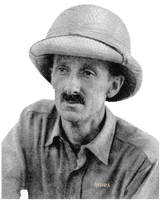
Isabel was a painter, an atelier-trained artist who had worked in scientific illustration and decorative arts. In the late 1920s, she took a job working for the mural painter, Ezra Winter. His studio was in Grand Central Terminal.
Winter designed large-format murals for public spaces, and had a team of artists executing his designs. His murals are at Radio City Music Hall, and the US Chamber of Commerce and the Library of Congress reading room in Washington, DC, among other places.
In her eighties, Isabel relished remembering her time at the studio. A favorite story was about a “funny little man” who darted through the studio from time to time. He would cross the artists’ work area, and pop through a small door at the other end. One day, one of the artists stopped him and asked what he was up to. “Why I’m the star lighter,” he said.
In the early 1930s, an un-named correspondent wrote The New Yorker and told the same story. I wonder if it was Isabel.2)Morris Bishop, Charles Cooke, and Robert M. Coates, “Twinkle, Twinkle,” Talk of the Town, The New Yorker, December 23, 1933, pp. 9-10.
In the 1920s, Grand Central Terminal had a map of the heavens painted on its barrel-vaulted ceiling above the main concourse. Sixty ten-watt light bulbs lit the prominent stars in the constellations it depicted. (A restored version of the night-sky ceiling is still there. Through a design error, the entire sky view is the reverse of the actual night sky.)
Somebody had to change burned-out light bulbs. Isabel’s “funny little man” had the job. There are still lights in the ceiling; the bulbs are now LEDs.
Note: Isabel’s stories often involved funny little men.
Working for Ezra Winter
By the late 1920s, Ezra Winter was getting big commissions for murals in public buildings, bank lobbies, and elsewhere, and was growing his staff. He was close friends with naturalist and scientific expedition leader William Beebe, for whom Isabel had long worked on expeditions to South America. She must have known of Ezra Winter through that connection. He offered Isabel work in his studio.
By 1926, when she went to work for Winter, Isabel had met Charles D. Mahaffie, her future husband. My guess is she no longer wanted to leave the country for months at a time on William Beebe’s scientific expeditions, which she had done since 1917.
Work in New York City best suited her new situation, Charles, who lived in Washington, DC, was only a train ride away.

Winter’s studio, where he employed a dozen or more artists, was high above the concourse in Grand Central Terminal, though not quite “above the ceiling”.
His attic space was large and had tall, arched windows that let in plenty of light. It had high ceilings that fit canvases of 20 by 40 feet. It sat near the level of the vaulted ceiling of the station, with its painted sky.

The right kind of artists mattered to Ezra Winter
In a speech to the Mural Painters Society in 1932 or 19335)Typescript of the speech, Ezra Winter Collection, Archive of American Art, Smithsonian Institution, p. 22., Winter talked about how he operated his studio. He commented that union painters tended to have work that was too standardized or too stylized. But, he said:
Among the non-union assistants which I did use in my studio I have always found them so individualized in the character of their work that I could depend on them to do only certain things the way I wished to have them done.
What I am trying to bring out is that artists are all so highly and intensely individual and it is so good and healthy for them to be that way that any attempt at standardization of their work or their time or any outside control is bound to be a hindrance and a handicap to their work.
Isabel’s work for William Beebe, executing scientific illustrations of animals, showed spark and wit. Her animals had personality (see her rendering of a king vulture, below). Winter had probably already seen her work and noticed its qualities when he sought to bring her into his operation. Beebe also had reported on how hard Isabel worked during his expeditions.6)Review of various expedition journals at the William Beebe archive, Princeton University Special Collections He may have recommended her to Ezra Winter as a talented and efficient staffer.

The Ezra Winter studio payroll records at the Archive of American Art span 1933-36, which is a period after Isabel no longer worked for him. They show he paid his staff artists between $25 to $60 per week.8)Review of unpublished records in the Ezra Winter Collection, Archive of American Art, Smithsonian Institution. But Isabel wrote in a letter to Charles Mahaffie (see below) that she “worked on time” for Ezra Winter, and was able to mix work for him with other projects. She earned $1,200 at Winter’s studio in 1927, as reflected in her tax return.9)Tax document in the author’s family archives. I don’t have records to show how many weeks of 1927 she worked in the studio.
That year, she also earned $900 from the Encyclopedia Britannica for illustration work, $2100 from the American Museum of Natural History, (for her murals and diagrams for their exhibits), and $1400 for miscellaneous decorating commissions. Her income in 1927 was $6,000. That equates to an estimated $113,859 in 2026.10)using the calculator here: https://smartasset.com/investing/inflation-calculator
A “haven for giddy frolic”
A biographical series of articles by Jessica Helfand on Ezra Winter in the Design Observer relate that Winter and the naturalist William Beebe were close pals. They used Winter’s Grand Central studio for parties.
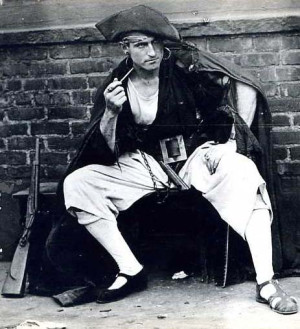
With his pals Bill (William Chadbourne, a lawyer) and Will (the zoologist William Beebe) Winter soon transformed his studio into a haven for giddy frolic. The parties became a palpable means of escape for the serious painter — a place to dance and dress up, to flirt and cavort and forget, for a few hours, about all the pressing obligations that otherwise circumscribed his days. These soirées proved a kind of temporary escape, a respite from ordinary life to the extraordinary world of make-believe.11)Jessica Helfand, “Ezra Winter Project, Chapter Six,” Design Observer, June 1, 2012, https://designobserver.com/ezra-winter-project-chapter-six/
Winter’s studio, and his fame, brought lots of people to visit, including for regular costume parties. The landlord, owner of The New York Central Railroad, took issue with Winter’s use of the space for parties and for his use of it as an apartment. He denied having more than the rare party there, and claimed he only slept in the studio over night occasionally when he worked late. But even the gossip columns noted he had an apartment there.12)From various newspaper gossip items and articles, and a review of the Winter archive at the Smithsonian Institution.
For key commissions, Winter turned to Isabel

Isabel proved her skills to Winter. He gave her work to do developing his concepts for mural scenes from his rough sketches through final painting and installation.
Among the projects where she did substantial work were the Willard Straight Hall at Cornell University, Ithaca, New York, and the Birmingham Public Library, Birmingham, Alabama.
Isabel and colleagues developed Winter’s sketched designs for those installations into complete murals. He trusted key staff, including Isabel, to flesh them out into complete murals. Below is a scene she worked at Cornell based on Winter’s instructions. She described the Cornell assignment in a letter to Charles Mahaffie in 1926:
You are perhaps wondering just what the dickens I do. Well, this morning, for instance, the inarticulate creature showed me a vast expanse of blankness, about ten feet square, and said to sketch up full-size an intelligent-looking Chinaman, a pile of treasure, and a black tiger, and ease them gently into each other with some inoffensive-looking shrubbery etc. Idea of the group: ‘wisdom and wealth.14)Letter from Isabel Cooper to Charles D. Mahaffie, March 1, 1926

More in Isabel’s words about this work and Ezra Winter, excerpted below, comes from letters she wrote to Charles between 1925 and 1926. They give a flavor of what she thought of the work, and of Winter.
________________________________
Isabel Cooper writing about Ezra Winter and her work for him, 1925-1926
Isabel lived in Manhattan (and also traveled with the William Beebe expedition for about seven months in 1926). She exchanged several letters a week with the man she married a few years later, Charles D. Mahaffie, who lived in Washington, DC.
Below are quotes from Isabel’s letters to Charles Mahaffie that are about Ezra Winter.
December 1, 1925
Tonight I am going to the ‘varnishing’ of the Centennial Exhibition of the Academy with my favorite mural painter, a lanky, vague, artistic, and amazingly capable creature.
Later that night Isabel added:
An assorted crew floated back to the capable mural-painter’s for coffee. Stayed well on into this morning, having the kind of talk which gets nowhere and you can’t remember what it was all about, but the fact remains it was a very jolly slice of talk all the same.
She went on about Ezra Winter:
Mural-painter, the complete host, never says a word, but just shoves edibles and smokes etc. around and looks at you (and probably others as well) as if you were the only person in the room. Nice simple way to please every one. . .
February 3, 1926
By later that winter she was in Winter’s sights as a someone he wanted working for him. She wrote to Charles:
I had planned to work hard as anything in the days and go to the theater every night for the next few weeks, but it now transpires that the nice Winter person . . . being duly impressed with my junk in the architectural show, wants me to plunge into some stupendous decoration job with him, for as long as I want to work at it. Murals, I believe, with a great deal of detail, at which I shall be put. Rather interesting for a while, so I shall shove my own work into the evenings and my reading into the smallest hours and my numerous demanding friends into meal hours.
February 12, 1926
My job is pretty good. I run up and down ladders etc. The murals are about 40 by 20 feet. It is fine to have the ladders. They get you out of the cold draughts. It is a most diverting place, with a variety of persons working at a diversity of things, and odd lots of musicians barging in and out and playing mostly very well on a very beautiful piano which hasn’t got rheumatism yet from the ventilation.
Job has the advantage of being flexible. I work on time, so that I can adapt it to my other activities rather well. Am managing better than you might suppose with my busy life.
February 17, 1926
Am starting some color work on the sketches for the murals, and what do you suppose they use for a medium? A pestilential mixture, dating from the Renaissance period, of raw eggs and vinegar and varnish, all nicely merged with the paint to make it stick or something.
March 1, 1926
A few weeks later, she wrote:
My odd job still interests me. The mural painter is really quite a person. One sees how he came to take the Prix de Rome. He has mastered the art of working hard, and appears to know exactly what he is about. But he can’t explain in words how he wants things done. Lots of men are like that, so I think up out my head what he wants, and then when he comes round and says how nicely I have caught his idea, I merely look duplex and docile.
You are perhaps wondering just what the dickens I do. Well, this morning, for instance, the inarticulate creature showed me a vast expanse of blankness, about ten feet square, and said to sketch up full-size an intelligent-looking Chinaman, a pile of treasure, and a black tiger, and ease them gently into each other with some inoffensive-looking shrubbery etc. Idea of the group: ‘wisdom and wealth.
And I discovered in some delightful archaic literature (the man has a really wonderful art reference library) confirmation of the use of a black tiger guarding treasure—ancient Chinese symbol of wealth.
You understand that the symbolism in murals is always very fatuous, but by the time the thing is all done and up on the wall 90 percent of the people passing it never see it, and the other 10 merely receive an impression of a jolly pattern of colors and lines and let it go at that. So the artist and his assistants can amuse themselves with the ideas to be portrayed, with the additional comfort of knowing that probably no one will ever come forward with criticisms.
The work on these enormous sketches is really rather a lark, particularly so because they leave me alone and let me mess along by myself. And the studio is a most amusing place. Several of my friends who are thoroughly “grata” with the boss have taken to dropping in to chat with me, having discovered that I am never comfortably at home any more. Some of them come and play on the piano by the hour, which is nice. Better than the tinned music which the German draughtsman keeps going.
March 30, 1926
A particular Ezra Winter commission she worked on was for Cornell University. On March 30, 1926, she wrote Charles:
Did ten hours straight at the studio yesterday and today. Am still engaged up on the drawings for the memorial at Cornell. A very hard job, and getting harder and more interesting all the time. My boss is very calm and unruffled about his work, and turns overall all sorts of stuff to me without reflecting that perhaps I am not perfectly adapted to carry it out. So it us up to me to make good regardless. Am now working on a group of Chinese having a chat with a sort of glorified Marco Polo in a grove of brilliant trees, with a mountain range in the back ground. And what sort of occupation is that for a grown woman. . .
May 6, 1926
As the year wore on, Isabel found herself doing lots of varied work, including, but not only, for Winter. She wrote Charles on May 6 that she:
had a business talk with my boss in which he urged me to give him as much of my time from now on as I intend to spend wage-earning. As you may have noticed, I am fairly casual about wage-earning. Just work enough to pay for my overhead and upkeep . . . and put in the rest of my time at more variegated pursuits, so that the sketchy character and excellent pay of the mural work will really suit me quite well. It will be only as permanent as I want it to be, which isn’t very, and as adaptable as I choose, and on my own terms.
She went on to say:
The gentleman has won some competitiveness for some ceilings, with much architectural detail, and also some historical panels. A lot of research work required for all this, which I can attend to while he is absent upstate . . . It seems like an excellent way for me to cash in on my very diversified artistic training and at the same time acquire a few dependable odds and ends of income, which seem necessary to me at present.
May 9, 1926
A little over a week later, she shared more on the Cornell murals:
Have been working very hard. There seems to be no end to these Cornell frescoes. Have been engaged for several days upon the foliage, as I were, of a truculent and pompous old phoenix who is to be strolling in the middle distance of the section representing ‘creative imagination.’ Other features of this group are a lady poet, a handsome sculptor, and a pondering mathematician, all pretty well draped in neo-Greek style without being really dressed, any of them. The boss is having some trouble adapting the mural-painter’s tradition of classical undrape to the needs of a co-educational institution full of mocking young persons.
And their continued to be parties at Winter’s studio. She added:
There is a big blow-out at the studio tonight, which I am wholly omitting. Crowds and crowds of people I don’t much fancy, and not one of them as stimulating on the spot as you, even at the end of an endless line of railway tracks.
May 18, 1926
She wrote about her techniques and the art of mural painting as well:
It [mural painting] will be a problem of continued adaptation of me and of art. And, Chass, I have been doing that for such ages. I invented and maintained standards of drawing techniques adapted to the needs of tropical research in the field, and worked out a graphic type of surgical chart. And of late I have been working hard for a man who doesn’t know what he wants until he sees it.
_____________
Isabel continued to work for Ezra Winter, including on his panels for the Birmingham Public Library well into 1927.
Work with Ezra Winter was a lark for Isabel, fun, challenging, interesting. And it helped pay the rent. She supported herself as a professional artist until she married Charles in August 1928.
References


 Mishkin, by Isabel Cooper
 Sadie Volvisch, by Isabel Cooper