Isabel Cooper Mahaffie — Memoir

This entry is post 17 of 21 in the ongoing series Isabel Cooper

Below is a short memoir written by Isabel Cooper Mahaffie when she was about 86 years old.

My Father and Mother — A Memoir

Isabel Cooper Mahaffie, 1978

There is an ancient photograph before me on my desk, taken in Tacoma, Washington. The date is 1891. The picture has faded to a pale sepia, but the faces are clear and charming in the light of a long-ago day. There is a dim old mansion in the background, mid-Victorian, with mansard roof, crescent dormers, and many verandahs done in fretwork. One could imagine a heroine out of a Trollope novel trailing her ruffled skirts across the threshold. But for all its mystery, it is only a photographer’s backdrop.

There are four figures in a stiff, old-fashioned group. In the center sits a serious, blond young man, complete with high collar, cravat, archaic mustache, bowler in one hand, umbrella in the other. He looks uncomfortable, as one whose pose has been dictated by an inept photographer. This is my father, James Sherman Cooper, whom I never actually saw except with the unremembering eyes of a child. Beside him on his right are his sisters. One is standing at his shoulder, a buoyant little figure, a faint disdain on her face, probably due to the photographer’s spidery clamp behind her head to hold her steady for the time exposure. She wears an elaborate satin dress and the quaintest possible little hat perched crossways on her head. This is my well-loved aunt, Joanna Elizabeth, named for Joanna Freer, her grandmother of French Huguenot ancestry, and for Elizabeth Hawes, her English grandmother. The other sister is seated at her brother’s feet. This is my youngest aunt — the musical one — Harriet, named for a sister, Harriet, who died in infancy many years before. Her hat is piquant, outlandish, charming, with its stiff brim above a delicate, sensitive face. On my father’s other side stand a fair, statuesque lady, wearing a beautifully fitted costume of the nineties. Her hat is the most absurd of all, merely a becoming little confection of ribbons. There is a diffident expression on her face. Perhaps she also has an iron spider behind her head. This is my mother, Honora Henry. All the ladies wear their hair brushed up severely from their foreheads, surely into shining bands or braids under the foolish hats. They all wear the dainty, many-buttoned gloves of the period.

I believe this picture was taken at the time of my parents’ wedding, the aunts having traveled across the continent to represent the family. There is a quietness about the scene, as if it were a frozen moment of time changed into a strange, waiting kind of now. So that I find myself saying, “What are these young people thinking?” They are solemn and seem detached one from the other during the minutes of the exposure. Is each one off in a private meditation, gazing into the future with wonder or questions or foreboding?

A long, sorrowful, and bitter story followed from this marriage, several, in fact. And I, who know all the stories, look with sadness upon this young generation of my family who passed away so long ago. If they could speak now, each would give a different account. The sisters in the picture held themselves rather aloof from the family tragedy, and their stories would not be so poignant or so important. Joanna was taken up with her books and painting and her exquisite concern with all the domestic arts. Aunt Harriet was completely absorbed in her music. I will speak later of their respective temperaments and the effect of these upon my life. There was another aunt, my father’s oldest sister, Mary, head of the clan, so to speak. She had apparently stayed at home to watch over the aged mother and father. In some ways her version of the family story would be the most important one. She became my guardian, and her decisions and her character had a profound influence on my life.

My father and my mother are the protagonists, of course. Their stories were indeed different, as will be seen. I, in my old age, propose to pull together the tangled threads and tell it all in orderly fashion.

I shall start with the story of my father. This will of necessity be shadowy, because I really know so little about him. His face is familiar, of course, but I have few clues to his personality. There remain to me only a few photographs, a schoolboy’s copy book of writing exercises done in a beautiful Spencerian hand, a very few vivid memories, letters, revealing facts of his short life. There is the one treasure, a diary of his Klondike adventure. I know very little of his early days. I have a picture of him in uniform with three young companions, “the silent four” of E Company, Iowa Infantry, taken in the late ‘80s, as inscribed on the back. The aunts used to speak of a visit to a ranch he had in Arizona at one time. That is all.

I believe my father to have been greatly loved and badly spoiled by his sisters. The youngest of nine children, he was many years younger than his father and was reported to have been a variance with him — rebellious and adventurous. He must have been sure that his fortune would be made far from home. In the late nineteenth century this could only mean the far West.

I do not know how he happened to settle in Tacoma. The trouble seems to have started when he met my mother there. They were married in the summer of 1891. I was born the next summer. The birth was difficult, and she was reported to have been badly injured. She was strongly advised not to have any more children. A brother was born a little over a year later, and a younger brother in 1895. She brought a suit for divorce in the fall of 1896. These facts were recorded in my father’s Bible. The divorce was granted in the northern city of Port Angeles, the children being awarded to the mother.

To continue with this stark outline, while she was away my father abducted my brothers and myself and, with the help of an apparently sympathetic nurse, carried us away on a transcontinental train to the family home and his mother and sisters in New York City. I did not see my mother for some thirty years. My father left for the Klondike in the summer of 1897 and died in January, 1898.

__________

I think I shall start with the memories, for what they are worth, and see what light they can throw on my story. There is only one, faint picture of my mother in my mind, and that is so vague as to have little meaning, but I could not have imagined it. I think I see a pretty lady lying on a chaise, ill and rather fretful. It is only a glimpse. I do not see the face clearly.

When I try to recapture some memory of the all-important journey across the continent, I get only fragments. I do not see my father’s face or the nurse’s, but I am aware of their watchful presence over us. There is an impression of the dim room on the train, and bowls of hot cereal being brought to us children. The bowls had rims of blue. Maybe I confuse them with some blue-rimmed bowls in a poem which Aunt Joanna used to read to me — Longfellow’s Hanging of the Crane. Perhaps it was the children in the poem, “with eyes of blue.” The long trip is a blank until our arrival in New York City. There is a dreamlike, but vivid memory — my grandmother’s carriage, horses, a stiff-backed coachman, and a stately figure of a lady coming toward us in bright sunlight. I remember particularly this blinding sunlight. It must have been the contrast with the dusky interior of the old Grand Central Station (not the resplendent new terminal, with the many-storied double windows through which I used to walk in later years to a mural-painting workshop — a great, echoing studio on the roof). The stately lady is Aunt Mary. I do not see the street. There is just the unreal tableau of the carriage and Aunt Mary, in the bright sunlight.

There must have been all sorts of impressions coming in upon me: a new home, new faces. It seems strange that I do not remember any of this until I come to my fifth birthday. Of this I have a vivid and elaborate picture. I see in my mind’s eye a beautiful lawn with giant oak trees. There is a table spread with a white lace cloth and a birthday cake, all white icing with flowers cut out of citron and cherries. But the most extraordinary part of the picture is the flight of enormous bees boring holes in the icing. I seem to be standing alone, watching them, fascinated. Some horrified grownup must have rustled up immediately and scared them away, but I shall never forget those delirious insects, drunk with the sweetness of my birthday cake. A vagrant thought: I wonder what kind of honey resulted from this diet? There is one other memory of insects. It might have been on the same day. I was sitting on the grass with Aunt Joanna, watching a detachment of leaf hoppers forming and reforming on our flowered organdy dresses, their wings translucent green with white edges.

These fragmentary memories of oak trees and bees and organdy dresses serve to point up the chronology of my story. It was my fifth birthday in August, 1897. The famous Klondike gold strike occurred in July of that year. The diary of my father’s journey to Alaska starts in August, so it seems that he was setting sail at the time of the famous birthday. I have a yellowing newspaper photograph of the crowded deck of a steamer about to sail from Seattle. It shows all the ferment and excitement of this dreadful gold rush. An elaborate volume about the Klondike has been published lately, with many historic photographs of crowds of happy prospectors. It is possible that my father’s face might appear in one or another of the eager groups. I have thought at times of taking a powerful lens and searching for his face, but to what avail? It would only be sad to see with what hope he set out, and know how it all ended.

I do not know about the empty period between the abduction of his children and his departure to the Klondike. It must have been a bad time for him. I believe that he tried to find interesting work in the East. There surely was discouragement, restlessness, and finally the lure of the gold rush and a fortune to be made, that led to his decision to go to Alaska.

The second and only other memory picture is of the day he left my grandmother’s house to seek his fortune. It seems to me that I remember his pale young face as he stood in the door to say Goodby. I see the spacious front hall quite clearly, the wide staircase landing, and the huddled group of the family, as he bade farewell to his mother and sisters and his three wide-eyed little children. The tableau is sharp and clear, but it has the look of a dream rimmed round with a bright halo of nothingness.

The tragic diary is in my father’s handwriting, except for the last entry announcing his death, January 8, 1898. This is a very interesting human document. The tone is impersonal, as he refers to himself as JSC, with only an occasional use of the personal pronoun. It starts off on a note of high adventure. First there was the long trip from Seattle to Skagway, an endless inland waterway of islands, narrows, sounds, canals, straits. It is a factual account of considerable interest. Then it was necessary to climb the terrible Skagway trail to reach the divide and the Chilkoot Pass — an ordeal, a melange of stumbling men and horses and baggage trains of all pitiful descriptions. Many turned back, and many were lost on the way. The final and longer part of the trip to Dawson City, at the mouth of the Klondike River, was by water — by boat and raft — over a chain of lakes and rivers. There were portages, perilous canyons, and sandbars to be negotiated. A high spot was the triumphant passage of the famous White Horse Rapids of the Lewes River (upper Yukon). It is a credit to the courage and stamina of my father and his friends that they, amateurs, got there at all.

It is sad to think that misfortune set in after all this. It is not clear to me just went wrong. Probably a combination of things. The arctic winter arrived, with perishing winds and temperatures of fifty and more below. They found they could not compete with the experienced miners. “Lays,” that is to say, areas allotted for digging, were scarce. There was a strike of mine employees, and all jobs were scarce. It became a question of giving up and trying to get home over the Yukon ice and the frozen trails, or somehow digging in and waiting for spring. There is an account of an heroic effort to build a cabin and cache their meagre supplies safely, cut their own firewood, and somehow endure day after day the dreadful cold. Imagine a cabin with no glass for the windows, only cloth stretched over. It is heartbreaking to think of.

There are so many human endeavors which fail because they start at the wrong time for the wrong reasons. It was a cruel circumstance that the infamous gold strike took place in late summer, so that many of the hapless prospectors were overtaken by the early arctic winter. I am thinking of the invasion of Russia by the French army in 1812. Wrong-headed, bent on conquest, they launched the assault on Moscow in mid-August, and by December they were dying in the snow, defeated, in the famous retreat. The analogy is not perfect. There was no burning city to thwart the conquerors, no wicked emperor to desert his faithful soldiers. There was only the gold, mysterious, implacable, inviolate in the hills, and many who wanted to go home and never got there.

It is a sorrowful tale of misfortune — privation, homesickness, and for my father bronchitis, pneumonia, a failing heart. It would seem that here ends the story of a man who died defeated, at thirty-two.

The end came later for his family. I have several letters written to his mother and his sisters during those last terrible weeks. I think they are about the saddest I have ever read: despairing, full of love and concern for his children. The latest of these were not received until the spring. Then, indeed, was the end of his story.

__________

The bitter history continues. There are several letters written by my father to his brother John at the time of the divorce, giving what seems to me an ill-considered account of the whole matter. It is a terrible thing to say, but I think that the intimation in these letters, that his wife had deserted her children and left him for another man, was speculation and misapprehension at best, or unthinking misrepresentation. Thirty years later my mother gave me her version. It has been difficult for me to judge between his wish to vindicate himself then in his family’s eyes and hers, so much later, to vindicate herself in mine. Of course, after thirty years one might expect rationalization, but there were some definite facts to uphold her story. The children were awarded to her; that would be a matter of record. He abducted the children, which makes the theory that she deserted us untenable. It was necessary for his sister Mary, after his death, to take legal steps to get control of us and establish her guardianship. There are papers in support of this, also a variety of affidavits which were necessary to persuade our mother that we were being well cared for and would be in better circumstances if raised by the family in New York. Who knows? I believe that she realized the truth of this. She might have found herself with limited resources with three children to bring up alone in what was certainly a frontier city at that time. The fact remains, she did give us up.

The terms of the agreement were harsh. She was forbidden to see us or to write to us. She was allowed to see any photographs taken of us by the family. The family escaped this stipulation by never having any taken themselves, though many were taken by friends. The result of all this was she saw no pictures of me until she came across some in the New York Times in 1925, taken upon my return from an expedition to the Galapagos Islands. She was reported to have been badly upset by this. I also heard of a sad thing that had happened earlier which she said had been terrible for her. She had traveled to New York when I was about seven years old to try to see us and get us back, but had been met with determined refusal to give us up. So three children, fatherless and motherless, were left in the care of their grandmother and their three maiden aunts.

In the loving eyes of his sisters my father could do no wrong. They believed his story. They were old-fashioned ladies and, I am sorry to say, narrow-minded. They had been prejudiced against my mother from the start: a stranger; a westerner. Or they may have felt that she was a adventuress of nineteen who had beguiled their young brother. The divorce was probably the last straw. It must be remembered that in those days divorce was practically a crime, certainly disgraceful behavior, to be censured and whispered about. So it all built up into a tragic hatred. It is hard for me to imagine kindly gentlewomen having so little compassion. As I have said, the sisters in the photograph were not so involved and were wise enough not to show their feelings. I do not remember either one of them making any cruel remarks about my mother. But Aunt Mary was extraordinarily bitter and did not share the wisdom of her sisters, so that as I grew up there was a shadow of disgrace hanging over me. I remember feeling there was something inferior about being an orphan. I envied my friends, who seemed to have mothers and fathers in good supply. I gradually outgrew all this; at least it became unreal in a strange way. It was there, and it was not there. It is hard for me to explain this ambivalence. I suppose it was due to a determined rejection of gloom on the part of a healthy young person. I was born with a sanguine nature, essentially optimistic, high-spirited, and with invincible health. So the sadness was eventually banished to some remote corner of my being.

__________

I should describe the home and the general scene in which the children started a new life. I remember some of it quite well: a large, old-fashioned city house; whole rooms clear in my mind; even some of the pictures on the wall. The pictures were mostly very fine but somber engravings: Burne-Junes, Turner, and the like. I remember cushioned seats and big bay windows in the front of the house; a parlor done in rosewood and white brocade, where children could not go except on special occasions (or, in my case, for the austerity of five-finger exercises); a cavernous kitchen, presided over by a tyrant who hated children. My room looked south and west over roofs and chimney pots — there were no skyscrapers in those days in New York. I could see the evening star, sometimes the moon speeding across the sky in a whirl of clouds, or proceeding majestically with a planet between her horns. There was an alcove with bookcases in the hall outside the parlor, where I liked to sit and read a listen to Aunt Harriet working over airy passages of Chopin or Brahms intermezzi. It seems odd that I recall so much about the house and so little about the happenings of my early childhood. Perhaps there were no happenings of importance.

As for the inhabitants of this scene, I should start with the grandparents. I have heard that my father took my mother and me to visit the family. In fact, my older brother was born in the east. My grandfather dies in 1894. Many years later my mother described him. He was apparently very old and frail, but entirely clear in his head. She told me as well that he was the only one of the family who gave her any friendship or understanding. I have letters that he wrote to his daughters in boarding school. They are old-fashioned, a little pedantic, full of a sort of homely wisdom and affection.

My grandmother lived until 1905 — her 80th year, my thirteenth. She was quite deaf and seemed remote. I did not know her very well, but wish I had. I remember her folded hands and the little lace cap she wore, and her gentle, patient smile. Perhaps this was to reassure everyone that she was all right, or was it in gallant defiance (or propitiation) of her world of silence?

I do not know to what extent my brothers were affected by the family bitterness. I did not really know them; in their younger years they were hardly ever home. The aunts were ill-equipped to deal with growing boys, who were badly in need of a kind mother and a strict but wise and gentle father. The three spinsters could not furnish such ambiance, so the boys were sent off to boarding and military schools from time to time. As the older boy grew up he threw off the authority of the family. He was quite young when he worked his way, with many adventures, and settled permanently on the West Coast. He looked up our mother and used to write me saying I should come out west to see her. It took a different approach to make me want to do this, as will be seen. The other boy, his father’s namesake, had inherited his father’s special place in the aunts’ regard, and they proceeded to spoil him badly. He was venturesome, as his father was. In spite of bad eyesight, and underweight, he talked his way into the American Expeditionary Force in World War I. He used to joke that he memorized an eye chart and augmented his weight with a large number of bananas. He went to France and managed, for the most part, to have an interesting, even an hilarious, time, though there were some dark, tragic days that he didn’t like to talk about. The stories of these boys and of their marriages and their descendants are interesting, as all life stories are, but they do not concern us here.

_________

The three aunts loom up as the most important figures in my early life, and I would like to go rather carefully into the characters and dispositions of these women. I should probably sketch in an account of my life. I will content myself with a brief catalogue of important points: a superlative school, which I attended from kindergarten to college entrance time; several years in two colleges; art schools; independence; seventeen years of a happy career; exciting expeditions; rare travel; highly variegated jobs, each one more interesting than the last. All this was only prologue to the important time: a momentous, romantic meeting; a long, delightful courtship by letter; engagement. I want to lead up gradually to the day in 1927 when I saw my mother. I was going to say “again,” but it was really the first time in my conscious life. I did not actually see the face of the ailing lady on the couch in that fleeting memory of c four-year-old girl. A strange day indeed, not long before my marriage. I will speak of the meeting with my mother later, and how it came about.

I will start with Aunt Harriet, the “musical one, as the family were wont to call her. She was whelmed in her music, as I have said, and did not have much to do with me, except that it never occurred to her that a child in the family would not have a musical education. So I was started in early — scales, octaves, arpeggios, etc., and exposure to great quantities of chamber music. The family wanted me to have my voice trained, an idea which I repudiated violently. “Parlor singing” by young female members of the family was in vogue, which always seemed to me the most dreadful bore. Aunt Harriet was greatly talented, nervous, and very hard to please. I’m afraid I disliked her intensely, and I am sure I was a trial to her, but as we both grew older we became more mellow and learned to appreciate each other. She had developed a highly original philosophy of her own. She lived to be very old, and retained a clear intelligence. I used to visit her in her late years and found it entirely rewarding to talk to her.

I would like to write a book about Joanna. It would be a book about a remarkable woman. She was spirited, intelligent, accomplished, resourceful, delightfully literate. You might call her a renaissance woman, except that the term implies a certain flamboyance which she did not have. Also, this designation seems to be reserved for men and a very few exceptional princesses.

Motherless, I might have been a candidate for the “disturbed child” class, a concept out of the dreary lexicon of the psychiatrists which happily did not exist at the turn of the century. Aunt Joanna saved me from this fate. She was prim and reserved, not exactly maternal. I remember no embraces or gestures of tenderness, but I knew that she loved me. She was the most wonderful figure in my childhood. As I look back it almost seems as if she had been waiting for a child, a young person to come into her life who she could cherish and inspire. She taught me alphabets and numbers and names of the piano keys; songs out of the “olden time;” to embroider and “sew a fine seam;” to love the seasons of the year, and weather in all its phases; beautiful things in nature or made by human hands. She read to me from a wide range of poetry, literature, and history. She painted things that Victorian ladies likes to paint, with exquisite care. She also supervised my early artistic efforts. When I found out what could be done with those shiny little sticks with ends of sharpened metal or pointed able hairs I started to draw and paint, and have practically never stopped since. Poor dear Aunt kept the most dreadful files of my little girl drawings.

Best of all, she had an inquiring mind, which she bequeathed to me. Or perhaps we both inherited this from an ancestor in the dark ages who liked “finding out about things.” This is sometimes called intellectual curiosity. The concept seems vainglorious. I prefer to quote the expression “to know how and why” out of Thomas Hobbes’ potent 17th century comment.[1] Whatever you call it, it is a gift beyond compare.

Aunt Joanna died when I was twenty-one. My brother and a first cousin are actually the only persons alive who remember that she existed. I do not think they knew what a wonderful person she was. All the friends who loved her have departed this world, and when I too depart it will be as if she had never lived. It saddens me more than I can say to think of all the charm and wisdom she had and all the loving kindness she bestowed on me vanishing into thin air. Perhaps these grateful words I have written will serve as a memorial for her.

I come now to a discussion of Aunt Mary. She was a martinet. At least she acted like one, that is to say a strict disciplinarian. There was a fatal flaw. She was inconsistent. When she should have been firm with the boys, she would be soft, and the other way around. She was violent in her prejudices, inflexible in her judgment of my mother. Perhaps she was not sure that my mother was a unworthy person. Was there a secret feeling of guilt, and a need to justify her treatment of her? Or was she just afraid of showing compassion? It was a terrible thing to do to a child, to let her grow up in the shadow of a hatred like this. But she had a very strong sense of duty, and I expect her disciplinarian ways, of which I felt the full force, were good for me. She lived to be very old and showed a loving side to her nature before, tragically enough, she lost her faculties. I used to visit her and found myself able to give her the affection she had probably craved all along. The solving of difficult family relationships does really seem to be to grow old and mellow, doesn’t it.

I think I was about ten when a friend of the family wanted to adopt me. Aunt Mary showed her strong feeling for family and faithfulness to my father’s memory; she refused flatly to let me go. I was not supposed to know about this, but it is hard to keep things from children. There were veiled words and a sickening kind of yearning toward me on the part of the lady. This would-be guardian was a woman of about forty years, whom I regarded with foreboding and horror. There is a photograph of her in an ancient family album, one of those old-fashioned leather-bound, brass-buckled, gilt-edged volumes which used to take root on Victorian parlor tables. Her face, examined under a lens, seems kind. Sometimes it is necessary to look long and hard at a person to find a hint of loving kindness. I find a small hand lens useful in the case of a photograph. Perhaps she would have been kind to me, but who know what sort of kindness it would have turned out to be.

She stands in the picture turning toward the viewer with posed romantic grace, leaning on a photographer’s impossible table. The general impression is a pile of braids and ruffles — a ruffled dress, a handsome jabot with ruffles. The ruffles had ruffles. I remember these Victorian jabots. The served to enhance a fresh young face and draw attention from the multiple chins of middle age or the withered throat of the octogenarian. They were always voluminous, a froth of the finest linen and lace, and always fastened with a cameo. These ornaments were usually decorated with bas relief figures in classical undrape. I wonder if the Victorian ladies mused upon this juxtaposition.

My usually reliable imagination does not tell me what my life with this person would have been. I only know that I did not want it. Children shy away from change and cling to anything faintly resembling home. I heaved a private sigh of relief when the whole idea was dropped.

I found myself often at variance with Aunt Mary. Was this the clash of personalities, or was it the age-old combat between youth and authority, parental or otherwise? Aunt Mary was given to imperial pronouncements. One decision she made for me marked a very special turning point in my life. To be sure, practically any moment of one’s life might be a special turning point: for instance, the moment of one’s birth, which presages a series of turning points, or the split second when a flying leap to a Manhattan curb saves one from death by a marauding taxi, thus allowing the series to continue. I had picked an art school for myself. Aunt Mary decreed another, which was nearer home. We had been walking in Central Park — that lovely park which used to be my playground. One walks there now at risk of unimaginable violence. I remember very well the street corner where we were standing and the moment when I agreed to her choice, with rather bad grace.

It was at that art school that I met the first of seven persons who led me directly to the eighth, a man who became my husband. These seven people were an odd assortment of men and women to be instruments of fate. Of course, I do not believe in fate, but things do happen. Sometimes, in retrospect at least, they seem to proceed with a certain stately and portentous rhythm. I could write a book about some of these people. I find I cannot resist the temptation to run the seven through a series of thumb-nail sketches.

The First one was a quaint little painter, head of the art department, who couldn’t paint. But he was a superlative teacher, so good, in fact, that you did not know you were being taught, but long afterwards you thought you had discovered for yourself subtleties of color or line or design. It was at one of his summer sketch classes that I encountered the Second of the famous seven — a flighty young woman with one blue and one brown eye — very disconcerting — who brought the Third to my acquaintance. This woman was a visionary — a philosopher way ahead of her time, incomprehensible, whom I came to appreciate and understand as the years went on. She brought a man to one of my studio parties, the Fourth, whom I remember not at all. But I remember the studio parties. I had reached the point in my career when I had fascinating work and a delightful circle of friends. Everyone gave lovely parties. This Fourth person was notable for one thing: he brought to my studio the Fifth, a debonair character who seemed to have no special occupation or means of support. But he was a fine dinner partner; he wore top hat and evening clothes with distinction; and he could throw together the best salad dressing that anyone had ever tasted. He brought the Sixth person to meet me. This man was a famous biologist, part scientist and part faker, if you can imagine a more weird combination. He introduced me to the Seventh, a festive lady who loved people, giving parties, and matchmaking. So in the course of time I met the Eighth, a wise and wonderful man.

_________

I had become quite far removed from the family tragedy, and had certainly lost the feeling that being an orphan set me apart from normal people. Years of independence and a variegated, happy career had given me confidence, but it seemed that the shadow of the old family story was not forgotten. I had had the good fortune to meet this eighth, all-important, person. And during the halcyon days of tranquil happiness when I was in the process of becoming engaged to marry him the old trouble came upon me with all the pain of a shameful blush. Immediately I realized that he should know about this, so I took courage and told him. He did not appear to be traumatized in the slightest. He, a kind and just man, merely made a quiet remark, which rocked me back on my heels. He said, “You should know, of course, that none of this has anything shameful to do with you. But the whole story seems to be slanted against your mother. Has she ever had the chance to tell you her side?’ I am ashamed to say that this had never occurred to me.

I think he was amused at the compulsive speed with which I decided to visit her. A few days after that I boarded a transcontinental train to Portland, Oregon, where I had asked her to meet me. I remember spending a miserable night dreading the encounter before me. A message came over the phone early in the morning: there was someone to see me in the lobby. It was a strange moment. There were three women sitting there. I did not know which was my mother. She knew me immediately. In my father’s family, as in many, there is a very strong look of the clan which follows through from generation to generation.

It was a kind of meeting which I think few people have ever experienced. I had been taken away from her in my fifth year. It was now my thirty-fifth. I had dreaded emotion on her part, but she had this under excellent control. She put no claims of kinship or duty upon me. As for me, I felt not the slightest connection with her. Dreadful, but understandable, I suppose. I had no real memories of her. She was seeing in her mind’s eye a four-year-old child — “winsome and beautiful,” as she put it. But are not all little four-year-old girls so? I wonder, if my father had reappeared after thirty years, if I would have felt a trace of the traditional filial affection of a daughter for her father.

We talked all day. There were reminiscences on her part of my early years. Stories about my baby brothers. She told me that I had loved them very much. There were endless questions about my life, and always my feeling of unreality. It was impossible for me to take in the fact that I was talking with my own mother. She gave me her version of the unhappy events of thirty years past. She told me that far from being interested in another man, she had not even met her second husband until some time later on. This was a crucial point of difference with my father’s story to his family — crucial indeed. She verified the fact that we had been awarded to her. And she said something that I had already figured out for myself, namely that she had not deserted us. She said she had been heartbroken when she found we had been stolen away. She also told me that the legal arguments and general persuasion in favor of Aunt Mary’s guardianship had been overwhelming. Very little was said about the divorce. It was a hard subject to discuss, but I decided anyway that my own conclusions about it were right.

I spoke to her, of course, of the way the aunts had felt toward her. She said she had been bewildered by it. Toward the end of our day together she made a very sad remark — that one comes in time to accept things, and that she had been able finally to take up a new life in which her children had no part. I put her on the night train. The parting was sad for her. I felt no more than a sort of detached compassion for her sadness. I remember writing to the man who started me off on this adventure, “I have been motherless for thirty years, and I remain so.”

I saw my mother again soon after my marriage. My husband and I were on the West Coast for one of his big railroad cases. We found ourselves in Seattle, so we arranged a long luncheon with her. Again, my hard heart felt nothing. Many years later our son and his bride called upon her during their honeymoon trip. She wrote me that this had made her very happy. She died in her eighty-third year.

_________

Now that I have come to the end of my story my thoughts go back to the two young people in the ancient photograph, on the eve of their wedding. I look at the faces and try to realize again that they were my parents. They seem so anonymous, strangers who are never thought of again. I and my brother, who unfortunately has forgotten many things, are the only living persons who even remember that they existed. Now perhaps the despair and the bitterness and the hate may be forgotten too, because I am speaking only the truth when I say that I am glad beyond reason and beyond words that they gave me life. Impossible to know how my life might have turned out. But many good and fine things have happened to me through the years. I have spoken of the wonderful, richly detailed background of my childhood and of the interesting life I made for myself in my career days. Best of all was my marriage of forty years, with more true friendship and happiness in it than is granted to most wives. And now, in my old age, I am living near my son and his wife, two of the kindest and most charismatic people in the world. And I can have the joy of watching two generations of their beautiful children growing up.

Is it selfish, heartless, to rejoice in these good things? Must I accept the sadness and tragedy of other people’s lives as a foundation for my own good fortune? Perhaps I will always have before me the paradox of my son’s happy family story set over against the sadness of my father’s. What does make for familial love? Is it only closeness, the sharing of lives, growing up and growing old together? I suppose the shadow and the questions will always be with me. Dear good and patient reader, I counsel you. Give those nearest to you your very special devotion and loving friendship, cherish them, and be glad. I hope you will never find yourself gazing into the face of one who should be most dear to you and know the desolation of a cold stone of indifference in your breast where your heart should be.

[1] “To know how and why is a lust of the mind that by a perseverance of delight in the continual and indefatigable generation of knowledge excited the short vehemence of any carnal pleasure.” Thomas Hobbies, 1588-1679.

The Mahaffie Boonsboro Maryland farm, 1970-1980

The other day, I stumbled on the land records for the farm we had in Western Maryland, about fifty years ago. And a few days later, my wife Jane Mahaffie, out that way exploring with my sister Margaret Church and their friend Amy Wolverton, decided to pass by the place, and Jane took a couple of pictures. One is below.

August 2024 photo of what was the Mahaffie Boonsboro farm, now Talley Longhorns
A similar view, early 1970s

Most of our family won’t remember the farm, having not been yet born. It was 101 acres near Boonsboro, Maryland, at 20406 Benevola Church Road, straddling Little Beaver Creek in Washington County. It was farmland typically, back then, used for corn and cattle.

The couple we bought it from, William and Linda Poffenberger, presumably couldn’t make the farming life work there–they had only owned the property for a few years. They moved elsewhere in the area.

Mom and Dad bought the farm in November 1970. The deed helpfully explains that they purchased the farm “with all of that tract of land, together with the improvements thereon, and all the rights, ways, privileges and appurtenances thereunto belonging or in anywise appertaining.” I have fond memories of all those appurtenances that appertained!

A plat map from the deed at purchase, is below.

Mom, Dad, the dogs, and us seven kids spent summer weekends and some whole summer weeks there in the early-mid 1970s. Dad set up a big vegetable garden and bought a small tractor for mowing.

The other day I asked my Mom, Judy Mahaffie, why she and Dad bought the farm and she said, “your father wanted a vegetable garden, and our yard was too shady.”

So we got a 100-acre farm. And Dad grew lots of vegetables; corn, zucchini, tomatoes, green beans, peppers, and others I don’t remember.

Playing in the creek while the pond was being dug, early 1970s

Dad had a 2-acre pond dug, and he filled it, per county or state regulations, with a slow pipe feed from Little Beaver Creek which ran through the farm. The feed valve was a plastic ice cream tub that fit over the pipe-end.

While the pond excavation was under way, one of the “Little Kids” (Mom says it was Bob), managed to start an enormous earth mover’s engine, and we had to call the contractor on a weekend to find out how to shut it off. (The answer was to cause it to stall.)

My older brother Jim Mahaffie and I built a bridge over Little Beaver Creek with 2 x 12 lumber, so we could drive the tractor across, and for easy access to the pond. Like a lot of projects Jim would undertake, it seemed implausible he could just build a bridge because he decided to, but it came out strong, level, and durable. When Jim declares a goal, he generally gets there.

Garden & pond construction

When a storm and flooding creek washed our bridge out, Jim and I towed it right back into place with the tractor.

The “Big Kids” target-shot with a 22 rifle at the farm, aiming, per Jim’s idea, at the rim of the then-steel beer cans so that the can would go spinning off into the grass.

Boots and Joey, our dogs, used the farm as a hunting ground. There were always groundhogs to try for, and with Joey’s hunting savvy, and Boots’ enthusiastic help, they bagged one from time to time. Joey was a natural-born hunter, and Boots was a go-along-to-get-along dog, an able assistant.

Boots and Joey, groundhog hunters

The dogs would leave the dead ground hog somewhere to ripen, and find it the next visit a week or two later, and roll in it to acquire the smell. We would then have to drive home with the smelly dogs.

Joey bested this once when he decided to investigate a skunk. Dad’s tomato juice bath cure didn’t get all that stink out.

Mom remembers when our friends Dick and Loretta Wertheimer and their kids visited and the tenant’s cattle got loose from their pasture. Dick, being city-oriented, sat on the grass laughing at the spectacle. Others among us had to decide how to shoo the cattle out of Dad’s vegetable garden.

Mahaffie Boonsboro farm house in 1972

The farm had an 1841-built red brick house on it, in the classic Pennsylvania German traditional style. It had a big barn also of the sort common in the region, painted red. There was a cinder block milk house and a corn crib. There was a chicken house and a small orchard of apple and cherry trees, as well. A spring supplied the water. The family there now calls their farm, “Hidden Spring Farm”.

Lou Church, before he married Marg, lived at the farm for a time in the mid-1970s, working a job in the area. He may be the only one of us that stayed there alone, and knows how haunted the place might be. It was plenty spooky when Jim and I stayed their on our own as teenagers.

The barn and milk house

The barn, from what I can see in Jane’s picture and Google Maps, is gone. Later owners had expanded the house, but based on the aerial view on Google, it looks like the original 1841 house is incorporated in the larger house that is there now.

From a recent time when the property was for sale, we learn that the home is now:

“5 bedroom 3 and half baths, a Great kitchen, 4 fireplaces, Heated floors, Wood floors, Heated Pool, Loft Sitting room, Great Views a wonderful place to enjoy peace and quiet, a true family play ground, over 5ac. of irrigated lawn, fish pond, fields for horses, Riding/Walking trails, and so much more.”

Suburban Mahaffies experiencing an encounter with cattle, early 1970s

While we had the place, Dad had several tenants use parts of it for cattle and corn. One of those tenants, Ray and Doris Hoffman, bought the place from Mom and Dad in 1980. I recall Dad gave the Hoffmans generous terms — they were local farm people, not city folks looking for a retreat. Other owners have had the place since. Jim had seen the extensive additions to the house some years back. The current ones operate Talley Longhorns there, raising and selling pure bred longhorn cattle.

The Google Earth image (below) shows the old Barn’s foundation still in place as of this year.

In the end, the beach won out over the country, which isn’t too surprising, since Dad had been going to the Delaware shore all his life, interrupted only by his years in the Navy. He set up a vegetable garden in Bethany, managing to grow tasty vegetables in what is mostly sand.

I’m thinking of sending the Talleys a few of these old pictures. Maybe they’ll enjoy seeing the place from 50 years ago.

Vickie Farrar driving the Cub Cadet tractor with one of us in pursuit

NOTE: Many of the 1970s snapshots here are by our cousin Vickie Farrar, who documented a lot of our family life during the time she lived with us in Bethesda, and lived nearby as a young adult. She did not learn to drive until years later, when she lived in Nevada.

Slavery in my ancestry

Perhaps dozens of men and women suffered enslavement under my ancestors. I know only four of their names from two ancestors’ wills, in which they were conveyed as property: Dick, Plato, Samm, and John. Many more are and will remain anonymous. I know nothing of any of their lives, other than in a broad way the condition they were forced to live in. But for me it is important to make concrete this expected truth about my ancestors. And that is what drove me to do this research.

______

I am a white person with a genealogy that goes back, in some lines, to Colonial America. I had long wondered if my ancestors owned slaves. In truth, I figured the only thing keeping many of them from doing so would be if they couldn’t afford to.

So I went looking. This was not so much hoping to clear myself of guilt for slavery. I would have been happy to find that there was no slaveholding in my family’s past. But it’s not possible to side-step that guilt. Whether slave owners or not, my ancestors benefited from the enslavement of others. Still, the fact of actual slave ownership is was something to for me to know, accept, lament, and most of all, learn about.

At the dawn of the Civil War, almost a third of households in what became the Confederate states owned at least one slave. Some of my ancestors lived in Maryland, Virginia, Kentucky, and Tennessee, along with other states with large slave populations.

And those ancestral lines include families that my research showed owned slaves, bought and sold them, and left them in their wills to their spouses and children. In fact, the only reason I know the names of four of the people enslaved by my ancestors is that those names appear in the ancestors’ wills.

I delved into sources digital and readily available, especially drawing on genealogical sources, and the U.S. Census. It was not hard to find these conclusive results.

Examples from my ancestry

For some of my ancestors, I found specific reference to slave ownership. Where there are wills available, we know certain details, and they can bring the situation to life.

George Bain of Woodford County, Kentucky

The will of George Bain offers the most vivid example. George Wesley Bain, who farmed in Woodford County, Kentucky, was one of my 4th great grandfathers. The 1810 Census of the county showed his household of 5 people owning 6 slaves. The 1820 Census showed Bain owning 4 slaves. His 1824 will sheds just a little light on this.

Text of George Bain’s 1824 will

I, George Bain, of Woodford County, Ky.  being weak of body but of sound and disposing mind and memory, realizing the certainty of death and having divided among my first wife’s children at their marriages the greater part of the property I possessed at the death of their mother, and each of them having received legacies from their grandfather, the property I am at present blessed with I am about the dispose in the following manner.

First, my will and desire is that all my debts be paid and my Negro man Dick be reserved for the payment of a security debt of Solomon Mitchell’s due George Woolfolk lately replevied for two years.

Second, I will give and bequeath unto my beloved wife, Elizabeth Bain, the plantation whereon I now live, with the Negroes and all the stock, farming utensils, together with all the household and kitchen furniture, to enjoy and possess during her widow hood and in case of her marriage, that she is to have only her choice of a horse and saddle and the choice of a feather bed and furniture.

Third, at my wife’s death or marriage, the plantation is to be divided between my two sons, George and Joseph Bain by a line beginning on Buck Run and running with the line passing the gate, the same course to the Kentucky River, George to have the upper part, including the dwelling house, etc., where I now live and Joseph the lower part down to the mouth of the Buck Run and also to have the privilege of a passway through Georges part and the right of getting firewood from off his land to have rail timber to keep up and supply his farm.

Fourth, at my wife’s death or marriage, I give unto my son George my Negro boy John and to my son Joseph my Negro man Plato and all my personal estate of every kind to be sold on a credit of twelve months and the money arising there from to be equally divided between my two sons.

Fifth, I give unto my two daughters, Sally Mitchell and Gincy Peacock, the sum of one hundred dollars each to be paid out of the monies arising from the sale of my personal property.

Sixth I give unto my grandson, Greenberry Peyton ten dollars to be paid by my two sons, George and Joseph Bain.

Seventh, I give unto my son, Joseph my tract of 200 acres of land in Washington County on Glenn’s Creek and waters of Chaplin.

Lastly I do hereby appoint my wife, Elizabeth Bain, and my son George Bain my executrix and executor of this my last will and testament hereby revoking and disannuling all wills or testaments by mere hereto made.

In witness whereof I have hereunto set my hand and seal this 21st day of April 1824.

Signed and acknowledge in presence.  G. Bain1


Slavery in Kentucky and Woodford County

The farms in Woodford County were small, distinct from the large-scale cotton and other plantation operations further south, such as in Mississippi. As agriculture evolved, the Woodford County slaveholders found they needed less labor from enslaved people and often they sold off people they enslaved to Mississippi plantations. They didn’t so often need the children of their slaves, and families were routinely split by the sale of what were seen as excess labor with a cash value. They literally sold people down the river.

The settlers of the county in the late 1700s came mainly from Virginia, but also from Pennsylvania, Maryland, and North Carolina. Seventy percent brought slaves with them to the new territory, which was being stripped of its Native American population and its dense woodlands, to make it ready for white settlers. The enslaved brought there cleared land and built fences and then took up the work of farming and trades as the new white settlements grew.

A historian of the county, William Railey, writing in 19202,  claimed that, essentially, that the county’s enslaved people were contented, well-fed, loyal, and happy. He alleges that the native peoples encouraged the slaves to join in an uprising against their masters, but that the Negroes of the county were “loyal to the master, and he not only warned him of danger, but stood ready at all times, and under all circumstances, to help protect his interests at any sacrifice.”

He continues, “that spirit of loyalty characterized the slaves until a few itinerant Baptist preachers from Ohio sowed tares in the settlers’ field, made some of them restless, others a little reckless, but the average remained quiescent and faithful until Mr. Lincoln issued the Emancipation Proclamation. In short, the ante-bellum Negro in Woodford was a happy, well-fed, well treated slave, and at no time since the Civil War has any county in the state had a better behaved colored citizenship than has this one. Much of this is due to the training they received from their several God-fearing masters.”

That line of thought, of course, is self-justifying nonsense. The people involved were held in slavery against their wills.

The county centered on the town Versailles. As of the 1810 Census, the vast majority of whites in the town owned slaves. Three fifths of the white population outside Versailles owned slaves. The town and county had a scattering of free people of color, but most of the people of color were enslaved. Of the total county population of 9,411, 3,179 were enslaved.

Captain William Barton of Southern Maryland (1634 to 1717)

William Barton was my 8th Great Grandfather. At about age 20, he emigrated from England with his family. They settled in Southern Maryland in 1654. His family bought plantation land in Maryland. He lived and farmed in Southern Maryland until his death in 1717.

Barton’s 1717 will directed that his slave Samm go to his grandson, Barton Smoot, noting, “if the Laws would have permitted, I would have given Samm his freedom”. His estate appraisal appears to show only one slave (Samm), but he may, through control of inherited property, had slaves who were, in effect, owned by an estate, rather than working directly in his household and thus considered personal property.3

From William Barton’s 1717 Will:

“I Give & bequeath unto my Grandson Barton Smoott My Negro Man Samm & do hereby Desire him to use him Kindly during his Natural Life knowing it was My Intent if the Laws would have permitted to have given him his freedome.”

This bequest made the top of William Barton’s list. He followed it with other specific bequests of his furniture, land, and other wealth, all was property entirely in his control, including Samm:

“… as for what Worldly Estate God hath been pleased to bless me with I Dispose of the Same as Followeth.

Item. I give & bequeath unto my Grandson Barton Smoott My Negro Man Samm & do hereby Desire him to use him Kindly during his Natural Life knowing it was My Intent if the Laws would have permitted to have given him his freedome.

Item. I give & bequeath unto My Grand Daughter Rachell Stone the Wife of Matthew Stone the feather bed & furniture that I now Lye on.

Item. I Give & Bequeath unto my Grand Daughter Ann Smoot two Cowes with Calves by theirs Sides to be Delivered after my Decease by My Executor.

Item. I Give & Bequeath unto my Grand Daughter Mary Hungerford two Young Cowes or Yearling Heifers to be Delivered as afsd.

Item. I Give & Bequeath unto My Grand Daughter Eliza: Philpott the Wife of Charles Philpott the feather bed & furniture belonging to the Same which is in the Great house Room to be delivered as afsd.

Item. I Give & bequeath unto my Grand Son Barton Warren Two Young Cows or heifers of Two Years old also one full share of my present Crop of Tobacco.

Item. I Give & Bequeath unto My Grand Son William Smoot one full share of my present Crop of Tobacco.

Item. I Give & Bequeath unto my Grand Daughter Eliza: Neale the Wife of John Neale one Cow & Calfe & forty Ells of Linnen.

Item. The full half of all the Remaining part of my Estate of what Nature Kind Soever it be or wheresoever the Same Shall or May be found I doe Give Bequeath unto My Daughter Margarett Miller & her three Youngest Children, the other halfe I doe give bequeath unto Thomas Smoot & Barton Smoot the Two Sons of My Grand Son Barton Smoot.


John Obadiah Cooper of New York (1755 – 1838)

Slaveholding was not just a thing of the American south. John Obadiah Cooper, another of my 4th great grandfathers, in the late 1700s, was a hatter in Fishkill, NY. He operated his manufactory and “owned a few slaves”.4 His was a line that descended to ever-more-prosperous families who built up wealth as manufacturers and merchants drawing on the labor of enslaved people.

Conclusion

There were no doubt other slaveholders among my ancestors for whom there are no surviving records or for whom I could not find records.

Finding this out was certainly inevitable. And I have to reflect that whether or not I had found specific evidence, my ancestors were white people, colonizers, and, in some cases, well-off landholders. That they would be a part of this system is inevitable. And they, whether slaveholders or not, benefited from the system that enslaved people.

Genealogical records and DNA analysis also show that I don’t have any African ancestry, so my ancestors were unlikely to have suffered from themselves being enslaved.

It is up to each of us to decide what this means. For me, it’s a reminder and deepening understanding of what privileges I have and how deeply rooted in history they are. It’s my obligation to know this and think of this, and to work where I can for social justice that can at least faintly begin to address the deep historical wrong that I am a part of. And if only to honor the many others, I will try at least to remember and think of Samm, Plato, John, and Dick.

______

1 Woodford County, Ky. will Book G., pages 148-149, cited in http://kansashealys.weebly.com/genealogy-wherritt.html

2 William E. Railey, “Woodford County Kentucky,” Register of Kentucky State Historical Society, Vol. 18, No. 52 (JANUARY, 1920),pp. 51, 53-70. Published by: Kentucky Historical Society. Stable URL: https://www.jstor.org/stable/23368492

3 http://phelpsfulpancestry.com/getperson.php?personID=I62640&tree=TAP

4 http://notorc.blogspot.com/2007/01/peter-cooper-story-1-lost-peekskill.html

Bart Mahaffie Part I — Introduction

Further posts in this series: 

Bart Mahaffie Part II — Childhood and education

Rule, Colo. 3.12.19

Dear Chas:

I received your letter a couple of weeks ago, but have been busy and didn’t notice how long it had been. Cattle are pretty thin and have to be watched mightily closely to see that they get to feed and don’t stray too far.

The loss has been very light, think I’ve only lost about 10 so far and if the weather will just partly behave from now on there should not be much more loss but most everything is thin now, even the range horses are weak so of course the cattle are bound to be thin.

I was in town last week and got the Heckler papers straightened out and ordered the abstracts. I expect that I’ll buy that land this spring, as he is going to leave and I can’t afford for anyone else to get the place. There are several places around me that are going to be for sale as soon as they are “proved up” and they are sure making me figure. Don’t want to buy anything that I can get a lease on.

Yes, I’ve been getting a novel every once in a while, and am ashamed ashamed that I’ve never even acknowledged the receipt of them but I always write in a hurry so forget about them. The Four Horsemen didn’t come but the W______ did come about that time. I’ve started to read it but have not finished it yet. Have not had much time for reading in the past month.

Do you expect to visit Oklahoma this summer? It is probable that at some yet uncertain date I’ll go down there to get me a housekeeper. There is no definite date yet other than before summer, for it is doubtful yet when I can get away. But if it is convenient and can be figured out far enough in advance I’d like for you to be there.

Must get to bed.

Yours,

G B M Jr.

George Barton “Bart” Mahaffie, by 1919 having lived almost five years alone on his remote southeast Colorado homestead, was joking in this letter to his brother, that he wanted to “get me a housekeeper.” He meant he wanted to marry his sweetheart, Marye Traylor, and he wanted Charles to be there. Bart had lived alone almost 5 years on 480 acres of rough, dry, grazing land in southeastern Colorado, a bachelor rancher.

George Barton “Bart” Mahaffie, 1911

When I was six or seven, I remember my Great Uncle Oscar Beatty Mahaffie visited my grandparents at their Washington, DC home. It was the mid-1960s. Uncle Beatty and my grandfather, Charles, sat in the upstairs front room in large armchairs, Beatty about ten feet away from my Granddad, two grey, balding old men. They were “visiting,” which for old men like these, prairie-raised, meant sitting almost silent, sipping liquor, and immensely enjoying each other’s company.

But there was a brother missing, George Barton “Bart” Mahaffie. It’s hard to imagine him there. He died of the Spanish Influenza in 1919 at 29, young and in his prime, on his remote Colorado ranch.

The old pictures show the young Bart as an athlete, uniformed and with his teammates, as a scholar at Kingfisher College, and later, branding cattle or on horseback, on his Colorado ranch.

Bart died with most of his potential ahead of him. He endures for me as a tragic story. Yet I have fixed him in my mind as that young man from the old pictures, in his prime. The occasion of the 100th anniversary of the Spanish Influenza of 1918 made me think of Bart. I wanted to remember more than the tragedy, so I will tell the story of his life as far as we can know it.

Bart Mahaffie in the winter of 1919

Bart Mahaffie on his ranch late 1910s

In the late winter of 1919, Bart Mahaffie, aged 29, was hard at work on his ranch in rural southeast Colorado. Winters there were hard. He was at work “proving up” his homestead claims. That meant gaining title to free Federal land by living on it and improving it for stockraising and agriculture.

Bart planned to marry Marye Traylor of Elk City, Oklahoma that May and bring her to his ranch. The lonely bachelor’s life on the ranch would soon be over. He would have a partner to help him build his life in Colorado.

Marye was the daughter of W. E. Traylor. Her father had operated a Hobart, Oklahoma grocery in the mid-1910s. Marye, born in 1892, she was three years younger than Bart, but likely knew him from Hobart High School, or social events in town.

Marye Keith Traylor, Bart’s fiance

Marye was an accomplished young woman. She played basketball at Hobart High School. The Hobart papers noted her piano playing at weddings, performing Mendelssohn’s Wedding March for the bride and groom. Later she had a long career in business, working as a book bookkeeper and office manager. It’s not hard to imagine her being integral to Bart’s success as a rancher.

Despite the hard winter, Bart could look forward and see his dreams coming into view.

The Spanish Flu of 1918

The Spanish Influenza hit hard in the U.S. the fall of 1918, particularly among massed and returning troops from World War I. Emerging in 1917, it was at first a mild flu; three days of fever, cough, and runny nose, and then a rapid recovery. But the flu virus, which mutates quickly, turned deadly in the summer and fall of 1918. It became a global, deadly pandemic, killing 20 to 50 million people, worldwide, and 675,000 in the United States. The biggest share of its victims were young adults. The lucky got the infection early, before it mutated. They were then protected against the new strain.

A public health chart of deaths from the Spanish Flu, 1919

The Spanish Flu’s symptoms were fever, nausea, aches, and diarrhea. Many victims developed severe bronchopneumonia. Patients would have dark spots on their cheeks. The body under attack by the virus overran with immune response, attacking most aggressively in the lungs. Victims turned blue with a lack of oxygen as their lungs filled with a frothy, bloody discharge. They drowned in their own fluids before treatment could save them.

The flu spread easily and quickly. Doctors could not keep up. People often died before they could get help, but medical help was limited in any case. The flu had no direct treatment, with no antiviral medicines were yet developed. Doctors were not even clear that the disease was viral.

The flu in Colorado

The first cases in Colorado came in late September 1918, with a spike in infections at the University of Colorado in Boulder. The most deaths worldwide were that fall as well.

Mary Allen Hurd, grew up on a neighboring ranch to Bart’s. Years later she remembered: “the flu epidemic came along killing lots of people. Laughing Joe Smith knew there was a couple of new families who lived in a half dugout. He rode over one morning to see if they were all right. He saw stock in the corrals with cows bawling so he went to the house. This couple had four small children and a brother and his wife who lived there also had four small children. Laughing Joe Smith asked the children where their parents were and they said, ‘They are asleep and we can’t wake them up.’ So Joe went in and they were all dead.”

Later posts in this series: 

Bart Mahaffie Part II — Childhood and education

Bart Mahaffie Part III — To Colorado for land of his own

Bart Mahaffie Part IV — The flu reaches the 500 Ranch

Bart Mahaffie Part II — Childhood and education

Previous post in this series: Bart Mahaffie Part I — Introduction

George Barton “Bart” Mahaffie was the second son and third child of George B. “Doc” Mahaffie and Mary Frances “Mollie” Williams Mahaffie. He was born October 3, 1889, in Olathe, Kansas. His parents were farmers. They also operated a store in Olathe.

Rose, Doc, Bart, Mollie, and Charles Mahaffie, 1891

The Mahaffie’s were a pioneering family. Bart’s grandfather, James Beatty Mahaffie, and grandmother, Lucinda Henderson Mahaffie homesteaded in Olathe, west of Kansas City, and kept a stagecoach stop there at the eastern end of the Santa Fe Trail from 1858 to 1870.

Bart Mahaffie at age 5

Doc and Mollie moved their family when Bart was three to a new homestead in Oklahoma Territory, joining the 1893 Cherokee Strip Land Run which opened Oklahoma lands taken from Native Americans to homesteaders.

During the Land Run, Doc galloped ahead on horseback with his brother Billy to try to secure the best land. Molly drove the team pulling a covered wagon, her three children, Rose, Charles, and Bart, and a household’s supplies aboard. They settled in Kingfisher, Oklahoma Territory. Another child, Oscar Beatty Mahaffie was born there.

Bart’s childhood home, Komalty, Oklahoma

In 1901, when Bart was 11 or 12, the family moved further west to Komalty in Kiowa County, near Hobart, in west-central Oklahoma Territory.

Hobart then was newly settled, with only a few businesses. There Doc raised wheat and livestock, becoming a prosperous rancher trading cattle and mules as far as Amarillo and Wichita.

Mollie ran a busy household and established herself as a community leader, prominent in Hobart’s civic affairs and social clubs. She was elected to the Hobart School Board, its first woman member, and served as School Board President from 1916 to 1919.
Mollie demanded that her children get the best education they could. In older age she said, “We were determined to educate our children if we never had a dollar.”

Before she married, she had taught school for nine years, starting at the age of 16, studying at a teacher’s college, called a normal school, in the summers. That focus on education was surely behind her daughter, Rose, being a school teacher and the fact that all four of her children attended college, two completing advanced degrees.

A little more about Hobart, the Komalty homestead, and Bart’s family is here.

“One of the most popular young men who ever lived in Hobart”

Teenaged Bart with sidearm about 1905

As Bart grew he learned ranching under his father’s tutelage and he got a good schooling under his mother’s direction. He grew to be a popular young member of the community.

Bart was a tall, handsome young man. He had blue eyes and dark hair. By high school, and surely before, he had distinguished himself as an athlete. He stood out, among other places, on the Hobart High School football team. After one game in 1905, the Hobart paper reported: “the sensational play of the game was made by Bart Mahaffie when Lee, Granite’s splendid left halfback, broke away and raced down the field for a touchdown, with a clear track before him excepting Bart, who made a flying tackle and saved Hobart from being scored against.”

High school graduation

Bart graduated from Hobart High School on Friday, May 18, 1906. The ceremony took place at the Presbyterian Church. There were a total of six graduates, most of whom spoke or performed at the ceremony. Bart’s part was to make a speech on the “Flight of the Bat”.

Bart (holding pennant) with his Kingfisher basketball teammates, between 1906-10

Higher education

Bart at Kingfisher College, between 1906-10

In the fall of 1906, Bart started at Kingfisher College where his older brother Charles had graduated in 1905. Over four years, he studied and played sports at Kingfisher, graduating with a bachelor’s degree in June 1910.

That fall, Bart began studying law at the University of Oklahoma in Norman. He was enrolled for two years, but did not take a degree. While studying in Norman, he joined Sigma Alpha Epsilon fraternity and played on the Sooners football team.

After college Bart tried his hand at various jobs. In 1911, he was in Hobart, working for a real estate firm. By 1912, he had gone to work in Dallas for U.S. Bond & Mortgage Co. He visited Hobart late that summer on his way to Oklahoma City, where he was being transferred by his company. Bart continued to work in Oklahoma City until at least April 1914. Likely it was that summer when he left for Colorado to homestead.

Seeing a path for himself

Bart came at last to see a path for himself: to be a stock man like his father, but his own boss with his own ranch.

American generations tended, in the 1800s, to move a state or more westward as each rose to adulthood. Westward meant land and it meant opportunity, a chance to make one’s own way. Families were large and the home place would only be more crowded, less able to support another adult and family.

The Mahaffie’s followed that path through their American generations; Bart Mahaffie’s great great grandfather crossing from Northern Ireland to Pennsylvania, his great grandfather from Pennsylvania to Ohio and then Indiana, his grandfather from Indiana to Kansas. Bart’s father, Doc, moved from Kansas to Oklahoma for new land. And now Bart was moving another state west for his own chance.

There was still land to be had, further west. The papers regularly wrote about Colorado, touting the opportunity to claim land and the state’s beauty and healthful climate. Colorado beckoned.

_________________

Later posts in this series: 

Bart Mahaffie Part III — To Colorado for land of his own

Bart Mahaffie Part IV — The flu reaches the 500 Ranch

Bart Mahaffie Part III — To Colorado for land of his own

Previous posts in this series: 

Bart Mahaffie Part I — Introduction

Bart Mahaffie Part II — Childhood and education

We don’t have an account of Bart Mahaffie’s 1915 move to Colorado to homestead. But to bring the story into view, the passage below tells it as if we do. It makes the best conjectures possible from news accounts, old photos, family and public records, and other settlers’ reminiscences. The boxed passages are from a 1915 guide for homesteaders. 1)Free Homestead Lands of Colorado Described: A Handbook for Settlers. George Samuel Clason. Clason map Company, 1915 – Colorado – 318 pages.

 _____________________________________

In the late winter of 1915, Bart Mahaffie, raised on a western Oklahoma homestead was working in the farm mortgage business in Oklahoma City. But the idea of securing his own place would not stop tumbling in his thoughts. He’d had his fill of the farm mortgage business. He’d lived in Dallas and then Oklahoma City. City life didn’t suit him.

With his job, Bart spent a lot of time with stock men, and the chatter among them would so often turn to the land you could homestead, if you went west. Some men were going, for sure. A lot more said they might or they wished they could.

Word of the land to be had also came in newspaper ads, pamphlets, annotated maps, and books. Bart borrowed “Free Homestead Lands in Colorado Described: A Handbook for Settlers” from a rancher in Hobart. The book was plain about the hard work it would take, but it got him excited about Colorado and the chance to have his own ranch there.

“Colorado has over 300 sun shiny days each year. Those who lived in damp foggy countries can appreciate the desirability of this. Unquestionably it is one of our greatest assets and combined with clear bracing atmosphere gives a vim and enthusiasm to our citizens that accounts for their physical and mental activities. It is rare indeed to find anyone with whom the climate of Colorado does not agree. Many who come to this State suffering from diseases in their incipiency become well and strong.”

He wasn’t married. He had nothing to keep him back. Twenty-some years back, his father had made his way west for land. So could Bart. After all, he knew a lot about stock raising.

It was time to give notice and make plans. Bart’s folks, Doc and Mollie, understood. He had their blessing. And Doc offered to help with a loan, a wagon, and a team of horses.

When the weather warmed, Bart made his plan. His best prospects were in southeastern Colorado. By wagon, the journey was 400 miles. That meant at least 20 days on the road. His Hobart friend Dick Cline said he’d go along for the adventure of it. So in the late spring, they hitched a team to a light spring wagon and said goodbye to their families. Mollie snapped a picture of the young men as they started off.*

“Bart and Dick Cline starting to Colorado, 1915”

They were 25 days on the trail, out through the Oklahoma Panhandle and then up into Colorado. They arrived, exhausted from the journey, in Lamar, where the Federal Land Office was. The town lay on the Santa Fe Trail. At the Eastern end, in Kansas, Bart’s grandfather and grandmother had operated a stage coach stop back in the 1860s.

Dick and Bart secured their gear and horses at a stable and took a room in town. The next day they found their way to a saloon and listened to the stories sweeping around about the claims to be had. Bart took it all in, there were truths to be found among the lies and tall tales and opinions.

One old fellow nodded his head towards the country outside, “you can’t find better soil for crops and gardens if you get rain.”

“There’s good land still to be had, but a man needs to hurry before it’s gone or too far from town,” they heard.

“Well, you’re already going thirty or forty miles, for good land,” another man said in response.

The next morning they called at the General Land Office and collected a map that showed available sections.

“Look fellas,” the clerk said, “understand, by the time you get to a spot, or get back here to claim on it, someone else may have filed.”

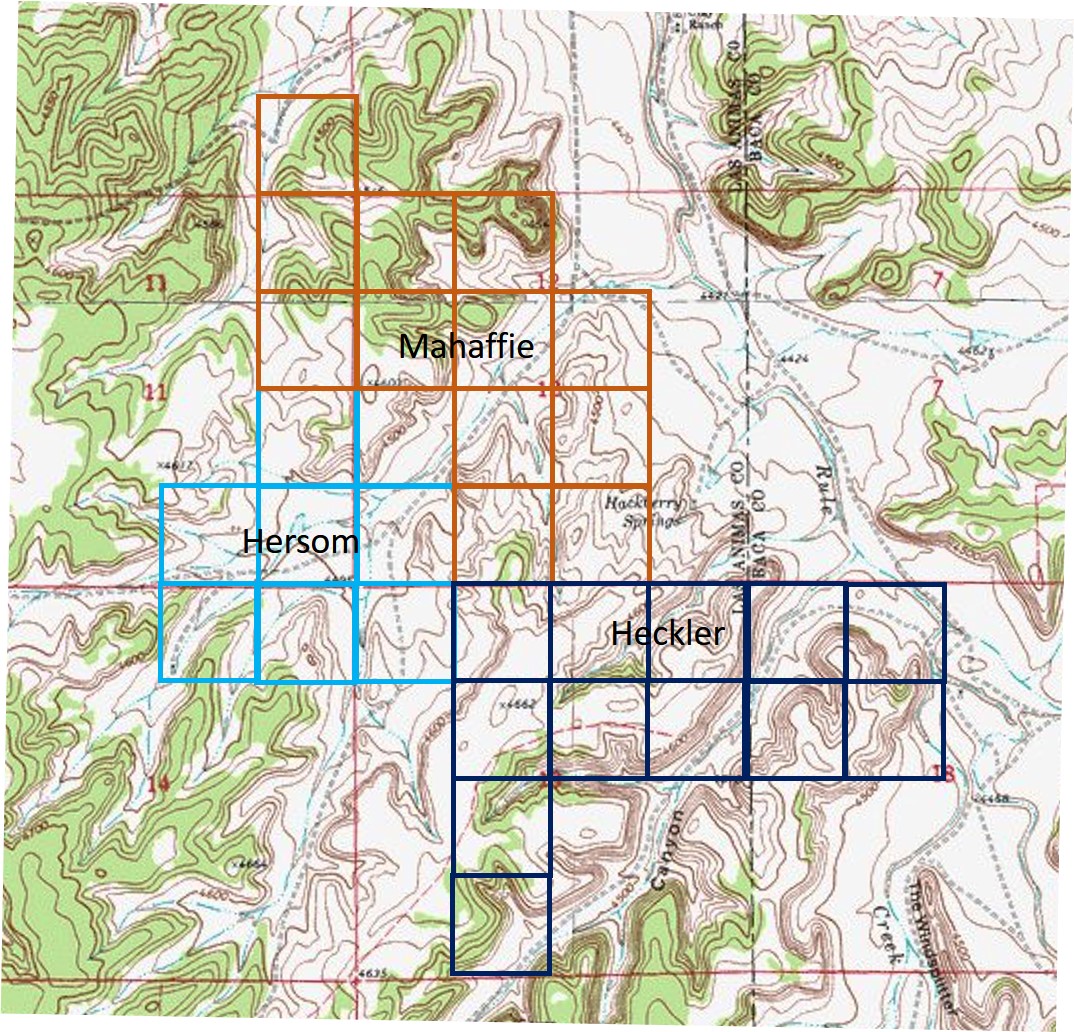
They needed to work fast. Bart and Dick jumped on their horses and started south. They worked their way south and west following Rule Creek toward Walker Canyon and Hackberry Springs, a promsing in Las Animas County. At over 30 miles, it was most of two days on the wagon road that ran along the creek. They camped the second night on Rule Creek.

A rancher living near the creek rode over to say hello. He sent his daughter to bring them a pail of hot beef stew from their kitchen.

“Happy to have fine young fellas like you in these parts,” the rancher said.

The man pointed some promising sections out on Bart’s map, and then rode with them up a nearby ridge to point the way.

Bart found land he liked in that north east corner of Las Animas County, some bottom land in a narrow valley, and the bluffs on either side.

They met another man who would be Bart’s neighbor. Bert Thomas operated the post office out of his ranch just to the southeast.

“Welcome to Rule, Colorado,” Bert said.

Dick asked him, “Well just where is the town?”

“The stock raising industry is one that few people outside of the stockmen understand or realize the possibilities of. Ten acres of average Colorado land will support one cow the year round. On a 320-acre homestead, the settler can graze twenty-five head of stock, and have sufficient land for a kitchen garden and plenty to cultivate in fodder crops for the winter feeding.”

“It ain’t a town,” Bert said, “It’s this here post office and the folks that live around it.”

They rode fast back to Lamar in one 35-mile day. Bart secured the land by filing his first claim, a half-section, 320 acres. He was benefiting from the Enlarged Homestead Act of 1909, which raised the size of an allowable claim for just this sort of dry acreage.

Likely a range stray at Bart’s well

With the claim secured, it was time to get to work improving the land. Before being opened for homesteading, the area had been open range land, with the JJ brand cattle of the Pairie Cattle Company grazing all through it.

“Listen young man,” Bart’s neighbor told him, “The J.J. cattle like to get into the fields and eat our crops. You’re fencing them out, more’n you’re fencing your own in. When feed and water gets scarce in the rangeland, they’ll come for yours.”

Pen for cattle and horses

In any case, by law Bart had to improve his land for livestock and put up at least a one-room house. And he had to cultivate a portion of it. If he did so and lived and worked the land for three years, it would be his.

Dick Cline had a few weeks to help out. The two men gathered a wagonful of supplies in Lamar, and planned straightaway to fix a pen for cattle and a place to keep some laying hens. They buildt a corral out of the crooked trunks of cedar and pinyon trees they dragged down off on the bluffs.

“It is a simple life but far from an easy life. One who has not lived on a homestead cannot realize the things to be done or the disadvantage under which most of them must be accomplished. To start out, the settler has fences to build, a home to build, a barn, chicken houses and pig pens, and usually a well to dig.”

They got to work putting up a house.  At least the main material was free and close by. Bart built his house out of the red-brown sandstone plentiful in the area. They laid the rough stones for the walls, and brought windows and hardware back from town on each trip. They roofed the house with sheets of tin and weighted them down against the prairie winds with more stones.

Rock house on Bart’s ranch

A couple of neighbors came by to help lift timbers up onto the rock house for its roof. Bart hadn’t been afraid to ask for help. He’d already learned some of the ways of the folks in the County.

Folks along Rule Creek had told him, “Listen, we want to be good neighbors and help out, but when we do we expect you to pay back and we will get along fine if you do.”

And some men from the nearby ranch were happy to come and help.

“Those who realize best the problems a settler must confront advise that he should have at least three milch cows, one or more sows, and some chickens to start in with. With this livestock as well as a good team and wagon, he is assured of a good living for his family and the ability to plow his land and take care of his crops. The cows supply the necessary cream and milk for the family and also provide more or less butter and cream to be sold or traded at the store. Many a successful settler, however, has made his start without most of these things. Oftentimes, his principal asset is a willing wife and a family of hungry children. Rabbits, grouse, and fish have helped out the larder at many critical times.”

Bart was glad to have Dick as long as he could. After Dick went home, he’d try to get a neighbor or two to help out from time to time. He wrote the home folks that he sure hoped his father and Beatty could come out that summer and see his place and maybe lend a hand.

After four weeks, he took Dick to town for a train home. Then Bart settled in to work the ranch on his own.

The days were long and hard. There was never enough daylight, even in June and July, to get enough done. But Bart made progress and felt the pride of seeing his place come into shape.

He soon brought a few head of cattle to get his herd started. He dubbed the homestead “The 500 Ranch” registering “500” as his brand.

Bart and helpers branding cattle, 1918

Men from the neighboring homesteads came to help out with branding and other work a man on his own would struggle to do. In return, Bart helped them where he could. The neighbors came to count on him as a willing and able hand.

Learning to manage ranch life meant learning to live off the land. Bart had heard folks on Lamar say you could tell how long a homesteader would last on his claim by the pile of tins cans around his house. If it was a big heap, he wouldn’t last. But if a fellow lived on beans and what he could raise and hunt, he would make it.

Bart on a horse bearing the 500 brand

In the first months, Bart grew to have a sense of the wildness of the area. The countryside had its share of wild animals, some useful to hunt, and some troublesome. Skunks, jackrabbits, possum, all sorts of creatures turned up, generally when you didn’t expect or want it. There were coyotes and wolves too, more of a threat to a stockman’s investment.

Bart with his horse and dog Wiggles

It wasn’t all hard work. George Heckler’s place, a mile or so off, was a sort of headquarters for the area bachelors. Bart made a visit when he could. The men would gather there, and fix up some Mexican beans, deer or antelope meat or mulligan stew, dried apples, rice and raisins and sour dough biscuits. It was a welcome break from the lonely ranch. But going home from George Hecker’s always made the 500 Ranch seem even lonelier.

_____________________

*It’s quite possible that Bart and Dick did not take a wagon all the way to Colorado. They may have driven in a motor vehicle, or taken trains. HERE is a look at the arguments on either side of the question.

Later post in this series: 

Bart Mahaffie Part IV — The flu reaches the 500 Ranch

References[+]

Bart Mahaffie Part IV — The flu reaches the 500 Ranch

Previous posts in this series: 

Bart Mahaffie Part I — Introduction

Bart Mahaffie Part II — Childhood and education

Bart Mahaffie Part III — To Colorado for land of his own


The winter of 1918-1919 in southeastern Colorado was especially hard, as Bart wrote in his March 12, 1919 letter to his brother Charles. (The letter is at the front of Post I [LINK] in this series.)

Cattle feeding on cactus, 1918

Bart did as other ranchers in the area did when heavy snowfall covered the forage. They burned thorns off cactus with a gas torch or held the pads on a pitchfork over a fire, and fed them to the cattle. Mary Allen Hurd 1)Mary Allen Hurd grew up near Bart Mahaffie’s ranch in Colorado and knew of Bart. An upublished collection of her reminiscences has circulated in Las Animas County, and I’ve drawn on it and cited her in these posts recalled how the cattle happily ate the cactus pads hot. It was often all they got, and some still succcumbed to hunger during the hard winters.

But Bart wasn’t discouraged. He had 480 acres in two homestead claims. He’d done the work to prove them up, building his house and improving the land.

Bart wrote to Charles about getting more acreage, with plans to acquire his neighbor George Heckler’s 320 acres. Heckler, an older man, was proved up and planned to sell. Later records also show Bart was working to get 320 further acres from Cleveland Hersom, another neighbor.

Bart’s ranch house by the late 1910s

That summer meant he’d get married to Marye Traylor and bring her to live on the ranch. The house was ready, expanded with a proper addition. With a bigger ranch he could earn more to support a family.

And at last the March days flirted with warmer temperatures and the snow was melting. The day he wrote Charles, the temperature reached 70 degrees. There was reason to be encouraged.

The flu reaches Bart

But the Spanish influenza virus was waiting for Bart. The historic epidemic looked to be over after its awful surge in the fall of 1918. But it had one more rampage and Bart was among its targets.

He did not contract the flu until March of 1919. He was unfortunate to be among is last deadly wave of victims that came that winter.

Living on a remote ranch kept him from getting the infection sooner. Of course he did business in town. Trains brought people and goods from other places. They readily brought the virus. And the homesteaders in his corner of Las Animas County were a community that visited and helped each other out with ranch work. Even a bachelor making his living alone on a ranch had occasion to be with others and to risk the infection.

Word of Bart’s illness

We don’t know how Bart alerted someone that he was sick. The flu tended to come on quickly. He may have felt ill during a day when he saw others, or a neighbor may have come to check on him. Someone soon came to help and alerted Bart’s family in Oklahoma. Bart would have seen others get the flu and probably knew about the symptoms and his prognosis.

Mary Allen Hurd recalled that the ranchers were far from doctors. They had to make do with whatever they knew how to do for each other.

George Heckler, Bart’s neighbor, was the knowledgeable veteran among the settlers. It’s possible it was George who first saw to Bart when he took sick.

Mary Allen Hurd recalled how George knew old remedies and how to make Mountain Sage Tea for congestion and other symptoms. She said “it either killed or cured.” But those remedies could do little when the flu hit. Not even doctors had much to offer when Bart took sick.

Late on Wednesday March 26, 1919, Bart’s parents, Doc and Mollie, got a telegram, probably arranged by a concerned neighbor, alerting them to Bart’s illness. They left by train on Thursday morning to go to him. The folks in Hobart knew Bart well, and his illness meant a short mention, “Bart Mahaffie Ill” in the Hobart paper, the Republican.

Based on the timing, we can assume that Doc and Mollie got to Bart’s bedside by the 27th or 28th. At least their presence could be of comfort to him.

Bart only had treatment for his symptoms and some comfort from not being alone in his rock house. But the ravages of the flu’s attack on his lungs meant a short, but excruciating decline, no doubt abject fear, and death. Gravely ill, he held on for two days longer, but succumbed on Saturday March 29th.

By the next Tuesday, April 1, the Hobart Republican story headline was “Body in Route Home.”

Bart’s funeral lagged until his oldest brother, Charles Mahaffie, could arrive from Washington, DC. The Hobart Republican wrote: “Scores of people attended the service to pay their last token of tribute to one of the most popular young men who ever lived in Hobart.”

Bart was buried in the Hobart Rose Cemetery.

Aftermath: those he left behind

Doc, early 1920s

Doc and Mollie, the August after Bart’s death, closed up their house in Komalty outside Hobart and sold their stock for what was an indefinite move to Rule, Colorado and Bart’s ranch. As Bart’s heirs, the ranch was now theirs to manage.

Bart had died before his Colorado claims were officially “proved up” which would normally happen after requirements were met and three years had passed.

The two patents on his original claims show an issue date of October 7, 1919, which means his heirs, namely Doc Mahaffie, his father, presented proof of qualification, and took ownership.

Mollie, early 1920s

Doc and Mollie went to Colorado complete that process and the transaction acquiring George Heckler’s place and Cleveland Hersom’s land.

The ranch was remote and the house small, a far cry from the substantial lifestyle and busy town they were used to. They were in their mid-60s, late to take up a life in a rough, remote place like Rule.

Doc may have had his eye on making Bart’s ranch big enough to be attractive to a buyer, or just saw opportunity in the additional land to be had cheap from frustrated homesteaders.

What became of Marye Traylor

Doc, Mollie, Marye Traylor, and Beatty Mahaffie, March 1920

After the death of her fiance, Marye worked as a bookkeeper in an ice plant in Elk City, Oklahoma. For a time after Bart’s death, Marye and her family kept in close touch with the Mahaffies.

She moved to Oklahoma City in the late 1920s. By 1930 she was heading her own household there, living with her father, sister, and brother in law. She worked as a bookkeeper at the Wetherbee Electric Company.

Marye Traylor, early 1920s

By the late 1930s, she had married a co-worker, Ernest Tanner, a foreman and salesman in the company. They moved to El Reno, just outside Oklahoma City. Ernest started his own business, Tanner Electric Co. in El Reno.

Marye was active in the El Reno community, a member of the Center Grove Home Demonstration Club, but also the El Reno Business and Professional Women’s Club, serving on its executive committee. Ernest died in November 1954.

Surviving her husband, Mary lived to 101 years. She died in 1993, and is buried in El Reno.

The ranch to the present

After Bart died, his family made a number of land transactions to finish out purchases Bart had set in motion with two neighboring ranchers, and perhaps to consolidate a more valuable and salable ranch. Doc and Charles were both savvy about money and investment. Both had loaned Bart money or guaranteed the notes he promised the men he transacted with for land.

Between land that Bart had acquired or planned to before he died, and transactions completed after he died by Doc and Charles, the holdings grew to 1120 acres in Las Animas and Baca Counties, Colorado.

Bart Mahaffie’s ranch ultimately included these three parcels

The land stayed in the Mahaffie family, owned by Bart’s brother Charles until his death in 1969. It then passed to his wife and later his son. Mark and Kimberly Wilson, whose family had long leased the land from the Mahaffies, bought it in 2009, and continue to raise cattle there.

Afterword

So many homesteaders in that dry, tough corner of Colorado tried and gave up. Bart had the makings of success and a fiance that had business savvy and drive of her own. We see what Bart was able to do on his own, and can imagine what Bart and Marye could have done together. In learning all we can know to know about Bart and his intended wife Marye, I’ve come to believe they not only would have made it, but would have thrived.

References[+]

Charles D. Mahaffie goes to Washington, 100 years ago

Charles D. Mahaffie
Charles D. Mahaffie, 1916: “A good mixer”

On Monday, September 18, 1916, Charles D. Mahaffie was sworn in as the Solicitor of the U.S. Department of the Interior. The Solicitor’s office provided legal services to the entire Department.

The Oregonian newspaper wrote, “Twenty-Six attorneys under his direction are today telling him what his duties are.” [Oregonian, September 19, 1916] He was now a Federal bureaucrat, serving a department now overseeing the brand-new National Park Service, and managing land issues including those involving Native Americans. The Solicitor would be a busy man.

Charles was 31, a graduate of Kingfisher College, Oklahoma and a Rhodes Scholar graduate of St. Johns College, Oxford. Still a bachelor, he moved his lodgings from the University Club, Portland, Oregon, to the University Club, Washington, DC, taking a residence with other single men in a club that had dining, commons spaces, and plenty of camaraderie. The Club was at 15th and I St., NW, on MacPherson Square.

Another paper said Mahaffie was a “bachelor and a tennis enthusiast” and a “public land specialist … much interested in the conservation of the natural resources of the country.” [The Oelwein Daily Register (Iowa), November 17, 1916]

2016-09-11-17-40-38Interior was a good fit for the talents and interest of this young man who as a toddler was in the Oklahoma Land Rush of 1889, was raised adjacent to Indian Territory, and was now steeped in matters of land use. [Note: those that remember him may struggle with the idea of Charles as a “toddler”.]

Charles had settled in Portland in 1911 to start a law practice. Over five years there, he had become enmeshed in city politics and other civic and professional activities. It’s likely, had he not been called to Washington by Woodrow Wilson, that he would have made his life in Portland, and perhaps entered elective politics there.

The sort of man he was
Three or four of Charles’ seven grandchildren are old enough to remember him as a gruff old man. In his marriage to Isabel Cooper, an energetic, creative, busy, people collector, he seemed just a quiet backdrop. But his younger adulthood as a bachelor, rising in Portland City politics, shows a different side.

Earlier that Summer, Charles’ Oxford alumnae magazine gave his perspective on Portland:

The report from Charlie Mahaffie, Oklahoma and St. John’s, glows with an optimism truly Pacific. “We’re strong here,” he says of Portland, Oregon, “for preparedness. Preparedness to welcome the ‘prosperity wave’ which we hear is now just east of the Cascade Mountains. We have sentries out to locate it. Otherwise the coast is very ‘Pacific’; and Wilson looks like a good bet in this part of it. Prohibition seems very effectual, and sociability speaks in a subdued tone. But we are getting used to it gradually, and if it does all that we were promised, everybody will be pleased.” [The American Oxonian, July 1916]

He complained about Prohibition. (Prohibition lasted from 1920 to 1933 for the U.S. overall. But Oregon had voted to ban all alcohol in 1915). He told The American Oxonian that it would create financial issues for the University Club. [The American Oxonian, January 1916]

Some other of Charles’ Portland activities

  • Served as assistant secretary of the Oregon Conservation Commission
  • Was advisory editor of the National Municipal Review, editing the department of Judicial Decisions Affecting Municipalities
  • Served as Director, Douglas County Fire Patrol Association
  • Served as Treasurer, Oregon Bar Association
  • Served as secretary, University Club, Portland
  • Played competitive tennis

Politics and opinion

Charles wrote an article in a Portland paper in favor of presidential candidate Woodrow Wilson, focusing on his brave reforms when President of Princeton. Charles had joined the faculty of Princeton University following his Oxford education, as an instructor in jurisprudence.

The issue in higher education as Charles reported it was, “so all-pervading has the craze for social honors become that the public itself wants to know of the recent graduate, not if he led his class or was a high honor man, but what fraternity or club he ‘made’.”

“Universities founded and supported for the purpose of preparing men for life in America were, consciously or unconsciously, coming to put the chief emphasis on matters destructive of the best ideals of American life. Most men not directly concerned saw the process with regret. Many of the keener academic authorities appreciated the danger by saw no effectual means of combating it. Woodrow Wilson was one of the first to diagnose the situation.”

Democracy and the Suffrage by Charles D. MahaffieAmong the steps Wilson had taken: eliminating fraternities and raising academic standards, despite strong pressures against those changes. [The Oregon Daily Journal [Portland], September 5, 1912]

Charles also authored and presented a paper, published also as a pamphlet, called “Democracy and the Suffrage,” [links to full article] supporting the vote for women. He wrote, “In no important line of human effort, except politics, is the sex of the thinker considered of importance in estimating the value of brain product.” [Charles D. Mahaffie, “Democracy and the Suffrage,” 1912.] Women’s voting rights were on the ballot that year in Oregon, and the referendum passed with 52% support. The United States didn’t give voting rights to women until 1920.

“New solicitor is called a good mixer”
The Day wrote about Charles under the headline “New Solicitor is Called Good Mixer”.

“Charles D. Mahaffie, of Portland, Ore., has arrived in Washington, DC. To take up his new duties as solicitor of the Interior Department. Both Senators Lane and Chamberlain of Oregon warmly urged the appointment of Mahaffie. He is popular throughout his native state, is known as a prominent attorney and is declared to be a good mixer.” [The Day, October 6, 1916]

Illustrating the story was the photo above, showing Charles, the good mixer suited, wearing a homburg, and striding along what might be Pennsylvania Avenue or F Street, in Washington.

Komalty: down on the old homestead

My son Robert and I passed through Kiowa County, Oklahoma on our way by car from Washington, DC to Colorado Springs in late May. We stopped to explore the country for a few hours, short to get a feel for the old home grounds of my Great Grandparents and their family.

Along a section road, Komalty, Oklahoma

The Komalty crossroads

The ranches today are mostly in wheat, the late winter crop during our visit was mature and some farmers were harvesting. The land also supports cattle, some oil and gas is pumped from the shale deposits under the ranchland, and now, in places, there are clusters of enormous wind turbines.

George B. “Doc” Mahaffie and Mary Frances Williams “Molly” Mahaffie, each at age 34, homesteaded in Oklahoma, at Kingfisher, just northwest of Oklahoma City. The Oklahoma Land Rush which started April 22, 1889, opened 2 million acres for homesteading, and 50,000 people lined up for the High Noon start. It was one of several openings and rushes in the late 1800s.

As best we know, the Mahaffies were not “Sooners.” They waited for the proper time to move in and find a homestead. George and Mary had begun their family 300 miles away in Olathe, Kansas where George’s father, James Beatty Mahaffie, had built his farm and stage coach stop.

Rose, Mary, Charles, Beatty, George, and Bart Mahaffie about 1903

In 1901, land further west that had been a Kiowa-Comanche-Apache reservation, in what become Kiowa County, opened to homesteaders. And the loss for Native Americans became the gain of thousands of homesteaders, including the Mahaffies. They moved one hundred miles further west and took claims at what became Komalty, Oklahoma. The county seat, Hobart, formed as a tent city with that 1901 land opening and before long the new homesteaders built the town.

Both land rushes were part of a wave of late 1800s/turn-of-the-century land confiscations by the U.S. Government which took treaty-promised plans from native peoples. Oklahoma, which had been Indian territory, became far less in the control of Native peoples, though there are still reservations spread through the state.

My grandfather, Charles D. Mahaffie, Sr., was about 4 years old when the Oklahoma land was opened to settlers. The family included his sister Rose who was 6. Their brothers George Barton “Bart”, and Oscar Beatty were not yet born, though Bart arrived that winter. Charles D. Senior was, if I recall right, with his father in a wagon for the Land Rush, and recalled hearing shots fired by homesteaders tussling over claims.

With each generation, the Mahaffies had homesteaded their way westward. Doc was born in Indiana, grew up in Olathe, Kansas where his father had settled. His father preceeding him was born in Pennsylvania and lived also in Indiana, before settling in Kansas. Picking up the pattern, Doc sought his fortune with his young family, further west, claiming his land in Kingfisher and then Kiowa County. The family prospered in Kiowas County, growing their holdings and becoming leading members of the community.

Robert Mahaffie deploying his drone

Robert and I explored the fields and section roads around Komalty, where the Mahaffie homestead was. Robert flew his drone out over the wheat fields towards Rainy Mountain and took in the scenery.

Komalty isn’t really a town now, if it ever was. The ranchers have assembled the old homesteads into larger parcels, and likely more often than not, they manage them from a home in town. Justin Krieger, who tenanted the land Charles D. Mahaffie, Jr. inherited and now owns it, lives in Hobart where he also has an insurance business on Main St.

Here is a little of the aerial video Robert shot:

The Mahaffie Headstone, Hobart Rose Cemetery
The Hobart resting place for George, Mary, and Bart Mahaffie

There are still scattered oil pumps in the Kiowa County fields, but there are also long arcs of wind turbines, adding power to the yield the area gets from wheat and cattle. Doc Mahaffie surely would have gone for turbines, anything to add to the productivity of his farm.

In Hobart, “town” for the Mahaffies, we saw a worn-out downtown, and not much in the way of commerce or energy. It is a big town, the county seat. There are fewer people in the county now than there once were, it takes far fewer to farm and ranch. Hobart shows the signs of a smaller population. There were 27,500 in Kiowa County in 1910. Today about 9,300 people live there.

A gravesite at Hobart Rose Cemetary has a Mahaffie headstone, and three small stones, for “Father” George, “Mother” Mary Mahaffie, and the youngest, which simply reads “Bart.” Bart is there because he died young, succumbing in 1919 to the influenza that killed millions. In his obituary, he is remembered as one of the favorite young men ever to live in Kiowa County.

George and Mary’s children kept up the established pattern of moving onward to find their own way, but now higher education shaped their prospects. Charles had gotten all the way to Oxford as a Rhodes Scholar and initially moved westward to Portland, Oregon, before taking a job in Washington, DC with the Federal Government. Rose married and also moved west. Oscar completed college and also took a government job. And Bart had started his ranch in southeastern Colorado when he died of the flu.

By the 1940s, no Mahaffie’s were left in Kiowa County, though Doc’s descendents still held land there until recently. Ranchers still thrive there, but much fewer in number.

“Mr. Mahaffie comes on from Washington Tues. midnight”

This entry is post 16 of 21 in the ongoing series Isabel Cooper
Dorothy Binney Putnam and Charles D. Mahaffie in May 1927

Dorothy Putnam wrote Isabel Cooper on December 20, 1924, inviting her to her Rye, New York home, and announcing that Mr. Mahaffie would be arriving that next Tuesday (December 23rd) at midnight. Mr. Mahaffie was clearly a topic of prior conversation. Isabel’s friend Dorothy, whom she called a “festive lady who loved people, giving parties, and matchmaking,” was determined that Isabel should meet Mr. Mahaffie.

Dorothy was to see Mr. Mahaffie in New York City on Wednesday, Christmas Eve, for lunch and a matinee. She urged Isabel to join them for the lunch and show, or at least join Charles and Dorothy to make the 5:35 pm train to Rye. Everyone was headed, ultimately, for a Christmas Eve party at the Putnams.

Isabel was a fascinating, adventuring young woman in the early 1920s, at the beginning of her thirties. And she was single. Hints in things she wrote later suggest tries at romance, but perhaps her exotic life as a scientific expedition artist, and perhaps also her temperament, left her unattached.

But Dorothy was inspired to match her great friend Isabel with her husband’s friend Charles Mahaffie. It’s hard to imagine why. Perhaps Dorothy fixed on the idea that opposites attract.

DBP to IC re CDM
Dorothy Putnam’s invitation to Isabel Cooper. A Red India ink outline was Isabel’s habitual way to highlight the signficant in old papers

Dorothy Binney Putnam was a daughter of Edwin Binney, who founded and co-owned Binney & Smith, Inc., the maker of Crayola crayons. She was married to George Palmer Putnam, a grandson of the founder of Putnam & Sons, the publishers. A few years later, George would drift to a new interest, Amelia Earhart, who fascinated him as a project–a woman aviator he could use to drive book sales–and as a lover. And Dorothy had her own affairs.

For at least a few years, Isabel and Dorothy were best friends. In 1925, Isabel wrote Charles from the Canal Zone, where she and Dorothy were together, “It is so nice to see her. I can’t get along without her for long, and her intelligence and lovableness and her knack of telling things so your diaphragm aches for hours with laughing.i

She said also, “Dorothy stands as a most excellent example of the sort of equable and valuable person I would like to be.”

Charles was forty, an established bachelor who lived with other unattached men in the University Club in downtown Washington, DC. He was a hard-working, Oklahoma-farm-raised Rhodes Scholar. A gruff government lawyer, working in the Federal Government’s Interstate Commerce Commission on the then-vital matters of railroad regulation.

The Putnams knew Charles from the 1910s in Portland, when George and Charles had both been connected to city politics and business affairs in the 1910s. But the Putnams had moved east for George to work in the family publishing business. They came to know Isabel from New York Society. Isabel and Charles were, separately, recurring visitors at the Putnam’s estate at Rye, New York.

George and Dorothy supposed that this mis-matched pair would take to each other. They arranged a Christmas holiday at Rye and invited Isabel and Charles.

So two people, world’s apart in temperament, background, and experience, got on a train for Rye on Tuesday, December 23, 1924.

Fifty or more years later, Isabel told me how she and Charles met before they were supposed to, on the train to Rye, so perhaps Dorothy didn’t take the same train after all. The two hit it off and realized they were the pair intended to meet at the Putnams. They got a laugh out George and Dorothy when they showed up at Rye, already acquainted. George, Isabel told me, remarked that since they’d already met, there was really no reason to go through with the festivities. But they spent at least a few days together as guests of the Putnams. And Dorothy’s matchmaking proved spot on.

“You do explode some grenades, you know”

ICM and CDM in Oct 1928
Isabel and Charles Mahaffie, 1928

Charles wrote Isabel when their acquaintance was only a few weeks old, “It was nice of you to come by yesterday. I’m glad to have had another chance to see you, even it it was for only a few minutes. You see, I’ve seldom seen anyone half so direct, downright, and stimulating a you, and I’ve liked having you wake me up a bit. You do explode some grenades, you know. Which comes, I suppose, from using an active brain as it was meant to be used. Altogether you are a most delightful person, and while Dorothy did not tie it up with nice Santa seals her introduction on December 24 was the nicest Christmas present I’ve had.ii

Charles and Isabel were married in August 1928. Isabel moved with Charles into an apartment in Washington and began a life very different from what she lived. She became a housewife and mother, though never typical at either. She continued her painting, soon forgoing paid work for doing art that pleased her. Her years of exploring the tropics were over.

___________________

i Letter, IC to CDM, from the Canal Zone, March 27, 1925.

ii Letter, CDM to IC, January 8, 1925.

Follow by Email
Instagram