
A three-part sub-series on the guest room that Isabel Cooper painted for Dorothy Putnam in 1925
In the late winter and into the spring of 1925, Isabel Cooper was committed to travel as a staff artist on naturalist William Beebe’s Arcturus Expedition. (Stories from that expedition are earlier in the series on Isabel Cooper on this website. See: here, for more.)
Isabel’s friend Dorothy Putnam joined for part of the Arcturus Expedition as it reached the Panama Canal Zone. The two had time together at leisure when the Arcturus readied for its onward in the Canal Zone. Dorothy had already gotten Isabel to agree to paint a Jungle Room in her new house.
It is likely that in their time together on the expedition, they further discussed the Jungle Room. The passage below creates what a conversation like that could have been like.
__________
Cristóbal, Panama Canal Zone, March 27, 1925
Isabel and Dorothy spent the day out in Cristóbal, in the Canal Zone, sightseeing, doing a little shopping, and laughing.
Footsore from their meanderings, by mid-afternoon, they dropped at last into canvas chairs on the terrace of the Hotel Washington. The afternoon was hot, but the trade winds kept off the worst of it. They ordered cocktails.
They had shopped on the plaza, and talked of whether they’d get George and Charles each a Panama hat. They worked over the logistics of getting the hats home in tact. Now they sat, relaxed, facing Limón Bay, under the shade of a large umbrella.
“Is that our ship, down there?” Dorothy asked pointing toward the harbor. She had just arrived the day before to join the expedition, and had yet to board the expedition ship.
The Arcturus was moored on the bay, below them. A large white steam yacht, it stood out amongst the smaller vessels and US Navy gray ships in the harbor.
“That’s her, home sweet home,” Isabel said, her laugh suggesting mixed views of shipboard life.
The Arcturus was a good ship, well-fitted for the scientific work. Isabel had worked aboard her for five weeks already, as they explored the Sargasso Sea in the middle Atlantic. But the vessel was overstuffed with gear and supplies.
“Wonderful!” Dorothy said. “I’m quite mad about this trip. I’m glad for a break from Rye. I know I’ll so enjoy the work and of course, spending this time with you.”
Isabel smiled and said, “Well I’m delighted to have you with me. We will have a marvelous time.”
The waiter brought them two sweating tumblers. Lime squashes, with vodka for Dorothy, and rum for Isabel. They raised their glasses and grinned at each other. They sipped the drinks.
“Well this is perfect. You and I having a chance to catch up before we all get down to work,” Dorothy said.
“Yes, things get feverish when we are in the thick of the work. The Director has too many ideas.”
Dorothy snorted a laugh.
They both knew William Beebe, the expedition director, well. He was kind, mercurial, generous, demanding, supportive, and exasperating, all rolled up together. It helped to joke about him. Calling him The Director, was part of the ongoing mockery of his staff. Dorothy knew him socially and through Isabel’s tales of his ways during their years of working together in the tropics.
“Enough about that silly man. I want to talk about my Jungle Room,” Dorothy said, her blue eyes twinkling. There was mischief in her smile.
“I want you to put a great big snake in it.”
“A snake?” Isabel said. “What sort of snake?”
She had thought out her design for the Jungle Room, and made a few sketches already. For Isabel, it should be a lush, colorful, immersive scene, palm fronds and flowers, dappled shade, maybe a few birds. The snake idea immediately made her think of Adam and Eve. A snake in paradise.
“Like that boa constrictor you and the ladies captured a few years ago. Oh, it will be delightful. An enormous boa,” Dorothy said, flinging her arms wide.
Isabel’s eyes narrowed. This didn’t fit the way she’d hoped to paint the room. A bit of a joke amidst the lovely scene she could create.
“Oh, I’m not sure that will work so well,” she said.
“Silly, of course it will. It will delight our guests. We’ll call her Eleanor. She should be ever so big.” She spread her arms wide, again.
“Eleanor the boa constrictor,” Isabel said. There was no stopping Dorothy when she set her mind on something. And it was Dorothy’s house, of course.
Isabel had an inkling this was a way Dorothy was getting one over on George, too. The two tussled over lots of things, with Dorothy seeing that she didn’t yield to all of George’s decisions over their lives.
“Oh, of course dear, you shall have your boa constrictor,” she said.
She didn’t mind getting one over on George herself. She was fond of George. George deserved some of the credit for her meeting Charles. But George was a bit full of himself.
As if reading her thoughts, Dorothy said, “It’ll poke George too, he’s so stuffy sometimes.”
By the time she wrote Charles that night, her enthusiasm for the Jungle Room, snake and all, had returned. Up late writing to him, as was her habit, she told Charles:1)IC to CDM, February 27, 1925 I am looking forward to the jolly month I shall spend painting up Dorothy’s house, the unsuspecting bit of space that doesn’t know that it is going to have four walls around it, much less a lot of wild looking forest trees painted on the walls. It will be a lark. She’d figure out the snake part along the way. Eleanor, of all names, to give it!
__________
Isabel’s art had a certain spark and personality
Painting the giant boa, Eleanor, for Dorothy’s jungle room, probably didn’t fit Isabel’s vision or her sensibilities about interior decoration. She seem to see room decoration in the way she saw her animal art. But it also was no difficulty for her to do.
If you look at the animal paintings made by Isabel, even those done for entirely scientific purposes, you recognize that her creatures have a personalities. Her job was supposed to be much more clinical: to capture species-specific markings for classification and expedition record-keeping. She transcended that, while doing such a superb job at it that she quickly became essential to William Beebe’s efforts to study tropical seas and jungles.
An illustration she made of frigate birds in the Cocos and Galapagos Islands, illustrate this.

But she had it in her repertoire to give the Jungle Room its key inhabitant. She would add the boa that Dorothy wanted.
The Jungle Room comes into being
In mid-summer of 1925, after she returned from the Arcturus Expedition, Isabel got to work on the Jungle Room. It would have its resident snake, too. Isabel, trained in interior decoration, didn’t necessarily think of it room design as including the charming animals she sometimes painted with their distinct personalities.
She wrote Charles on July 8th,2)IC to CDM, July 8, 1925 “I am starting the mural horror shortly, as I can be sure I won’t have chills at [Dorothy’s] house.” She did not want to be a house guest and companion to Dorothy in the throes of malarial fever, which she had suffered off and on since her first year in the tropics.
Isabel was still in Rye, working on the mural, in mid-August “trying to finish the blooming wall.”3)IC to CDM, August 16, 1925. At some point, Charles made a visit and had a look. Though he was a law-trained bureaucrat, a regulator of railroad finance, and about as far from the arts and design as a man could be, he apparently weighed in on the design and gave pointers.
At the end of August, she wrote Charles:
The forest is coming along. I have fixed the horrid place which you objected to. Also the leggy looking flowers. But Dorothy has requested a little livestock, so I have caused a large boa-constrictor named Eleanor to appear among the ferns well back of the bed, so no one need ever see her. I think it is inartistic and rather dangerous, but Dorothy loves it, for its rarity. I suppose, or devilishness….4)IC to CDM, August 27, 1925
Dorothy’s “livestock” was the boa constrictor she was to call Eleanor. Isabel was reluctant to add the snake to her fully-imagined design, but didn’t want to disappoint her friend.
Isabel had comprehensive experience painting snakes. For more on that, visit here.
We can imagine that day when Dorothy came in to see the work:
“Absolutely stunning,” Dorothy said, gazing all around, her bright, warm smile taking it all in. “Oh but where’s my snake?”
“Just here,” Isabel would have said, sheepishly pointing to the space along the baseboards, behind the headboard.
“Touche!” Dorothy surely said, “I’ve got my snake, but you’ve had your way too, you clever girl!”
Imagining what the Jungle Room looked like
No pictures that I know of survive of Isabel’s Jungle Room. Several magazine and pictorial features described the room over the years.
Coincidentally, on the same day that Charles and Isabel traveled to Rye to be introduced by their mutual friends, George and Dorothy Putnam, the Midweek Pictorial (of the New York Times) published a story on the Putnam’s Rye home:5)Midweek Pictorial, December 24, 1924, p. 14.
The Jungle Room’s: walls picture a vivid jungle scene, with trailing vines and plants and flowers and gay-colored birds perched here and there and a huge python winding about the base board, partially hidden, fortunately, for ‘screamish’ guests, by the bed. The snake’s name is Eleanor, by the way…6)Midweek Pictorial, December 24, 1924, p. 14.
Isabel, in her time in the tropics, made watercolors of tropical foliage, and entwined roots, among other motifs. Her three-panel screen, submitted to the Architectural League of New York 1926 Exhibition, suggests what her jungle details might have looked like. A photo of it is below.

Isabel also took photographs from time to time, perhaps to remember a scene to paint later. The photo below is in her scrap book pages relating to her time in British Guiana. It probably inspired her 1926 Architectural League entry labeled “jungle roots”. It could also have inspired her design for the Jungle Room.

Another profile of the Putnam home in Better Homes & Gardens, in 1937, said:8)Elizabeth MacRae Boykin, “Amelia Earhart at Home,” Better Homes & Gardens, February 1937, pp. 239–40.
Visitors to the house were often shown the Jungle Room, where lushly painted scenes of plants, birds, and flowers seemed to hum—not with actual birdsong but with the idea of birdsong, as if even the discreetly included python named Eleanor, coiled gracefully among the painted foliage, might lift her head and, in a moment of grace, whistle a tune.
As noted, the “python” this and several other articles described, was in fact a boa constrictor. British Guiana, now Guyana, has no pythons, which are native to Asia and Africa.
While we have no pictures of Eleanor and don’t know which species of boa she was, Isabel captured several varieties in her work with the Department of Tropical Research expeditions to British Guiana (now Guyana) in the 1920s.
To read a bit more about Isabel and snakes, visit this page. Below are some of her paintings of boas from her work with the New York Zoological Society’s Department of Tropical Research in the 1910s and 1920s. Her art and that of other department artists are in the digital archive of the Wildlife Conservation Society, and are available here.

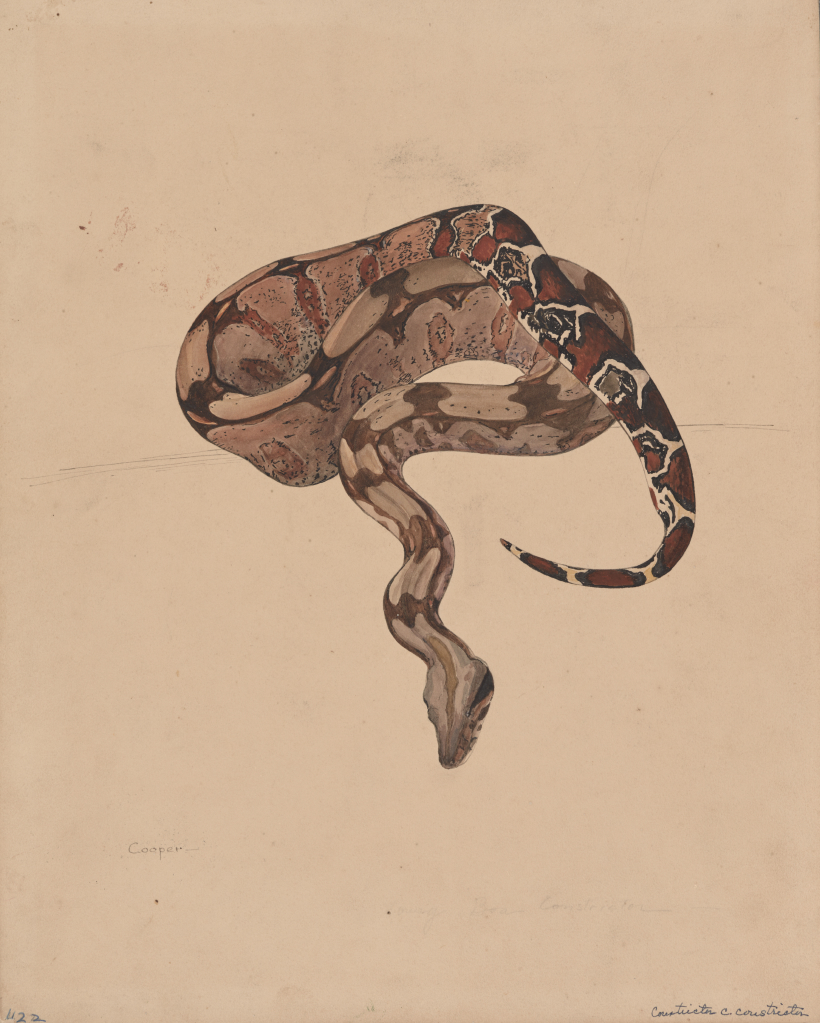
But painting a fanciful jungle room may have given Isabel permission to make a fanciful snake, and thus it could be a composite of the snakes she knew from her work.
Two birds and a pair of fish
Other creatures lived in Isabel’s jungle. There were two grey birds, and the Jungle Room had a couple of fish. The fish were named Finn and Haddie.11)“Mrs. W. H. Burghardt Receives Description of Putnam Home at Rye, New York,” Statesman Journal (Salem, Oregon), January 24, 1926 Since the big snake had a name, Dorothy probably decided to also offer names to the interviewer for the two fish. Finn and Haddie was an easy-reach option.
Finnan Haddie was a traditional cold-smoked haddock, sold in fish shops. Cartoons and humor of the time also used Finn and Haddie as names for a humorous pair of characters.
Isabel painted hundreds of fish for her work with the New York Zoological Society’s Department of Tropical Research. Some examples are below.
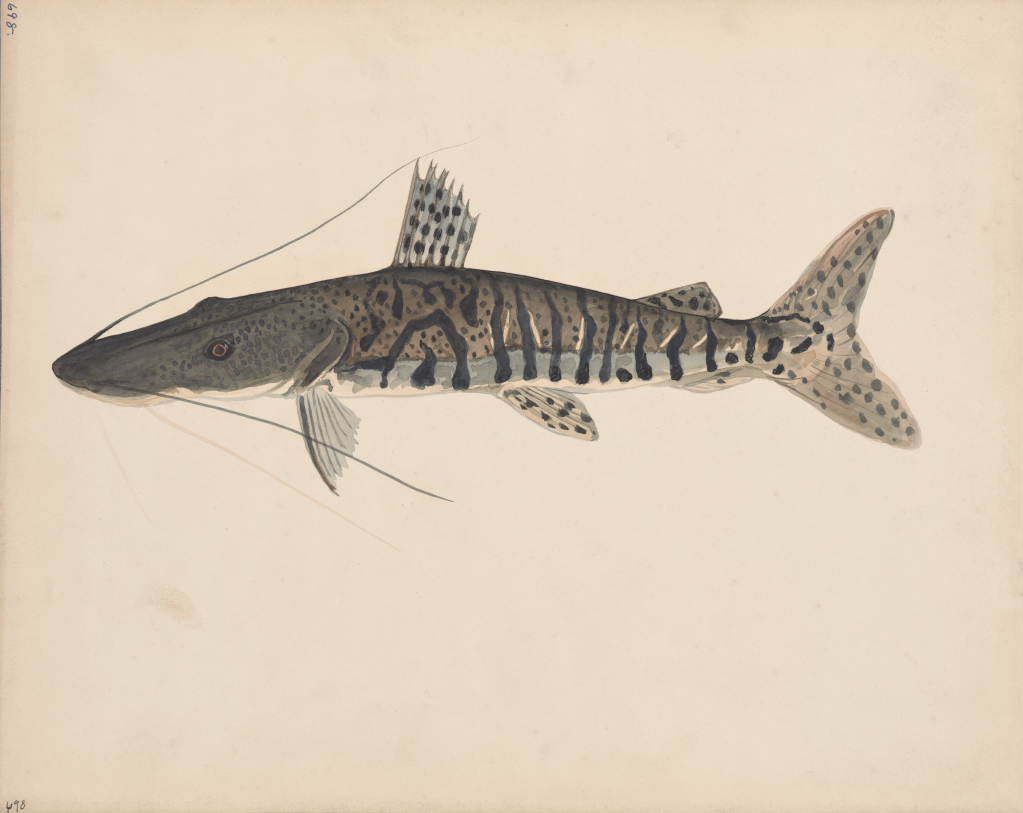

For a further sense of what the Jungle Room might have been like, we also have the example of Don Blanding’s Undersea Room. It was the other themed guest room at the Putnam house. It shows the full, four-wall, and at least in the case of Blanding’s room, ceiling treatment.

For a little more on Blanding and the undersea room, visit here.
Part Three rounds out this series with a look at what became of the Jungle Room and the legacy for Isabel and the rest of us.
References

