
A three-part sub-series on the guest room that Isabel Cooper painted for Dorothy Putnam in 1925

Locust Avenue, Rye, New York, November 2, 1925
Isabel read late into the night in the silent house. Dorothy and George Putnam’s home in Rye was her refuge from the racket and bustle of Manhattan. It was a fine weekend, and she hadn’t had any bouts of fever, the lingering effects of the malaria she’d contracted in British Guiana. Those could strike at will, ruining an evening out or a weekend plan.
She picked up her book. Charles, who she hoped to marry, had urged her to read H. G. Wells’ new novel, Christina Alberta’s Father, so she had packed it with half a dozen other books for her sojourn on Locust Avenue in Rye.

This time, she hadn’t come up to Rye for a weekend of socializing with the Putnams and all their their visitors and friends. And she hadn’t come to relax with her best friend Dorothy.
Dorothy and George were away. George was traveling somewhere on business, and Dorothy was off, according to her note, on a “spree”. And the servants had the night off. So Isabel offered to look after Junie, Dorothy and George’s 4-and-a-half-year-old son.
Junie, was, Isabel told Charles, a delectable, though perfectly naughty little boy. But he hadn’t given her any trouble that afternoon. She’d read a story to him and put him to bed. She had time then to play the Putnam’s Steinway, with no listeners to inhibit her.
Now she sat in the Morris chair by the mica-shaded reading lamp in the Jungle Room, the guest room she had custom decorated for Dorothy. She put on only the single lamp, so she could ignore Eleanor, the boa constrictor, whom she had painted on the wall at Dorothy’s insistence.
Eleanor hadn’t fit her vision for the room, but Dorothy was a persuasive friend, probably the most persuasive woman she knew. Isabel painted the boa low on the wall behind the headboard of the guest bed, so that visitors wouldn’t have to contemplate her too much.
Her reading lamp quieted Eleanor and dimmed to shadowy background the the fronds and roots and birds and frogs that decorated the room.
She read late into the evening, as was her habit. Eleanor, the boa, stayed hidden from view behind the bed, twined along the baseboards.
About Isabel Ruth Cooper
Isabel Ruth Cooper (1892–1984, later Isabel Cooper Mahaffie), was this author’s grandmother. She was an professional artist who, later in her life, retired from paid work to paint landscapes and still lifes. [Yes, the plural of still life is still lifes.]
As a young, single woman, she’d made a lucrative career in art. That paid work came to include mural painting and decoration, in addition to the scientific illustration she became noted for.
A recent blog post here explored Isabel’s work as a mural painter in the studio of the muralist Ezra Winter.
But Isabel had an earlier history of work in design and interior decoration, and before she did mural painting professionally, she painted at least one room-sized mural, the Putnam’s Jungle Room. That mural featured an enormous boa constrictor named Eleanor.
The tale of Eleanor the Boa, while it seems but a fun side journey for Isabel, brings new threads of her story as an artist together.
Isabel spent a year at Bryn Mawr College outside Philadelphia when she was seventeen. Her guardian Aunt Mary P. Cooper paid the tuition and expenses, and may well have chosen the college. Isabel enjoyed Bryn Mawr, but was not cut out for, at least at that young age, an academic life.
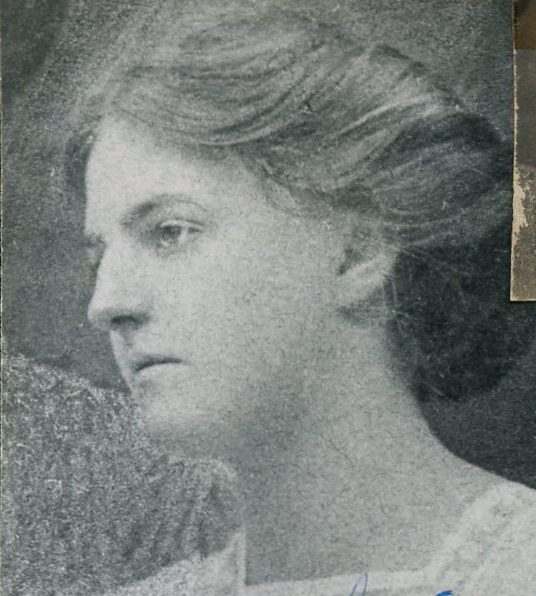
Any of us who knew her would have trouble putting “coed” and “Isabel Cooper” in the same sentence. The school work didn’t catch her interest. And, as she told a later interviewer, instead of buckling down in her studies, she was “eternally sketching.”1)John Monk Saunders, “Jungle Creatures ‘Sit’ for Her in Their Own Back Yards,” American Illustrated Magazine. United States, Crowell-Collier Publishing Company, February 1926.
Isabel left Bryn Mawr at the end of her freshman year. She returned to New York City. It became clear that art was calling her.
In New York, Isabel turned to advancing her art education on her terms, or as far as she could bend things with her supervising guardian Aunt Mary. (In November 1913, just after she turned 21, Isabel secured her legal emancipation from her Aunt Mary’s guardianship. That story is here.)
Isabel would go forth on her own terms from then on. She was interested in everything from fine art painting to myriad more practical and applied arts. Isabel told an interviewer that she “took every art course offered.”2)John Monk Saunders, “Jungle Creatures ‘Sit’ for Her in Their Own Back Yards,” American Illustrated Magazine. United States, Crowell-Collier Publishing Company, February 1926.
She studied at the Art Students League in New York City, and took classes at Columbia Teacher’s College from 1910 to 1913. Columbia directories and Bryn Mawr alumni listings show her at Columbia Teachers College studying house decoration and fine arts, and also practical arts. She also took architecture classes and seems to have been keenly interested in that subject.
She gravitated toward design and decoration, and began to work in interior design by the late 1910s, perhaps as a surer way to make a living. A 1913 Bryn Mawr College listing notes her as “Student, Department of House Decoration and Fine Arts, Teachers’ College, New York City, 1910–12;” but also as working as an “Interior and House Decorator, 1912–13.3)Bryn Mawr College Calendar, 1913. Bryn Mawr, Pennsylvania: Bryn Mawr College, 1913. p. 190. This makes it clear she was working as well as attending classes. She was paying her own way in life, and needed income.
Making a profession of art and decoration
Paid and unpaid, Isabel tried all different arts: drawing from life, rug and tapestry design, clay sculpture, pottery, metalwork, interior decoration, and stage costumes.4)John Monk Saunders, “Jungle Creatures ‘Sit’ for Her in Their Own Back Yards,” American Magazine, February 1926, Vol. 101, p. 26.
She was good at interior design. It’s likely she worked in the early 1910s for Anton Hellmann, who had a interior decoration practice and school at the Benedict Studios on Washington Square in New York City.5)The Upholsterer, June 1916, Vol. 55, p. 83. She gave the Benedict Studios as her mailing address for several years.
By 1917, Isabel was pursuing work as a scientific artist and in interior decoration at the same time. Because the scientific illustration took place during the dry season, and when she was in the tropics, she then toggled to interior design and other artistic work when she was back in New York City. And the two art forms fueled and inspired each other.
Isabel was explicit about how she drew on nature to inspire her art. Submissions she made to the Architectural League of New York’s 1926 exhibition show her blending in natural themes and details:6)Year Book of the Architectural League of New York, and Catalogue of the Annual Exhibition. United States, Secretary of the Architectural league of New York, 1926.

Moving away from decoration
But Isabel had mixed feelings about decoration. She found interior decorating too commercially demanding.8)John Monk Saunders, “Jungle Creatures ‘Sit’ for Her in Their Own Back Yards,” American Magazine, February 1926, Vol. 101, p. 26. She found additional illustration work and also wrote magazine articles for further income.
Part Two is about how the jungle-themed room she painted for Dorothy Putnam came about and what it might have looked like
References

