My Grandparents, 100 Years Ago this Year – Did their Twenties Roar?

In June 1923, Prohibition was the law in the United States. Movies were still silent. Jazz was brand new and selling a lot of 78rpm records and Victrolas.

American women had gotten the right to vote nationwide three years earlier. Their first chance to vote for U.S. President had come in 1920. Warren Harding was elected that year, his success often attributed to new women voters.

My four grandparents were adults, making their way in the “Roaring Twenties”. I’ve sometimes wondered what their lives were like back then, and what they were like as young people.

I knew three of the four, but only when they were well into old age. Old pictures, letters, newspaper stories, and things I remember them saying tell me they led rich, fun, exciting lives when they were younger.

But did their Twenties roar?

My best sense is all four of my grandparents suffered little from Prohibition. The United States had gone dry at midnight on January 17, 1920. It became illegal to make, sell, or transport alcoholic beverages, though not to possess or consume them.

But the savvy and well off in the United States never stopped getting access to alcohol. My grandparents were surely no different. There’s an old line about how Prohibition didn’t stop people from drinking, it just made it more fun. That sounds about right.

My grandparents were active, connected, cultured people, three of the four living in New York City, the fourth well-traveled and based in Washington, DC. They lived at the leading edge of the emerging modern age.

Roberta Becker and Redmond Farrar about 1915
Isabel and Charles Mahaffie 1928, visiting Charles’ childhood home in Hobart, Oklahoma

John Redmond Farrar, Jr. and Roberta Becker Farrar

In 1923, my mother’s parents, Redmond and Roberta Farrar, were 25, married since 1919. They had met in Brooklyn society, both active in and connected, via their families and schools, to the social scene in the borough.

Their first child, Robert Bartlett Farrar was born in June 1923. His mother Roberta was social and outgoing. She had been a teen-age dance champion. She was an active part of Brooklyn society. But she began that year three months pregnant with her first child and was establishing what was a more domestic life.

Redmond worked at a bank. He was a key figure and performer in the alumni musical shows of his school, Brooklyn Collegiate and Polytechnic Institute (called then and now, Poly Prep). The shows were a big deal. He composed music for them, as well as for Tin Pan Alley publishers. In 1923, he co-wrote three published songs.

By that year or soon after, Roberta and Redmond were living in the newly-built apartment building The Rulian, at 295 St. Johns Pl. in Prospect Heights, Brooklyn.

1923 Ad for The Rulian in Brooklyn

The Rulian was “Brooklyn’s Most Beautiful Apartment House”. In was one block from Prospect Park and convenient to the subways. During the summers, Roberta and Redmond went to Sound Beach, Connecticut. In 1924, they stayed there from early August to the end of September. This is near where they ended up building their Riverside home (in 1930) where they raised their three children, Robert (born 1923), Joan (born 1925), and my mom Judith (born 1930).

At the Rulian, they could enjoy a “built-in needle shower” and “every modern convenience” in their own apartment. And by as early as 1924 they had a telephone (no. STE(rling) 4945).

Roberta’s parents had both died, and she was their only surviving child. She was close to her father’s sisters, Karolina Becker Brion and Louise Becker Stoltze, and their families who lived in Brooklyn.

Redmond’s parents also were in Brooklyn, on Hudson Street in the Bedford-Stuyvesant neighborhood, about 2 miles from their apartment. Redmond’s father, John R. Farrar, Sr., was still active as a Brooklyn Superior Court Judge. Redmond’s older sister, Grace, then 29, was studying voice at The Fontainebleau School of Music, a conservatory southeast of Paris in France.

Oscar Widman (left) and Redmond Farrar (right) in “Just Apples” the 1923 Poly Prep Alumni Spring Show

In 1923 Redmond published (as co-writer); “Hurry Up Matilda,” “I’ll Have Vanilla,” and “When the Moon Shines on the Cow Shed”.

“I’ll Have Vanilla” was the biggest hit among them. Recorded by (and co-composed) Eddie Cantor, then a huge star of Vaudeville and radio, it was Redmond’s closest brush with real music success. (Listen to it here).

Redmond’s song collaborators were established, even notable composers. While he wasn’t making a real living at composing songs, it had to be a big deal for him. That year, as noted, he was likely working in a bank; his 1918 draft card noted he was a clerk at Farmers Loans. By the 1930 Census, his profession listed as stock broker. He was not yet writing “B” side tunes for Plaza ARC Records, which he did later in the 1920s as a house composer for that label.

That Spring, Redmond continued to help create and appeared in the alumni shows of Brooklyn Poly Prep, his all-boys middle and high school. He played “Kitty May”, giving a ‘fine characterization, for he is a true artist as a delineator of the fair sex…’

Isabel Ruth Cooper and Charles D. Mahaffie, Sr.

Isabel Cooper passport photo, 1923

In 1923, Isabel and Charles had not yet met. Each was still single. Isabel was 31. She worked, part of the year, in South America, at scientific illustration, and lived an artist’s life in New York City. If her twenties roared, she brought her own flavor and style to it, and favored the artistic and bohemian life. She was no flapper.

In March 1923, Isabel sailed with William Beebe’s scientific expedition on the Noma for the Galapagos Islands, via the Panama Canal. The ship returned to NYC in May. This was the first of two trips to the Galapagos she joined. She went again in 1925.

Isabel, emancipated at 18 from her guardian aunts who had raised her as a late teen, had cobbled together work as an artist and in adjacent areas. She wrote about these jobs in 1924, when she had spent a few years in her preferred one, “wild-animal painting in the jungle”:

Isabel Cooper from one of her scientific expeditions (later 1920s)

“I used to dream of such a job as I went bleakly about my various occupations, such as assisting at the legerdemain of interior decorators, or degrading oriental perfections to terms of a modern rug factory, or building feeble disguises for player kings and queens, or filling in the cracks of my time with painting lessons, sadly convinced the while that you cannot learn to be a painter and accomplish anything else the same year.”

Among other accolades, in 1923 Isabel had two species of moths named for her: Cirphis cooperi and Paectes isabel.

Isabel didn’t meet Charles until the next December (1924). By then, she had committed to a second trip to the Galapagos. They wrote long letters back and forth during that second journey. It was a courtship by post. They finally married in 1928. They had one child, my father Charles Jr., born in 1931.

When not off on an expedition, Isabel lived at 136 West 65th Street, New York (site today of The Lincoln Center). That address housed other artists and at least one art studio around that time.

Part of that time she lived there with a pet red howler monkey, brought back from South America. That lasted until the neighbors objected to it, presumably for its howling. (Howler monkeys are the loudest land animals on Earth, with their howling audible from 3 miles away.)

Charles (right) on the Putnam’s boat likely in Florida, November 1923

Charles D. Mahaffie, Senior, still a bachelor at 39, was out and about with his great friends George and Dorothy Putnam and others. (The Putnams later introduced Charles and Isabel.)

He lived at the University Club on 15th Street, in NW Washington DC (on McPherson Square). There were about a hundred residents at the Club, all men. Charles was on the Committee on Literature, Art, and Decorations at the club. Before moving to DC from Portland Oregon in 1916, he had lived in the University Club there.

From a1924 description of the Washington, DC University Club in its yearbook:

“This dignified, well proportioned building faces McPherson Square, one of the small parks so characteristic of Washington. The large reading room, the spacious and beautiful lounge, the library, the large and dining rooms, like the spacious entrance hall and beautiful open stairway, which extends to the room floor, secure open spaces and airiness, an important matter in Washington.”

“The Club also provides for newspapers and periodicals and for cards and billiards.” Gambling was not allowed, and women were only allowed in the designated ladies rooms.

Charles with Dorothy Putnam in 1925

Charles was Director, Bureau of Finance, of the Interstate Commerce Commission. It was a job that took him all over the United States, attending to the Federal regulation of the railroad industry.

His salary was $6,000 per year. Senator Charles Curtis, presumably for political partisanship reasons, wanted Charles removed from that job. Curtis, a Republican, was even from Charles’ birth state, Kansas. The senator ended up as Vice President under Herbert Hoover. But Charles kept the job and soon rose to become a Commissioner of Interstate Commerce.

Each of these four people were distinct personalities and lived active, interesting lives.

So did their 20s roar? I’d say yes!

Roberta Becker Farrar, Part 3: Courtship, Marriage, Family, and Old Age

This entry is post 3 of 3 in the ongoing series Roberta Bartlett Becker Farrar

Colored by the times and the power of the literature, you might be forgiven if, looking at the pictures and stories of the young couple Redmond Farrar and Roberta Becker, you think of Scott and Zelda Fitzgerald. That is my strong bias, and it colors my impression of them as a young couple. F. Scott Fitzgerald was exactly the same age as Roberta and Redmond. Their young adulthood coincided with the emergence of the Jazz Age (and Redmond participated at least on the edges of the jazz scene in New York as a song composer through the 1920s).

But that line of thought probably warps my thinking about Granny, who, when I knew her, didn’t come across in any way like Zelda Fitzgerald. And of Redmond, I only have second-hand impressions.

Meeting and courting at Lake Mahopac

The Dean House, Lake Mahopac, New York, where the Farrars and the Beckers stayed in the summer during the late 1910s

Roberta’s family stayed at Lake Mahopac for portions of their summers. So did Redmond Farrar’s family. We know they were both there at least as earlier as 1915. The Mahopac resorts had athletic contests, dances, dinners, and other social activities. The Brooklyn Daily Eagle reported much of each summer’s goings on in its society column.

Lake Mahopac was a summer resort community near Carmel, New York, in Putnam County, fifty miles north of New York City. Vacationers could get there by train. Some hotels sent horse-drawn coaches to fetch their guests.

Brooklyn Daily Eagle, November 1919

Redmond may have stood out to Roberta there for his prowess in swimming, sailboat racing, foot races, and his violin playing—he was classically trained. When there was dancing, she likely would have stood out to him. Their families lived in different parts of Brooklyn, but through their schools and places in Brooklyn society, they were often at the same social events. From Joan Farrar’s picture album, we see that they were a couple by 1915 when each was still in high school and about 17 years old.

Meanwhile, Roberta had a first cousin, Lester Brion, who wanted to marry her. Lester was five years older. His sister Estelle was one of Roberta’s close companions. Roberta had lived with the Brions for part of her childhood. Lester was her first cousin, and while there are sometimes marriages between first cousins, Roberta didn’t believe it was acceptable. And given her childhood spending time and living with the Brion’s the two were near to siblings. It’s possible too that she simply didn’t care for Lester, or that she was already interested in Redmond.

Left and right, Roberta and Redmond, 1915
Roberta’s wedding portrait, 1919

Late in and just after high school, Roberta and Redmond courted for several years, during which he participated regularly in the alumni shows of Brooklyn Poly Prep, and she helped organize society events. Redmond was also away attending college for parts of two years during that period.

They married on November 26, 1919. Roberta was 22, and Redmond just shy of that age. Roberta’s father, August Becker, had died the previous autumn. She was escorted down the aisle by her uncle Frederick Becker. Redmond’s sister Grace Farrar was her maid of honor.

Here is a description of Roberta’s wedding outfit: “The bride’s gown of white satin was embroidered in pearls, her tulle veil was arranged in fan effect and held in place with a coronet of Dutchess lace and orange blossoms and she carried orchids and lilies-of-the-valley.” (From Brooklyn Life, December 12, 1919).

The wedding was at the Hotel Bossert in Brooklyn Heights, a prestigious place to get married. The hotel is still there. With its Italian Renaissance decor recently restored, it operates as a high-end, boutique hotel.

The wedding announcement in the Brooklyn Daily Eagle society column raises two mysteries about Redmond. It notes Redmond “is also well known in the tillery and recently returned from 18 months foreign service.”

First, military service. In the Fall of 1918, at age 20, Redmond registered for the draft, but before long he was enrolled in courses at Columbia University that were part of the war effort. The students were enlisted in the U.S. Army. But Armistice was declared during that Autumn, and he did not serve in the Europe. Redmond was discharged from military service in December 1918. So according to military records, the newspaper account was simply wrong. The newspapers of the time routinely included things that were simply wrong, misheard, and misspelled, but for plenty of details, they are all we have.

Redmond in his 50s

Second, I cannot discover what a “tillery” was. The word may relate to his work in banking and finance. There was a Tillery Building in Brooklyn, but it was headquarters for the Department of Education. And there is Tillary Street in Brooklyn  (the name spelled with an “a”), but it’s not clear if that is what “well-known in the tillery” referred to.

Redmond Farrar led an interesting life. He was drawn to first the music business having scored and performed in a number of musical shows as a teen and young adult, he found his way to work, off and on, as a song composer. I am not certain whether this was, for periods, full-time work. He also worked as a stock broker and later a film maker. His varied careers, centered on Manhattan, meant while the family lived in Riverside, he commuted to the City.

Roberta and Redmond’s children

Joan and Judy in about 1931

Redmond and Roberta had three children, Robert (born 1923), Joan (born 1925), and Judith (born 1930). Joan, not too long into her childhood, developed disabilities that would shape the rest of her life. She lived with her parents, then with Roberta, through her life, dying at age 41 in 1966.

By 1930, the Farrars had moved from Brooklyn to Meadow Road in Riverside, Connecticut. Redmond would have commuted by train to Manhattan for work, while Roberta raised the children at home, a common pattern for the time. They enjoyed suburban life there and were members of the Riverside Yacht Club.

Robert, Judith, Roberta, and Joan Farrar, early 1930s. Screen capture from a home movie

At about 18 years old, the oldest child Robert went off to become an Army Air Corps navigator, serving in Europe in World War II. He flew on B-24 Liberators with the 392nd Bomb Group rising to 1st lieutenant. He married Emily Ober and they were drawn west, moving to California. Robert stayed in the West after he and Emily divorced and after some years moved from Los Angeles to Bullhead City, Arizona, where he lived until his death in 1992.

At this YouTube link is a 40-minute compilation of home movies, digitized from old magnetic media, showing Roberta, Redmond, their children and friends in their Riverside, Connecticut neighborhood. The quality is poor, and there is no sound, but some flavor of their lives and times there comes through. The first part is film from a neighborhood pageant of some sort from the early 1930s. The video also includes later footage of the family, and the last portion is in (badly faded) color. Redmond was, for a time, a filmmaker, and may have had early access to color film.

Charles D. Mahaffie, Jr., Roberta, Judy, and Joan (seated) at Judith and Charles’ wedding

Robert had six children: Robert, Jennifer, Victoria, Phyllis, Polly, and Constance. Constance at age 3 went to live with her Aunt Judith.

Judith was the only one of the three to enter and complete college. Meeting and marrying Charles D. Mahaffie, she settled with him in Bethesda Maryland after Charles’ service in the Navy in the late 1950s. They raised seven children, including their niece Constance.

Redmond and Roberta’s marriage was troubled, and it worsened. They separated by the late 1950s. Redmond died in New York City in 1957 at age 59.

Elegant Senior

Roberta, undated photo

Roberta was a quietly sociable senior, living near her daughter and grandchildren in Bethesda after her daughter Joan died. She made good friends at the Westwood Apartments in Bethesda, playing bridge and going out to lunch. She entertained her Mahaffie grandchildren there, sometimes having them to lunch. She attended Little Flower Catholic Church.

One highlight was a time when she was clocked on the Beltway driving too slowly in her Dodge Dart. As her grandson Matt Mahaffie remembers it:

I do remember her getting pulled over for driving too slow in the Dodge Dart. Mike and I leaned over the back seat and reported to the two ladies in front on how the policeman seemed to be getting frustrated at Granny’s failure to stop. “He can’t mean me” said Granny, “I’m only going forty.” (This on the Interstate.) And Mike and I suggesting that he probably did indeed mean her, as his pull-over-NOW! hand signals and facial expressions got angrier. I also remember Grandma (Isabel) enjoying the whole episode immensely.

The penalty included attending traffic safety classes. I recall her complaining that the other miscreants were long-haired teenagers who of course had driven too fast, not too slowly.

Granny died on September 25, 1972 at Suburban Hospital in Bethesda. I remember Dad waking us the following morning and telling us that Granny had died of a massive heart attack. She was just shy of 75 years old. She had been a smoker for much of her life, leading to the common cycle of atherosclerosis that can afflict a smoker when they don’t succumb to lung cancer.

Granny is buried in Green Wood Cemetery in Brooklyn, alongside her daughter Joan and son Robert, in the Farrar family plot.

____

Granny had three children, twelve grandchildren, twenty great grandchildren, and, so far at least six great great grandchildren. It might be time to do a survey to find out how many of them can wiggle their ears, each one independently.

Roberta Becker Farrar, Part 2: Roberta in School

This entry is post 2 of 3 in the ongoing series Roberta Bartlett Becker Farrar

As a child, Roberta went to a school known as “Knapp Mansion” at 554 Bedford Avenue, Brooklyn, quite close to her home (537 Bedford). Old directories note Knapp Mansion as a non-sectarian day school. The promotional description below suggests the school is all about dancing, posture, and deportment.

“At the Knapp Mansion School ‘especial attention is given to dancing and physical culture… Both sexes and ages can get at this institution instruction in all kinds of dancing, and the principal makes a point of being posted and able to teach all of the newest things in this form of diversion. The absolute necessity of knowing how to dance is of course apparent to persons who go much into society, but not a little of the pleasure to be derived from this exercise by all who participate in it is dependent upon proper instruction, not only in the movement of the feet but in the carriage of the body, and all of the other details which insure grace and confidence. Careful instruction in these details and also in the etiquette of the ball room is given by Professor Rivers. Thorough training in physical culture is included with the course given at the Knapp Mansion.”  –From: The Director, Volume 1, 1898.

Packer Collegiate Institute, Brooklyn

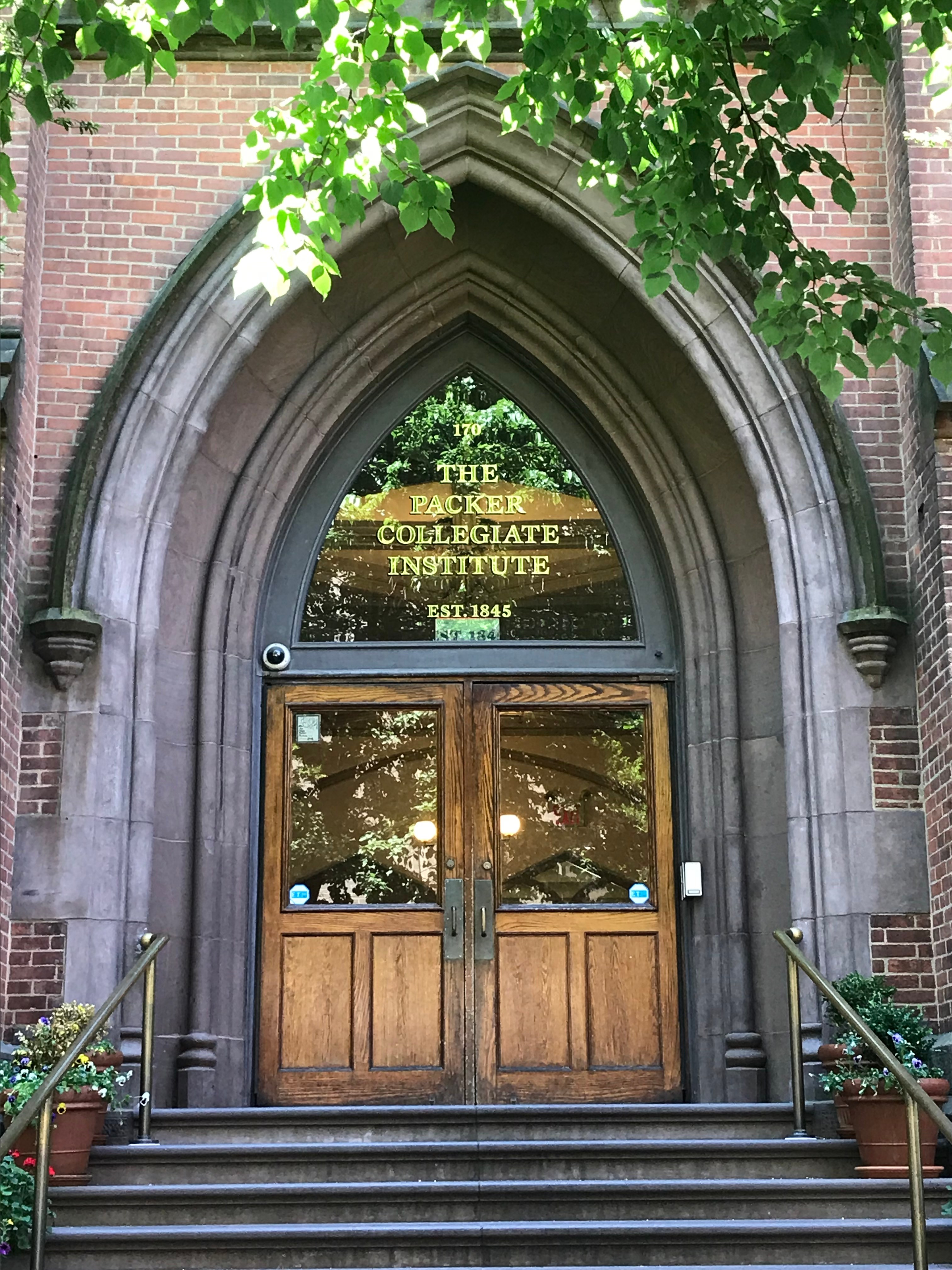
Entrance of Packer Collegiate Institution, June 2019

Before long, August sent Roberta to a more conventional private school, Packer Collegiate Institute.

When August enrolled her at Packer in September 1908, the school placed Roberta, then almost 11, in the second preparatory grade. Packer may have given her a what we now call a social promotion after that first year. The records show her next in the fourth preparatory grade.

Through the Packer Collegiate Institute archives, which I visited at the Brooklyn Historical Society in the summer of 2019, I got two views on who Roberta was as a girl. From her earlier years there, when she was about 10 to 12, she was not just an undistinguished student but a lousy one.

Roberta surely had an emotionally-tough childhood, losing her mother when she was one and a half years old. She was the third but only surviving of three siblings. ON the other hand, she had a prosperous and loving father, and they lived with his sister and her family with relatives that Roberta was close to then and later.

Her prior schooling, at the Knapp Mansion School in Brooklyn, could have been a factor in her lousy school performance. Knapp Mansion emphasized dance, perhaps leaving its pupils less-prepared for traditional curricula.

Packer Collegiate girls in gym class on the school’s roof, 1910s

A lousy student

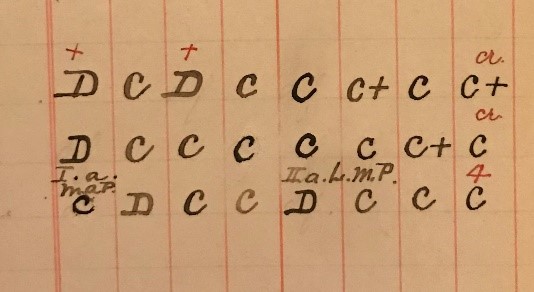
Grades from Roberta’s fourth preparatory transcript

Initially at Packer, Roberta seemed to get on track, with her scores through the Fall and Spring in the 80s (in percent, with 100 being perfect). Best of all was spelling, where in her first year she got 97.

But as she continued there, her performance, which moved to letter grades, deteriorated. Her best subjects were drawing and, again, spelling. Her worst, grammar and Latin.

She was now a C student. Among her contemporaries there were far more As and Bs. I did not see her grades from later years—the archive librarian would not allow access to those, in case the same carton of documents had papers relating to still-living students.

Voted most attractive

Roberta, when I knew her, was elegant, poised and sociable, with all the social graces (plus the ability to wiggle her ears). It’s clear these qualities were present and served her well in school and her social late teen age and young adulthood.

By the late 1910s, when she was in her late teens, Roberta was active, social, and had an advanccd talent for dancing. She was often on the school committees that threw dances and parties. She was part of Brooklyn society and the social columns of the Brooklyn Daily Eagle listed her among the guests at society events, routinely noting what she and the other young women wore at dances and socials.

With repeated joint social events between Packer Collegiate Institute, her school, and Brooklyn Poly Prep, his, she met John Redmond Farrar, Jr., of Brooklyn, the son of a well-off Brooklyn judge. Both their families went in the summer to Lake Mahopac, New York, fifty miles north of New York City, so Roberta and Redmond had ample chances to notice each other and get acquainted. According to the dates on some pictures, they had done so, and were likely engaged, by 1916, each of them were 17 or 18.

Senior year

I learned from the Packer Collegiate school records, especially the yearbooks, far more about Roberta in her senior year of high school. The records are in the library of the Brooklyn Historical Society. I spent about four hours there looking for all I could find about Roberta.

At Packer, she was vice president of the French club and involved in planning a number of school social events. Some of the clues to who Roberta was in high school don’t jibe with the proper lady I knew.

Roberta’s page in the Packer class of 1917 yearbook

The little couplet reads: “Oh, bed! Oh, bed! Delicious bed! That heaven upon earth to the weary head.” What about her did this refer to? We will never know. Bottom left reads “Censored!!” which has to have a story behind it.

The Packer Collegiate Institute’s Class of 1917. Roberta is likely in the front row, center, just behind the “K”

“Knocks”

On the “Knocks” page of the class of 1917 yearbook, the class laid out their views of each girl’s “Present Occupation” “Future Occupation” and “Needs”. For Roberta, these were “Cataloguing her beaux,” “Keeping them busy,” and “A secretary”. In this Roberta was not a standout. Other girls’ entries were funny, played on apparent inside jokes and reputations, and included double meanings and general naughtiness.

For example, Dorothy Cummings: Present occupation: “Thrills”. Future occupation, “More thrills”. Need: “A chaperone”.

The Senior Class Ballot

In the spring of their senior year, the girls met to vote the class ballot. Roberta was voted “Most attractive”. There was also a “Prettiest” and a “most beautiful” and the distinctions among those are not clear to me, but what those words most precisely meant 100 years ago is likely different from what they mean now.

Designations for other girls included “most dignified,” “wittiest,” “brightest,” and “most self-possessed,” “noisiest,” and “class baby”.

Glory on an outing of automotive engineers

Roberta’s Uncle, Adolph Brion, was a member of the Society of Automotive Engineers. He was an executive at Peter A. Frasse and Co., Inc., a steel company that sold materials to the automotive industry.

In the summer of 1916, he joined the Society for its annual meeting and Great Lakes cruise, taking his wife Lina, daughter Estelle, and niece Roberta along for the journey. Roberta was 18 years old.

The automobile, and therefore automotive engineering was just a few decades old and the profession was in a white-hot growth mode. The Society had been founded in 1905.

The S.A.E. Bulletin from that summer assures us that “every minute [of the cruise] was filled with pleasure and profit.” By day, the men attended arcane lectures about ball bearings and carburetors, and met to established standards for their industry.

“Though it was 10 o’clock when the entertainment of the Cleveland section came to an end, there was still another feature on the day’s program, namely, the dancing contest for the S.A.E. championship. This contest was won by Miss Roberta Becker, of Brooklyn, her partner being W. J. Cohalan a member of the Detroit section.” (He was ten years her senior). From: “Mixing Acting with Engineering,” Horseless Age: The Automobile Trade Magazine, Vol. 38, July 1, 1916.


Roberta Becker Farrar, Part 1: Introduction and childhood

This entry is post 1 of 3 in the ongoing series Roberta Bartlett Becker Farrar
Roberta B. Farrar

Our Granny could wiggle her ears, each one independently. This astonished me when I was a small boy. She did it without being in any way goofy. She was an elegant old lady, kind and attentive, but always giving off a sense of properness. For my Catholic Confirmation, she gave me a map of the Holy Land. Goofiness didn’t fit the Granny I knew, but maybe wiggling ears for small children was a clue to more about her.

When I was little, we would load into the station wagon and drive from Bethesda, Maryland, to Riverside, Connecticut, to visit. She lived in a big, old Tudor-style house. The house had things we didn’t know about: a country lane ran right behind it. The kitchen had a Dutch door, opened only in the top half on a summer morning. The sink taps had separate spouts for hot and cold.

My mother’s sister, Aunt Joan, then in her 30s, and disabled, lived with Granny. We saw Joan in her room, visiting her while she was in bed, or once that I remember, while she sat in her wheelchair, downstairs. Someone would have had to carry her down from upstairs where her bedroom was. Granny was widowed and had, from Joan’s girlhood, cared for her daughter, sometimes with the help of a live-in nurse.

By the time I knew Granny, she was in her 60s. She was a cheerful, though proper woman who wanted to be sure we, particularly me and my brother Jim, who were preteen boys, knew how we should behave; hold doors for a lady, and never, ever hit a girl, which in this case would be our sister Margaret.

Granny also had an encyclopedic knowledge of card games. I think my sister Margaret, the oldest of our set of her grandchildren, spent the most time with her, learning games. Jennifer Farrar, another of her grandchildren, remembers Granny teaching her and her sister canasta. She told me: “I thought it was extremely complicated and that she was very smart to know how to play it and to teach it to us.” I remember playing crazy eights with Granny. And I’m rather sure she taught me solitaire.

When Granny couldn’t fit a jigsaw puzzle piece, or drew a card in gin rummy or solitaire that she could not use, she’d say “drat”.  I can’t imagine her using language stronger than that, though that doesn’t mean she never did.

In 1966, Granny and Aunt Joan moved to Bethesda where we lived. Joan’s health had worsened, and they wanted to be near Roberta’s daughter Judy, my mom. Granny and Joan had a nurse traveling with them. All three stayed with us for a time, there were now six of us kids, three under 5 years old. We shuffled rooms to fit everyone, and the dinner table for a time had eleven people around it. But Joan soon died. She was only 41.

Before long Granny moved to her own apartment near us. Over her time in Bethesda, she made some good friends. She attended Little Flower Catholic Church. We saw her regularly, sometimes making visits for lunch at her apartment. She took the Washington Star, and would cut out the word jumbles and the Marmaduke cartoons for me. Despite her distinct differences in style and background with our other grandmother, Isabel Mahaffie, they got along well and socialized.

This account
What I share here is mainly about Roberta’s childhood and young adulthood, the part of her story I wanted most to know about. I have explored each of my other grandparent’s stories, but of Granny I knew the least, until now.

Early childhood, losing her mom

Susan Ann “Susie” Bartlett Becker, Roberta’s mother

Roberta Bartlett Becker was born on October 31, 1897, Halloween, to Augustus C. Becker and Susan Ann Bartlett Becker, in Brooklyn, New York. August was a first-generation German-American, engaged in the same business his father Valentine Becker had pursued, plumbing and gasfitting in Brooklyn.

Brooklyn was a fast-growing city by the late 1800s, spreading outward from the first strong connection between Manhattan and the western edge of Long Island, the Brooklyn Bridge, built in 1883. By 1890, Brooklyn was the fourth largest city in the United States. (It was later annexed to become part of New York City.) It was a great place for August’s business.

August and Susie had had two other children, but by the time Roberta was born, both children had died. Their daughter Beatrise was born in 1886. Their son Robert was born in 1890.

Roberta at about 2, 1899

Roberta’s daughter Judy remembers learning that the two children each died of something different. In fact, fast-growing Brooklyn suffered multiple infectious disease crises in those decades.

Beatrise died at age six in 1892. The diagnosed cause was acute peritonitis an inflammation of the abdomen. This was likely caused by typhus.

On February 25, 1895, August bought a 3-story house at 148 Taylor St, Williamsburg, Brooklyn for $9000. He and Susie, with their young son Robert, moved in. Then Robert died in 1897 of diphtheria and heart failure. He was seven years old. It was only a few months later that Roberta was born.

Roberta and her father Augustus Charles Becker, when she was about four

August and Susie named their new daughter Roberta, perhaps in remembrance of both their lost son Robert, and after Susie’s father, Robert Bartlett, a Greenport, Long Island menhaden fisherman.

Roberta’s mother was a Roman Catholic and wanted her raised in the Catholic Church. Granny was and remained a Catholic, though August, her father, was likely a Lutheran.

Then, compounding the family’s tragedies, Susie died of a kidney illness in June of 1899 at age 38, when Roberta was about a year and a half old. This left August Becker a 44-year-old widower with an infant daughter.

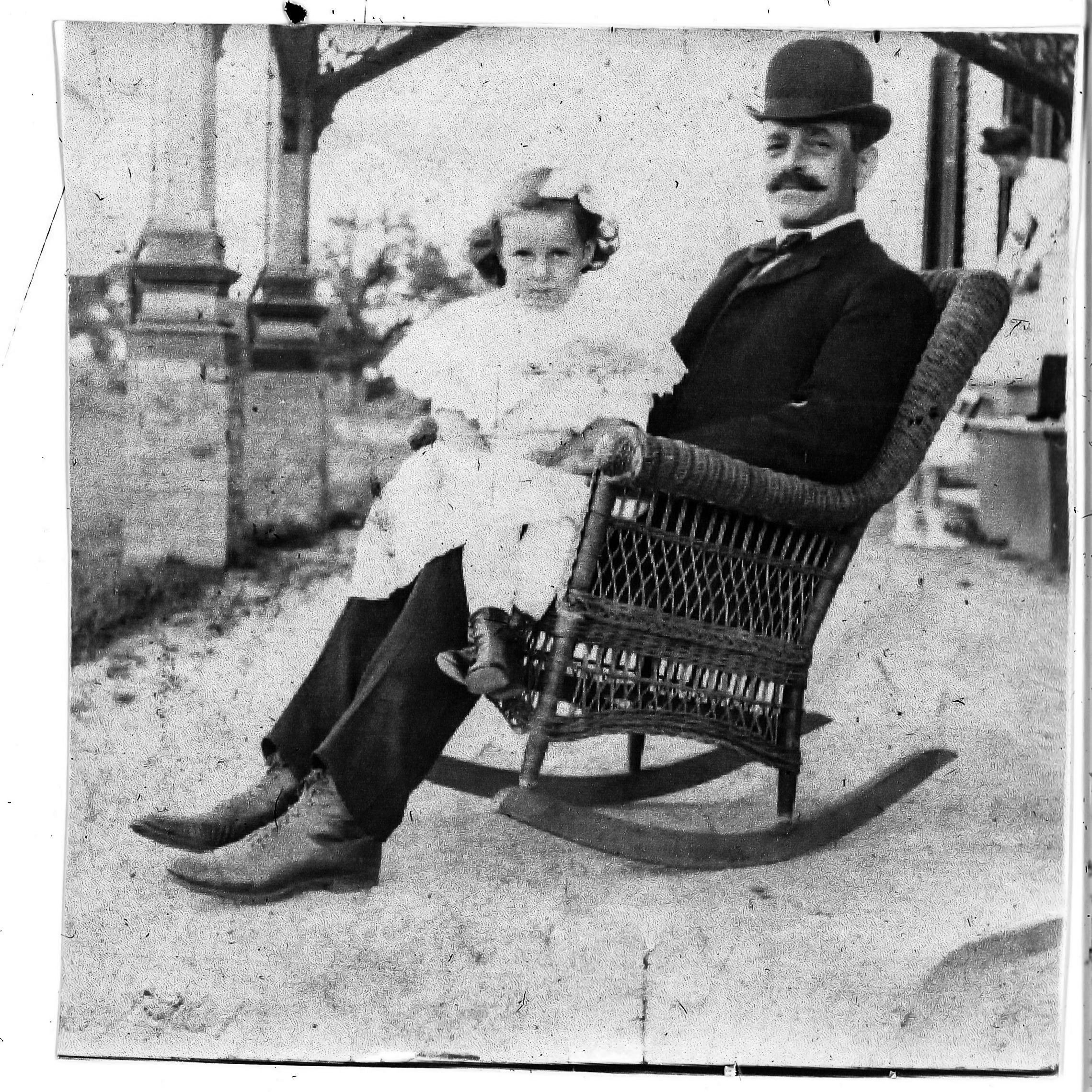
Roberta at about 6 and her grandfather, Augustus Valentine Becker, 1903. He was an immigrant from Germany. He ran a plumbing and gasfitting business in Brooklyn

August leaned on his two sisters for help. They lived nearby in Brooklyn. By the early 1900s, he and Roberta shared a home at 537 Bedford Avenue, Brooklyn, with his sister Louise, Mrs. August Stoltze. They were also close to his sister Lina (Karolina), Mrs. Adolph E. Brion, also of Brooklyn.

Roberta’s daughter Judy remembers her mother telling stories about how she would be shunted from one of her aunts to the other, the two women either not getting along or at least not approving of the other’s choices for the child. Each would take Roberta out for new dresses because she didn’t like what the other aunt had put Roberta in.

The Brions had a daughter Estelle, three years younger than Roberta. The two girls did much together then and later.

August Becker, sanitary plumbing and gasfitting

August Becker prospered in his business, which for a time had Brooklyn locations at 312 Grand Street, Brooklyn and 1230 Broadway. He got city contracts and also bought and sold properties around the city.

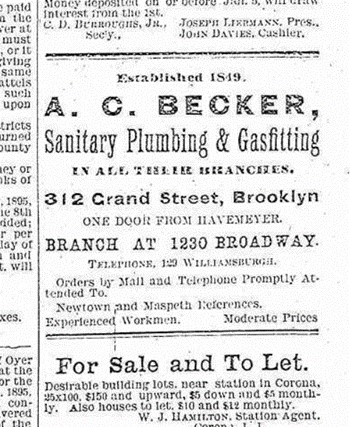
Newspaper ad for August Becker’s business from the Newtown Register, January 3, 1895.
A. C. Becker’s premises in 2019, 312 Grand Street, Williamsburg, Brooklyn


The A. C. Becker ad above notes the business was established in 1849. This is likely when August’s father, Valentine Becker, a German immigrant, commenced his work at the same trade.

A threatened kidnapping

Roberta, about four years old

In September 1901, when Roberta was just shy of four years old, August received a letter at his business which attempted to extort money from him. It instructed him to place $800 where the would-be kidnapper could get it, or his daughter would be kidnapped. The amount is equivalent to about $24,000 today.

This was a common scam in those years, often blamed on Italian immigrants.

At least three newspapers carried the story, the versions differing in each. It’s clear that Roberta (referred to in one paper as Katie, another as Edwina, and never as Roberta, was staying for the summer with her Aunt Louise Stoltz in Patchogue, Long Island. (The New York Tribune story has several names wrong; “Katie” for Roberta, and “Mrs. Shultz” for Mrs. Stoltze.) Possibly, the varying first names and other details were meant to obscure the little girl’s whereabouts, she had stayed in Patchogue for at least several weeks after August got the letter.

New York Tribune, September 18, 1901

August told the Brooklyn Daily Eagle he hadn’t taken the letter too seriously and had taken no action. But he did tell the paper that his daughter had since been sent out West to stay with other relatives.

The Brooklyn Daily Eagle, in 1899, referred to “the kidnapping craze”. A string of stories of kidnappings and threats to kidnap, which seem most often to be ascribed to Italian immigrants, dot the Brooklyn papers in the late 1890s and early 1900s. Often the articles note that a threat wasn’t considered too serious. The targets of kidnapping threats were often business owners. The Brooklyn Daily Eagle published a joke in its humor column in 1901:

“Are the Goldbanks up in society?”

“I should say so! Why, the have received no less than a half-dozen letters threatening to kidnap their son if they did not give up five thousand dollars.”


Follow by Email
Instagram