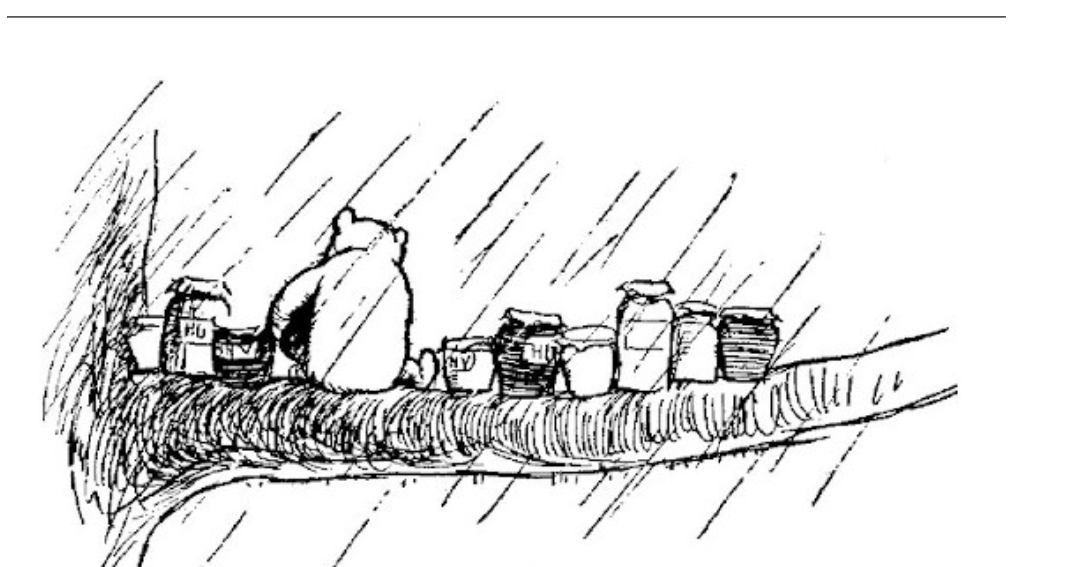
A. A. Milne and his illustrator E. H. Shephard, in creating Winnie the Pooh (1926) and its illustrations, did an OK job, at least in terms of showing bees in a tree cavity. They were less solid on bears and their point of view on bees. Bears, most of all, go after bee larvae. But larvae aren’t cute.
Images from Winnie the Pooh (1926)1)Public domain, https://www.gutenberg.org/ebooks/67098
But then things got further out of whack.
It was no fault of Shepard or A. A. Milne when certain Disney media started to show Winnie the Pooh trying to get honey from what is either a paper wasp nest or a bee skep hive hanging in a tree. Neither plan will work.
Cover of the 2012 edition of Pooh’s Honey Trouble
They inadvertently hinted at greater truths with the titling of this children’s book (2012 and earlier editions), Pooh’s Honey Trouble. Pooh’s plan here would lead to failure one way or another.
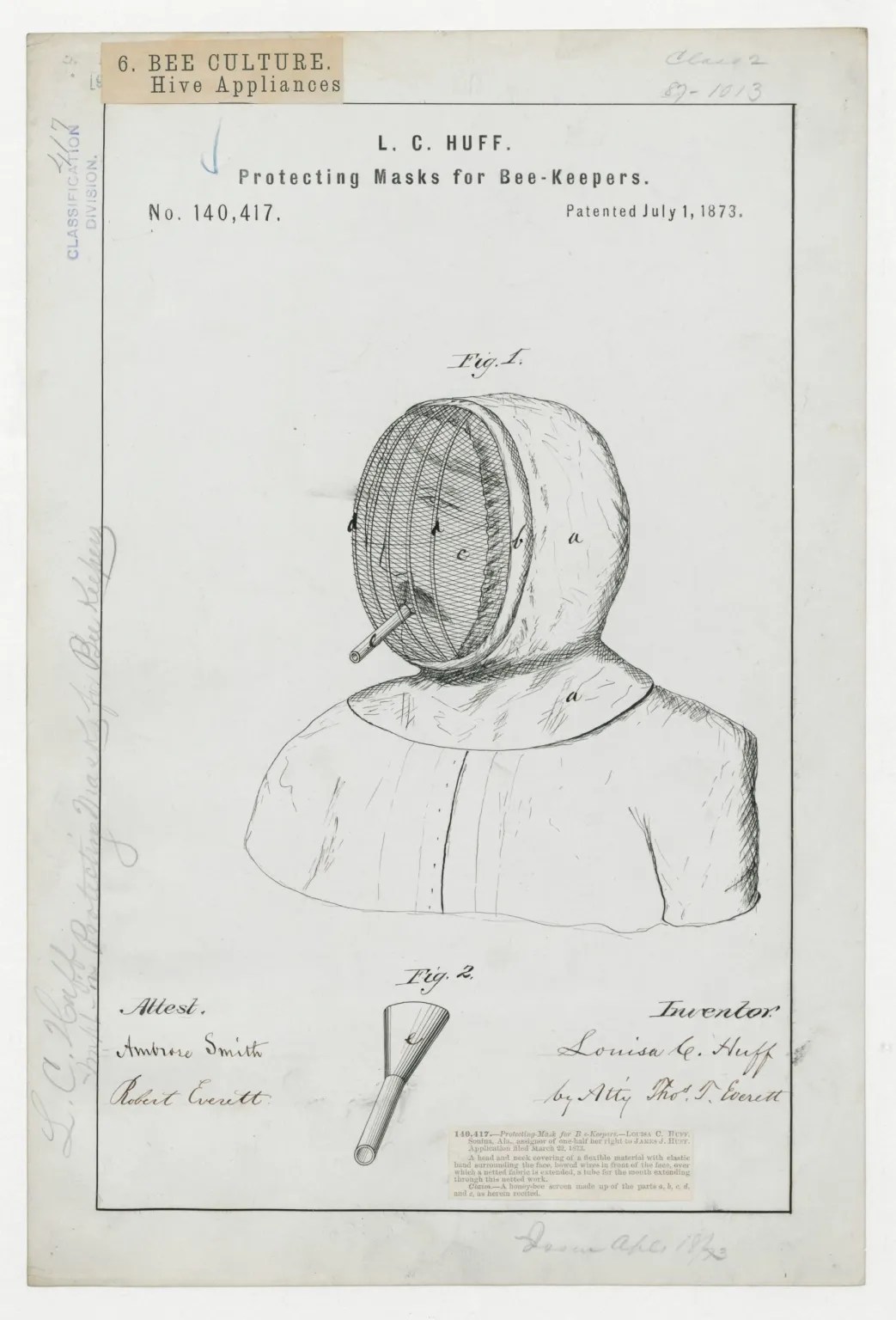
The motivation of avoiding stings has meant a long history of protective equipment innovation. One of many many designs that came along was the protective mask shown below which included, per the patent:1)US Patent US140417A “Improvement in Protecting-Masks for Beekeepers, https://patents.google.com/patent/US140417A/en
An expectorating-tube, 0, passes through the gauze in the line of the mouth and properly fastened to the gauze. This device is more for the convenience of tobacco chewers than others.
A protective system for beekeepers who smoke or chew tobacco from 18732)US Patent US140417A “Improvement in Protecting-Masks for Beekeepers, https://patents.google.com/patent/US140417A/en
The image shows a narrow expectorating tube protruding and the illustration appears to show an alternative device with a large funnel end.
The Flow Hive is a hive form in which honey frames are designed to, at the turn of a crank, release their honey which then flows out a tap.
They were invented by a father-son team in Australia and have had relative success, prompted by the appeal of tapping honey directly from a hive.
While Cedar (the son) and Stuart (the father) Anderson have had success with their invention, it wasn’t the first to try for this outcome.
A 1940 American patent1)U.S. Patent no. 2,223,561, https://patents.google.com/patent/US2223561A/en was issued for a hive technology that did almost exactly the same thing. The U.S. patent award went to Juan Bizcarro Garriga of Barcelona, Spain. Bizcarro Garriga’s design never saw commercial production, however.
Drawing from a 1940 patent2)U.S. patent 2,223,561, https://patents.google.com/patent/US2223561A/en for a hive closely similar to the Flow Hivefor a hive closely similar to the Flow Hive
The user would turn a lever to shift the movable parts vertically. This would opening the cells, capped with bees wax, and allowed honey to flow out. This is almost exactly how the Flow Hive works. The 1940 patent hive had aluminum cells. The Flow Hive uses plastic cells.
Beekeeping will forever chase easy, instant, and automated methods. It’s worth the case, but progress is often slow. Honey Flow, the makers of the Flow Hive, say that 130,000 customers worldwide are using their technology.
This entry is post 21 of 21 in the ongoing series Isabel Cooper
Isabel Cooper and the Jungle Room A three-part sub-series on the guest room that Isabel Cooper painted for Dorothy Putnam in 1925
Painting murals was soon to become another professional skill and means of income for Isabel Cooper. It’s tempting to give credit to Dorothy Putnam and Eleanor the Snake for this. But even before she completed the Jungle Room at Dorothy’s Rye, New York house, Isabel was hearing from the head of the American Museum of Natural History, Henry Fairfield Osborn, whom she called “the dear old president of the American Museum.” Isabel wrote Charles Mahaffie that Osborn had asked her to “go abroad and study mural painting and do some of the walls of the new buildings of the museum…”1)Letter IC to CDM, July 22, 1925.
She continued, “it doesn’t seem any good for me to say that I don’t feel properly talented for such an enterprise.” Before long, Osborn got her to paint the murals, though she did not go first abroad to study mural painting.2)Letter IC to CDM, July 22, 1925.
The following year, she became a mural painter for commissions won by muralist Ezra Winter, for several prominent public buildings, including the Birmingham, Alabama central library and Cornell University’s student union. For more on her work with Ezra Winter, see this post.
A coda for Eleanor, the Jungle Room, and the Rye Putnam mansion
A house, likely with at least some of the bones of the 1925 Putnam home, still stands at 349 Locust Avenue, in Rye.3)Paul Hicks, “Amelia Earhart’s Time in Rye, Part II,” Rye Record, November 12, 2024, https://ryerecord.com/amelia-earharts-rye-part-ii/
That house today is worth, according to realty websites, almost five million dollars.4)Redfin.com estimated value, June 2026. But it no longer includes the Jungle Room and Undersea Room.
I have found no further record of the decorative painting work by Cooper and Donald Blanding in the Rye house. Likely, Isabel and Donald’s murals are long gone, painted over, or lost to removed and relocated walls.
More on what became of the Putnam Rye house and the two painted rooms may be found here.
Isabel Cooper’s retirement from paid art
Marrying Charles Mahaffie in August 1928 (more on Charles is found here.) led to Isabel no longer doing artistic work for pay. And she made a complete retirement of it. She was 36 years old, and would be moving to Washington, DC. For a short time, she completed promised illustration work for the Encyclopedia Britannica, but she took no more gigs.
She would now have a wholly different life. Isabel embraced the change. She swapped exploration for engaging with DC society, the wife of a government official. She made, in her way, an adventure of that.
Isabel’s Legacy as an artist and a mythologized forebear
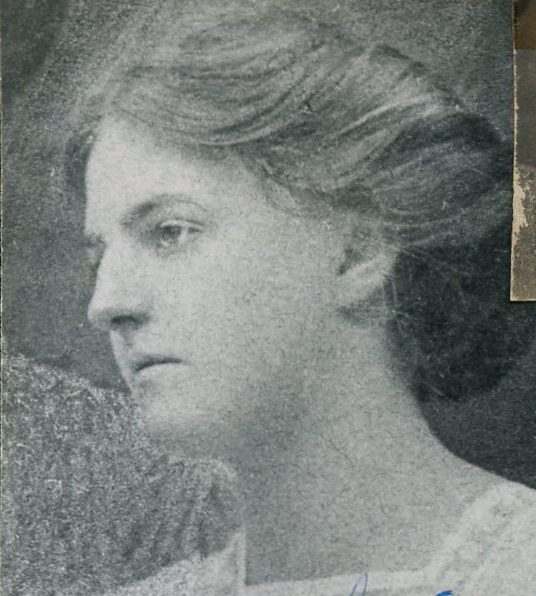
Isabel Cooper Mahaffie died in January 1984 at 93 years. She had, at the time, 7 grandchildren and four great grandchildren. (She now has seventeen great grandchildren and two great great grandchildren.) Many of her seven grandchildren spent time with her and remember her wit, intelligence, stories, and style. A grand niece likewise remembers her well, having made of Isabel a mentor as she came of age in the 1970s.
Only a few of us still remember her vividly. But for all of her descendants, she is an iconic figure, with stories, paintings, shared memories, and images worthy of becoming, for some, tattooed body art.
We owe her thanks for urging all of us on to our enthusiasms, to take on life, to adventure, to go places. Her legacy in all that is powerful and will continue.
Isabel’s scientific art was so distinctive that at least one of her grandchildren and four of her great grandchildren have versions of it in tattoos. I think she would find this delightful and hysterical.
A great granddaughter’s tattoo honors Isabel Cooper’s art (2023)5)Photo courtesy of Skye Mahaffie
For a complete list of posts on this site about Isabel Cooper, see the series here.
This entry is post 20 of 21 in the ongoing series Isabel Cooper
A three-part sub-series on the guest room that Isabel Cooper painted for Dorothy Putnam in 1925
In the late winter and into the spring of 1925, Isabel Cooper was committed to travel as a staff artist on naturalist William Beebe’s Arcturus Expedition. (Stories from that expedition are earlier in the series on Isabel Cooper on this website. See: here, for more.)
Isabel’s friend Dorothy Putnam joined for part of the Arcturus Expedition as it reached the Panama Canal Zone. The two had time together at leisure when the Arcturus readied for its onward in the Canal Zone. Dorothy had already gotten Isabel to agree to paint a Jungle Room in her new house.
It is likely that in their time together on the expedition, they further discussed the Jungle Room. The passage below creates what a conversation like that could have been like.
__________
Cristóbal, Panama Canal Zone, March 27, 1925
Isabel and Dorothy spent the day out in Cristóbal, in the Canal Zone, sightseeing, doing a little shopping, and laughing.
Footsore from their meanderings, by mid-afternoon, they dropped at last into canvas chairs on the terrace of the Hotel Washington. The afternoon was hot, but the trade winds kept off the worst of it. They ordered cocktails.
They had shopped on the plaza, and talked of whether they’d get George and Charles each a Panama hat. They worked over the logistics of getting the hats home in tact. Now they sat, relaxed, facing Limón Bay, under the shade of a large umbrella.
“Is that our ship, down there?” Dorothy asked pointing toward the harbor. She had just arrived the day before to join the expedition, and had yet to board the expedition ship.
The Arcturus was moored on the bay, below them. A large white steam yacht, it stood out amongst the smaller vessels and US Navy gray ships in the harbor.
“That’s her, home sweet home,” Isabel said, her laugh suggesting mixed views of shipboard life.
The Arcturus was a good ship, well-fitted for the scientific work. Isabel had worked aboard her for five weeks already, as they explored the Sargasso Sea in the middle Atlantic. But the vessel was overstuffed with gear and supplies.
“Wonderful!” Dorothy said. “I’m quite mad about this trip. I’m glad for a break from Rye. I know I’ll so enjoy the work and of course, spending this time with you.”
Isabel smiled and said, “Well I’m delighted to have you with me. We will have a marvelous time.”
The waiter brought them two sweating tumblers. Lime squashes, with vodka for Dorothy, and rum for Isabel. They raised their glasses and grinned at each other. They sipped the drinks.
“Well this is perfect. You and I having a chance to catch up before we all get down to work,” Dorothy said.
“Yes, things get feverish when we are in the thick of the work. The Director has too many ideas.”
Dorothy snorted a laugh.
They both knew William Beebe, the expedition director, well. He was kind, mercurial, generous, demanding, supportive, and exasperating, all rolled up together. It helped to joke about him. Calling him The Director, was part of the ongoing mockery of his staff. Dorothy knew him socially and through Isabel’s tales of his ways during their years of working together in the tropics.
“Enough about that silly man. I want to talk about my Jungle Room,” Dorothy said, her blue eyes twinkling. There was mischief in her smile.
“I want you to put a great big snake in it.”
“A snake?” Isabel said. “What sort of snake?”
She had thought out her design for the Jungle Room, and made a few sketches already. For Isabel, it should be a lush, colorful, immersive scene, palm fronds and flowers, dappled shade, maybe a few birds. The snake idea immediately made her think of Adam and Eve. A snake in paradise.
“Like that boa constrictor you and the ladies captured a few years ago. Oh, it will be delightful. An enormous boa,” Dorothy said, flinging her arms wide.
Isabel’s eyes narrowed. This didn’t fit the way she’d hoped to paint the room. A bit of a joke amidst the lovely scene she could create.
“Oh, I’m not sure that will work so well,” she said.
“Silly, of course it will. It will delight our guests. We’ll call her Eleanor. She should be ever so big.” She spread her arms wide, again.
“Eleanor the boa constrictor,” Isabel said. There was no stopping Dorothy when she set her mind on something. And it was Dorothy’s house, of course.
Isabel had an inkling this was a way Dorothy was getting one over on George, too. The two tussled over lots of things, with Dorothy seeing that she didn’t yield to all of George’s decisions over their lives.
“Oh, of course dear, you shall have your boa constrictor,” she said.
She didn’t mind getting one over on George herself. She was fond of George. George deserved some of the credit for her meeting Charles. But George was a bit full of himself.
As if reading her thoughts, Dorothy said, “It’ll poke George too, he’s so stuffy sometimes.”
By the time she wrote Charles that night, her enthusiasm for the Jungle Room, snake and all, had returned. Up late writing to him, as was her habit, she told Charles:1)IC to CDM, February 27, 1925I am looking forward to the jolly month I shall spend painting up Dorothy’s house, the unsuspecting bit of space that doesn’t know that it is going to have four walls around it, much less a lot of wild looking forest trees painted on the walls. It will be a lark. She’d figure out the snake part along the way. Eleanor, of all names, to give it!
__________
Isabel’s art had a certain spark and personality
Painting the giant boa, Eleanor, for Dorothy’s jungle room, probably didn’t fit Isabel’s vision or her sensibilities about interior decoration. She seem to see room decoration in the way she saw her animal art. But it also was no difficulty for her to do.
If you look at the animal paintings made by Isabel, even those done for entirely scientific purposes, you recognize that her creatures have a personalities. Her job was supposed to be much more clinical: to capture species-specific markings for classification and expedition record-keeping. She transcended that, while doing such a superb job at it that she quickly became essential to William Beebe’s efforts to study tropical seas and jungles.
An illustration she made of frigate birds in the Cocos and Galapagos Islands, illustrate this.
Frigate birds, painted by Isabel Cooper, Cocos Islands, 1925. Each one has a distinct personality
But she had it in her repertoire to give the Jungle Room its key inhabitant. She would add the boa that Dorothy wanted.
The Jungle Room comes into being
In mid-summer of 1925, after she returned from the Arcturus Expedition, Isabel got to work on the Jungle Room. It would have its resident snake, too. Isabel, trained in interior decoration, didn’t necessarily think of it room design as including the charming animals she sometimes painted with their distinct personalities.
She wrote Charles on July 8th,2)IC to CDM, July 8, 1925 “I am starting the mural horror shortly, as I can be sure I won’t have chills at [Dorothy’s] house.” She did not want to be a house guest and companion to Dorothy in the throes of malarial fever, which she had suffered off and on since her first year in the tropics.
Isabel was still in Rye, working on the mural, in mid-August “trying to finish the blooming wall.”3)IC to CDM, August 16, 1925. At some point, Charles made a visit and had a look. Though he was a law-trained bureaucrat, a regulator of railroad finance, and about as far from the arts and design as a man could be, he apparently weighed in on the design and gave pointers.
At the end of August, she wrote Charles:
The forest is coming along. I have fixed the horrid place which you objected to. Also the leggy looking flowers. But Dorothy has requested a little livestock, so I have caused a large boa-constrictor named Eleanor to appear among the ferns well back of the bed, so no one need ever see her. I think it is inartistic and rather dangerous, but Dorothy loves it, for its rarity. I suppose, or devilishness….4)IC to CDM, August 27, 1925
Dorothy’s “livestock” was the boa constrictor she was to call Eleanor. Isabel was reluctant to add the snake to her fully-imagined design, but didn’t want to disappoint her friend.
Isabel had comprehensive experience painting snakes. For more on that, visit here.
We can imagine that day when Dorothy came in to see the work:
“Absolutely stunning,” Dorothy said, gazing all around, her bright, warm smile taking it all in. “Oh but where’s my snake?”
“Just here,” Isabel would have said, sheepishly pointing to the space along the baseboards, behind the headboard.
“Touche!” Dorothy surely said, “I’ve got my snake, but you’ve had your way too, you clever girl!”
Imagining what the Jungle Room looked like
No pictures that I know of survive of Isabel’s Jungle Room. Several magazine and pictorial features described the room over the years.
Coincidentally, on the same day that Charles and Isabel traveled to Rye to be introduced by their mutual friends, George and Dorothy Putnam, the Midweek Pictorial (of the New York Times) published a story on the Putnam’s Rye home:5)Midweek Pictorial, December 24, 1924, p. 14.
The Jungle Room’s: walls picture a vivid jungle scene, with trailing vines and plants and flowers and gay-colored birds perched here and there and a huge python winding about the base board, partially hidden, fortunately, for ‘screamish’ guests, by the bed. The snake’s name is Eleanor, by the way…6)Midweek Pictorial, December 24, 1924, p. 14.
Isabel, in her time in the tropics, made watercolors of tropical foliage, and entwined roots, among other motifs. Her three-panel screen, submitted to the Architectural League of New York 1926 Exhibition, suggests what her jungle details might have looked like. A photo of it is below.
A three-panel screen design by Isabel Cooper, 19267)Year Book of the Architectural League of New York, and Catalogue of the Annual Exhibition. United States, Secretary of the Architectural league of New York, 1926.
Isabel also took photographs from time to time, perhaps to remember a scene to paint later. The photo below is in her scrap book pages relating to her time in British Guiana. It probably inspired her 1926 Architectural League entry labeled “jungle roots”. It could also have inspired her design for the Jungle Room.
Photo by Isabel Cooper from the jungles of British Guiana, circa early 1920s. From Cooper’s scrapbook pages about her time there.
Another profile of the Putnam home in Better Homes & Gardens, in 1937, said:8)Elizabeth MacRae Boykin, “Amelia Earhart at Home,” Better Homes & Gardens, February 1937, pp. 239–40.
Visitors to the house were often shown the Jungle Room, where lushly painted scenes of plants, birds, and flowers seemed to hum—not with actual birdsong but with the idea of birdsong, as if even the discreetly included python named Eleanor, coiled gracefully among the painted foliage, might lift her head and, in a moment of grace, whistle a tune.
As noted, the “python” this and several other articles described, was in fact a boa constrictor. British Guiana, now Guyana, has no pythons, which are native to Asia and Africa.
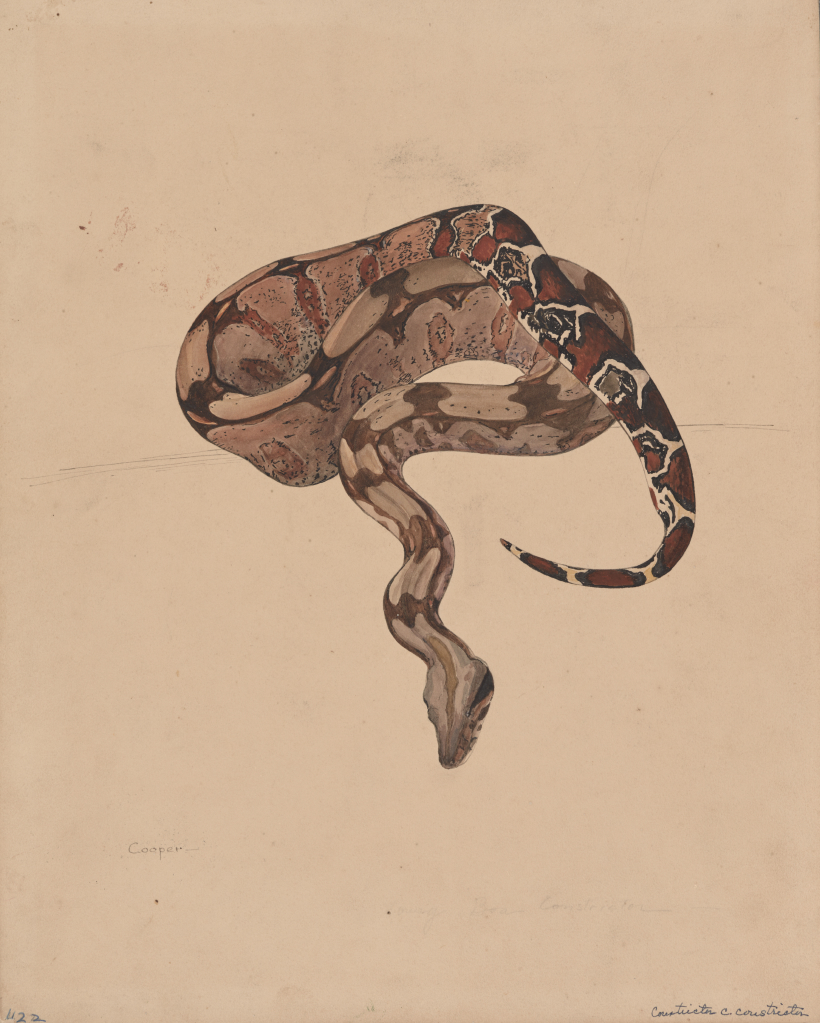
While we have no pictures of Eleanor and don’t know which species of boa she was, Isabel captured several varieties in her work with the Department of Tropical Research expeditions to British Guiana (now Guyana) in the 1920s.
To read a bit more about Isabel and snakes, visit this page. Below are some of her paintings of boas from her work with the New York Zoological Society’s Department of Tropical Research in the 1910s and 1920s. Her art and that of other department artists are in the digital archive of the Wildlife Conservation Society, and are available here.
Spotted boa, painted by Isabel Cooper9)New York Zoological Society, Department of Tropical Research. British Guiana (now Guyana), March 5, 1921. Digitized by the Wildlife Conservation Society, available at https://wcs.access.preservica.com/archive.Small boa constrictor, painted by Isabel Cooper10)New York Zoological Society, Department of Tropical Research. British Guiana (now Guyana), July 15, 1922. Digitized by the Wildlife Conservation Society, available at https://wcs.access.preservica.com/archive.
But painting a fanciful jungle room may have given Isabel permission to make a fanciful snake, and thus it could be a composite of the snakes she knew from her work.
Two birds and a pair of fish
Other creatures lived in Isabel’s jungle. There were two grey birds, and the Jungle Room had a couple of fish. The fish were named Finn and Haddie.11)“Mrs. W. H. Burghardt Receives Description of Putnam Home at Rye, New York,” Statesman Journal (Salem, Oregon), January 24, 1926 Since the big snake had a name, Dorothy probably decided to also offer names to the interviewer for the two fish. Finn and Haddie was an easy-reach option.
Finnan Haddie was a traditional cold-smoked haddock, sold in fish shops. Cartoons and humor of the time also used Finn and Haddie as names for a humorous pair of characters.
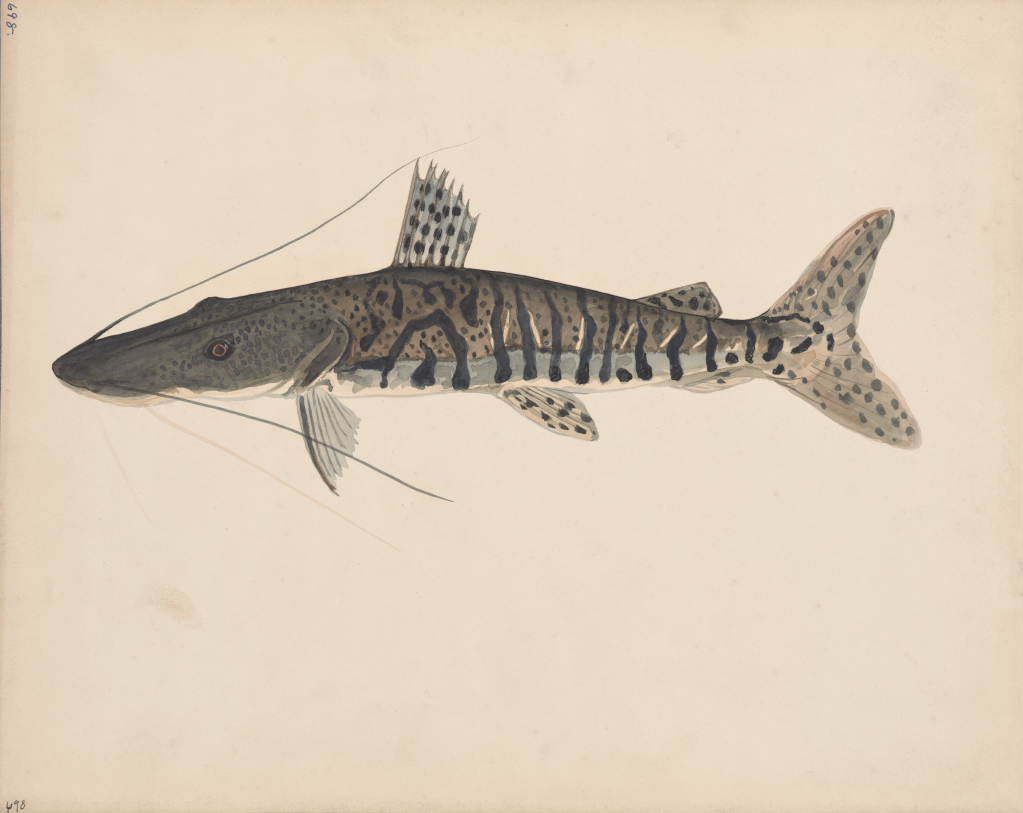
Isabel painted hundreds of fish for her work with the New York Zoological Society’s Department of Tropical Research. Some examples are below.
Pseudoplatystoma fasciatus, painted by Isabel Cooper12)New York Zoological Society, Department of Tropical Research. British Guiana (now Guyana), March 16, 1924. Digitized by the Wildlife Conservation Society, available at https://wcs.access.preservica.com/archive.Cichla ocellaris, painted by Isabel Cooper13)New York Zoological Society, Department of Tropical Research. British Guiana (now Guyana), April 26, 1924. Digitized by the Wildlife Conservation Society, available at https://wcs.access.preservica.com/archive.
For a further sense of what the Jungle Room might have been like, we also have the example of Don Blanding’s Undersea Room. It was the other themed guest room at the Putnam house. It shows the full, four-wall, and at least in the case of Blanding’s room, ceiling treatment.
The undersea room at the Putnam house, painted by Don Blanding. This suggests how Isabel approached painting her Jungle Room. No pictures of the Jungle Room appear to still exist.14)Elizabeth MacRae Boykin, “Amelia Earhart at Home,” Better Homes & Gardens, February 1937, pp. 239–40.
For a little more on Blanding and the undersea room, visit here.
Part Three rounds out this series with a look at what became of the Jungle Room and the legacy for Isabel and the rest of us.
Year Book of the Architectural League of New York, and Catalogue of the Annual Exhibition. United States, Secretary of the Architectural league of New York, 1926.
New York Zoological Society, Department of Tropical Research. British Guiana (now Guyana), March 5, 1921. Digitized by the Wildlife Conservation Society, available at https://wcs.access.preservica.com/archive.
New York Zoological Society, Department of Tropical Research. British Guiana (now Guyana), July 15, 1922. Digitized by the Wildlife Conservation Society, available at https://wcs.access.preservica.com/archive.
New York Zoological Society, Department of Tropical Research. British Guiana (now Guyana), March 16, 1924. Digitized by the Wildlife Conservation Society, available at https://wcs.access.preservica.com/archive.
New York Zoological Society, Department of Tropical Research. British Guiana (now Guyana), April 26, 1924. Digitized by the Wildlife Conservation Society, available at https://wcs.access.preservica.com/archive.
As my family and I prepare to do our annual honey harvest, the care we take to preserve both bees and beeswax comb stand out in contrast to what used to be. The long-standing use of basket skep hives, for example, meant each year, the colony established in one faced a crush and strain process for wax recovery. And it could be worse than that.
Joseph Warder, in his 1716 treatise on bees, shared a method for harvesting honey and wax. He acknowledge it was destructive, so he suggested only using the method with the weaker hives.
When you have poiz’d them all, and marked which of them you resolve to take, then proceed after this Manner. Have in Readiness some split Sticks about 6 Inches long, and some Rags dipt in Brimstone*, and put in each of these split Sticks, then dig as many Holes in the Ground near your Bees, as you design to take Hives, then in the Evening stick in each Hole one of your Matches, and lighting one at a time, fetch the Hive and set over it, immediately with some of the Earth top the Hive all round to keep in the Smoak, and keep in the Bees, they will be all dead in half a quarter of an Hour; so giving the Hive two or three Knocks with your Hand to shake down the Bees that hang about the Combs. Take it into your House for your use.1)Joseph Warder, The true Amazons : or, The monarchy of bees : being a new discovery and improvement of those wonderful creatures … : also how to make the English wine or mead, equal, if not superior to the best of other wines, London: J. Pemberton and W. Taylor, 1716, p. 76.
*brimstone is sulfur
In the context of a farm family, deciding to make mead, and needing to take honey from the bees to do it, Warder wrote the above. 2)Joseph Warder, The true Amazons : or, The monarchy of bees : being a new discovery and improvement of those wonderful creatures … : also how to make the English wine or mead, equal, if not superior to the best of other wines, London: J. Pemberton and W. Taylor, 1716, p. 24.
It was the destructiveness of this and other methods of harvest that led innovators, including Reverend Langstroth, to promote movable combs and honey supers. The use of basket skeps and other one-use technologies, went deservedly into decline.
Joseph Warder, The true Amazons : or, The monarchy of bees : being a new discovery and improvement of those wonderful creatures … : also how to make the English wine or mead, equal, if not superior to the best of other wines, London: J. Pemberton and W. Taylor, 1716, p. 76.
Joseph Warder, The true Amazons : or, The monarchy of bees : being a new discovery and improvement of those wonderful creatures … : also how to make the English wine or mead, equal, if not superior to the best of other wines, London: J. Pemberton and W. Taylor, 1716, p. 24.
With no judgment on how you and yours may be planning to spend this Independence Day, I share the following, a story of drunken bees and Prohibition.
If bees gather juices from over-ripe fruit or the fermenting mash of moonshiners, they may fly impaired.
A few times during Prohibition, this led revenuers straight to the moonshiners’ stills. Recognizing this, in 1930, a police department in Wichita, Kansas, added a bee colony to its law enforcement equipment. The stories here are too brief to say whether the detectives mastered some reverse form of beelining to find the stills.
The Times-Union (Rochester, NY), May 23, 1930.
Newspapers had fun with this tale, and it was reported as far away as Tasmania, Australia (where there was no prohibition).
The Advocate (Burnie, Tasmania, Australia), August 16, 1930
This entry is post 19 of 21 in the ongoing series Isabel Cooper
A three-part sub-series on the guest room that Isabel Cooper painted for Dorothy Putnam in 1925
Isabel Cooper in the late 1920s
Locust Avenue, Rye, New York, November 2, 1925
Isabel read late into the night in the silent house. Dorothy and George Putnam’s home in Rye was her refuge from the racket and bustle of Manhattan. It was a fine weekend, and she hadn’t had any bouts of fever, the lingering effects of the malaria she’d contracted in British Guiana. Those could strike at will, ruining an evening out or a weekend plan.
She picked up her book. Charles, who she hoped to marry, had urged her to read H. G. Wells’ new novel, Christina Alberta’s Father, so she had packed it with half a dozen other books for her sojourn on Locust Avenue in Rye.
A sketch Isabel made for Charles of the main living room at the Putnam Rye house, from Christmas 1926
This time, she hadn’t come up to Rye for a weekend of socializing with the Putnams and all their their visitors and friends. And she hadn’t come to relax with her best friend Dorothy.
Dorothy and George were away. George was traveling somewhere on business, and Dorothy was off, according to her note, on a “spree”. And the servants had the night off. So Isabel offered to look after Junie, Dorothy and George’s 4-and-a-half-year-old son.
Junie, was, Isabel told Charles, a delectable, though perfectly naughty little boy. But he hadn’t given her any trouble that afternoon. She’d read a story to him and put him to bed. She had time then to play the Putnam’s Steinway, with no listeners to inhibit her.
Now she sat in the Morris chair by the mica-shaded reading lamp in the Jungle Room, the guest room she had custom decorated for Dorothy. She put on only the single lamp, so she could ignore Eleanor, the boa constrictor, whom she had painted on the wall at Dorothy’s insistence.
Eleanor hadn’t fit her vision for the room, but Dorothy was a persuasive friend, probably the most persuasive woman she knew. Isabel painted the boa low on the wall behind the headboard of the guest bed, so that visitors wouldn’t have to contemplate her too much.
Her reading lamp quieted Eleanor and dimmed to shadowy background the the fronds and roots and birds and frogs that decorated the room.
She read late into the evening, as was her habit. Eleanor, the boa, stayed hidden from view behind the bed, twined along the baseboards.
About Isabel Ruth Cooper
Isabel Ruth Cooper (1892–1984, later Isabel Cooper Mahaffie), was this author’s grandmother. She was an professional artist who, later in her life, retired from paid work to paint landscapes and still lifes. [Yes, the plural of still life is still lifes.]
As a young, single woman, she’d made a lucrative career in art. That paid work came to include mural painting and decoration, in addition to the scientific illustration she became noted for.
A recent blog post here explored Isabel’s work as a mural painter in the studio of the muralist Ezra Winter.
But Isabel had an earlier history of work in design and interior decoration, and before she did mural painting professionally, she painted at least one room-sized mural, the Putnam’s Jungle Room. That mural featured an enormous boa constrictor named Eleanor.
The tale of Eleanor the Boa, while it seems but a fun side journey for Isabel, brings new threads of her story as an artist together.
Isabel spent a year at Bryn Mawr College outside Philadelphia when she was seventeen. Her guardian Aunt Mary P. Cooper paid the tuition and expenses, and may well have chosen the college. Isabel enjoyed Bryn Mawr, but was not cut out for, at least at that young age, an academic life.
Isabel at 17, in 1909. She entered Bryn Mawr College that Fall
Any of us who knew her would have trouble putting “coed” and “Isabel Cooper” in the same sentence. The school work didn’t catch her interest. And, as she told a later interviewer, instead of buckling down in her studies, she was “eternally sketching.”1)John Monk Saunders, “Jungle Creatures ‘Sit’ for Her in Their Own Back Yards,” American Illustrated Magazine. United States, Crowell-Collier Publishing Company, February 1926.
Isabel left Bryn Mawr at the end of her freshman year. She returned to New York City. It became clear that art was calling her.
In New York, Isabel turned to advancing her art education on her terms, or as far as she could bend things with her supervising guardian Aunt Mary. (In November 1913, just after she turned 21, Isabel secured her legal emancipation from her Aunt Mary’s guardianship. That story is here.)
Isabel would go forth on her own terms from then on. She was interested in everything from fine art painting to myriad more practical and applied arts. Isabel told an interviewer that she “took every art course offered.”2)John Monk Saunders, “Jungle Creatures ‘Sit’ for Her in Their Own Back Yards,” American Illustrated Magazine. United States, Crowell-Collier Publishing Company, February 1926.
She studied at the Art Students League in New York City, and took classes at Columbia Teacher’s College from 1910 to 1913. Columbia directories and Bryn Mawr alumni listings show her at Columbia Teachers College studying house decoration and fine arts, and also practical arts. She also took architecture classes and seems to have been keenly interested in that subject.
She gravitated toward design and decoration, and began to work in interior design by the late 1910s, perhaps as a surer way to make a living. A 1913 Bryn Mawr College listing notes her as “Student, Department of House Decoration and Fine Arts, Teachers’ College, New York City, 1910–12;” but also as working as an “Interior and House Decorator, 1912–13.3)Bryn Mawr College Calendar, 1913. Bryn Mawr, Pennsylvania: Bryn Mawr College, 1913. p. 190. This makes it clear she was working as well as attending classes. She was paying her own way in life, and needed income.
Making a profession of art and decoration
Paid and unpaid, Isabel tried all different arts: drawing from life, rug and tapestry design, clay sculpture, pottery, metalwork, interior decoration, and stage costumes.4)John Monk Saunders, “Jungle Creatures ‘Sit’ for Her in Their Own Back Yards,” American Magazine, February 1926, Vol. 101, p. 26.
She was good at interior design. It’s likely she worked in the early 1910s for Anton Hellmann, who had a interior decoration practice and school at the Benedict Studios on Washington Square in New York City.5)The Upholsterer, June 1916, Vol. 55, p. 83. She gave the Benedict Studios as her mailing address for several years.
By 1917, Isabel was pursuing work as a scientific artist and in interior decoration at the same time. Because the scientific illustration took place during the dry season, and when she was in the tropics, she then toggled to interior design and other artistic work when she was back in New York City. And the two art forms fueled and inspired each other.
Isabel was explicit about how she drew on nature to inspire her art. Submissions she made to the Architectural League of New York’s 1926 exhibition show her blending in natural themes and details:6)Year Book of the Architectural League of New York, and Catalogue of the Annual Exhibition. United States, Secretary of the Architectural league of New York, 1926.
Isabel Cooper’s entries in the 1926 Architectural League Exhibition7)Year Book of the Architectural League of New York, and Catalogue of the Annual Exhibition, Index of Exhibits, United States, Secretary of the Architectural league of New York, 1926.
Moving away from decoration
But Isabel had mixed feelings about decoration. She found interior decorating too commercially demanding.8)John Monk Saunders, “Jungle Creatures ‘Sit’ for Her in Their Own Back Yards,” American Magazine, February 1926, Vol. 101, p. 26. She found additional illustration work and also wrote magazine articles for further income.
Part Two is about how the jungle-themed room she painted for Dorothy Putnam came about and what it might have looked like
John Monk Saunders, “Jungle Creatures ‘Sit’ for Her in Their Own Back Yards,” American Illustrated Magazine. United States, Crowell-Collier Publishing Company, February 1926.
Year Book of the Architectural League of New York, and Catalogue of the Annual Exhibition. United States, Secretary of the Architectural league of New York, 1926.
Year Book of the Architectural League of New York, and Catalogue of the Annual Exhibition, Index of Exhibits, United States, Secretary of the Architectural league of New York, 1926.
I wonder if there are any steampunk1)https://en.wikipedia.org/wiki/Steampunk beekeepers out there. They would favor late 18th century tools like those described here.
When other farm and light industrial tasks harnessed steam power, so did beekeeping. There were steam wax extractors and steam uncapping knives, among other devices, in the late 1800s.
A steam-powered wax extractor2)Advertisement from Thomas G. Newman & Son, Chicago, Illinois, American Bee Journal, May 17, 1890, Vol. XXVI, No. 20, p. 337.
A steam-heated uncapping knife from the early 1900s3)Everett Franklin Phillips, Beekeeping : a discussion of the life of the honeybee, 1908
The Industrial Revolution eventually reached beekeeping. In the 19th century, as agriculture and production mechanized, and saw the arrival of all sorts of innovations, so did beekeeping.
It was not just Reverend Langstroth’s patented hive – which beekeepers still use – that emerged. And as with today’s trade in beekeeping innovations, some had merit, perhaps many did not. The critic quoted below made perhaps wise points about the phenomenon in general, whether or not he was right about the specific example he pilloried, Bevan’s Cross Bar Hive.
Thomas Miner wrote in 1849:
During the last twenty years, many new and useless bee-hives have been palmed off on the ignorant and too confiding bee-keepers of our country. Men who have had sufficient brains to devise some new plan and style of hive that did not before exist — who never understood a single principle of the management of bees correctly, have, by dint of unblushing falsehood and impudence, bled the bee-keeping community pretty freely. There seems to be a greater cloud of darkness hanging over the management of bees, than over any other branch of rural economy.1)Thomas B. Miner, The American bee keeper’s manual: being a practical treatise on the history and domestic economy of the honey-bee, embracing a full illustration of the whole subject, with the most approved methods of managing this insect through every branch of its culture, the result of many years’ experience, New York: C. M. Saxton, 1849, p. 117.
One of many inventions Miner denounced: Bevan’s cross bar design of which he wrote: “This is all very well, provided the bees will follow these bars; but they will not.”2)Thomas B. Miner, The American bee keeper’s manual : being a practical treatise on the history and domestic economy of the honey-bee, embracing a full illustration of the whole subject, with the most approved methods of managing this insect through every branch of its culture, the result of many years’ experience, New York: C. M. Saxton, 1849, p. 138.
Thomas Miner did not like Thomas Bevan’s top bars, and suggested not using such.
Every new-fangled ”patent” hive that is brought along, is represented as the ne plus ultra of improvement, and the very acme of perfection ; and the lesson that is so glibly recited by their vendors, of the wonderful and astonishing merits of their inventions, often causes one to become duped again and again, until he gives up in despair, and returns to his first love — the simple box and brimstone management of ages past. 3)Source: Thomas B. Miner, The American bee keeper’s manual : being a practical treatise on the history and domestic economy of the honey-bee, embracing a full illustration of the whole subject, with the most approved methods of managing this insect through every branch of its culture, the result of many years’ experience, New York: C. M. Saxton, 1849, pp. 117-8.
His view on the proliferation of beekeeping and hive gizmos, gadgets and purported improvements:
But a wise Providence has so ordered, that the bee requires merely the simplest tenement. Screens, ventilators, valves, &c., are but hindrances to their natural prosperity, and the thousand and one complicated inventions of the day are but so many deceptive tricks of the astute and keen, to filch our pockets of a few spare dollars.
Thomas B. Miner, The American bee keeper’s manual: being a practical treatise on the history and domestic economy of the honey-bee, embracing a full illustration of the whole subject, with the most approved methods of managing this insect through every branch of its culture, the result of many years’ experience, New York: C. M. Saxton, 1849, p. 117.
Thomas B. Miner, The American bee keeper’s manual : being a practical treatise on the history and domestic economy of the honey-bee, embracing a full illustration of the whole subject, with the most approved methods of managing this insect through every branch of its culture, the result of many years’ experience, New York: C. M. Saxton, 1849, p. 138.
Source: Thomas B. Miner, The American bee keeper’s manual : being a practical treatise on the history and domestic economy of the honey-bee, embracing a full illustration of the whole subject, with the most approved methods of managing this insect through every branch of its culture, the result of many years’ experience, New York: C. M. Saxton, 1849, pp. 117-8.