Shipboard work for a scientific artist

This entry is post 10 of 21 in the ongoing series Isabel Cooper

Isabel Cooper wrote a long article, “Fish Portraits,” on her work illustrating fish, hoping to get it published in Asia Magazine. It was not published. This post offers excerpts of that article, focusing on the work and working conditions, and leaving aside her colorful observations on the different kinds of fish she worked with. The full article manuscript is here: Fish Portraits by Isabel Cooper 1925 in a PDF.

What follow are Isabel’s words.

___________________

The ship as a workplace

Our ship was exceedingly sturdy and staunch, and broad-beamed, and well adapted to the requirements of an ocean laboratory.

On the upper deck of the laboratory-proper, neatly wedged between a chart table and the ship’s laboratory, was my ‘studio’. This may sound a bit cramped and crowded; studios are supposed to be reasonably spacious, with plenty of swinging-room for brushes, at least. But I assure you that the more tightly a floating studio is wedged, the [more] beneficial for the work and nerves of the artist! These boundaries fore and aft, together with the wall on the port side, made three directions in which I could not roll.

Isabel Cooper at work on ship_Arcturus Adventure

Image from William Beebe, The Arcturus Adventure. New York: G. P. Putnam & Sons, 1926

Possibly the most remarkable feature of my sea-going studio was the fact that it never remained quietly in one plane of space for longer than an instant….

By which mild and rather negative statement I really mean the gruesome fact that, in open ocean, the studio and its entire contents oscillated violently and almost continually through one, two, or three dimensions. This activity became really astounding at times. When the ship was merely slanting about, objects on my desk would develop the most interesting and intricate sorts of rhythm all their own. So you can see the necessity of keeping things as compact as possible. …

My immediate surroundings on the “Arcturus” were not bad at all, – if unusual. … To the starboard of my work-table was an open space which collected chairs and people, towards evening, and which was nightly rent asunder by the stress of arguments and discussions, – always the breath of life to me. And out of my wide, salt-splashed port there was continually to be seen the sea, – stormy Atlantic, or sparkling Caribbean, or slow, beautiful Pacific, with the comforting level of the horizon to furnish a refuge for my thoughts, at least, on tumultuous, busy days.

I had a great deal of trouble with my paints and inks and other rolling stock on board the ‘Arcturus. All these things would tend, in rough weather, to merge gradually into an indistinguishable mass, right before my eyes, – no matter how many new and fantastic tethering devices and halters and barricades I invented.

Imagine a desk which slants in almost any direction, or else revolves with a strange, shuddering corkscrew motion. And a working light which shines indiscriminately from east or west or north or south. And models who are mostly alive and swimming. And you will have a faint picture of my “Arcturus” studio. I am thinking especially of a wild morning in Mid-Atlantic, when I had definitely made up my mind that the elements were not to hinder me from finishing a special portrait. My desk had been long since hooked firmly to the deck. And I had worked out a complicated system of paddocks for microscopes, ink bottles, brushes, etc. My model was a very small and unprepossessing deep-sea fish, whose tiny aquarium was wired to the microscope slide. As far as I can remember my paints were safely sliding about in [a?] drawer. I was sticking to my chair in much the way that a rider sticks to a frisky horse, – a matter of knee pressure. But we struck a wave whose trough just fitted the wide sides of our ship. Which means that you roll as far as possible without actually turning over completely in the water. Whereupon I was projected across the room, several of my tools jumped the traces, a whole section of heavy scientific literature moved forward in a mass, and caught me amidship. A funny moment. I suppose the microscope must have looked like the Campanile in an earthquake, with a strange pale little fish spinning off through space like a lost soul.

I was obliged to study new phases and phenomena of gravitation which had never before troubled me. And not the least of these concerned the control of my subjects. In order to achieve sketches to suit the scientists’ purposes the fish had to pose alive. And they happen to be the most difficult models in the world. You cannot hold them still with any degree of comfort or success. They are nowhere near as easy to manage as my jungle models, the snakes and lizards and frogs of Demerara. Once you had a good firm grip on a snake’s neck the problem was solved. And some of the lizards and frogs would even sit still of their own accord and and look you angrily in the eye for minutes at a time.

Dealing with fish as subjects

There are just three ways to deal with fish. You can let them swim around in a glass tank, and regard them through the glass sides. Or you can have them flopping about in a pan of water. Or you can hold them up by the tail. If they swam, I considered myself lucky if they moved slowly and peaceably, allowing me a glimpse now and then of the pose which I wanted. But they were much more likely to whirl about in a panic, stirring up a terrific surf in the aquarium, and gulping great gulps of fear and dismay. Or they jumped right out of the water, and landed, slime and all, in the middle of my drawing or my face.

Arcturus Adventure IC plate vi yellow tailed surgeon fish
Yellow-tailed surgeon fish by Isabel Cooper. From The Arcturus Adventure

The most becoming pose a fish can take is in profile, – so that you may catch the full, charming contours of his deficient brain-case, the backward sloping forehead, and the definitely receding chin. But this profile view is almost impossible to get. They prefer to gaze at you head on, concentrating all the sadness and distrust of their bulging, jeweled eyes upon you through the glass, and biting feebly at nothingness, with their strange skeleton mouths.

A fish model who is reclining upon his side in a pan of water is far from satisfactory. He either flops appallingly, or else dies, which is just what must be carefully avoided. When you find yourself with a really adaptable and congenial fish you may be sure it is dead! I arrived long ago at the point where I was willing to hold a fish up by the tail, through they are damp, slippery handfuls at best. But it is not often that I have been able to keep a firm hold upon a living fish. They have the most slithering of contours, as well as a violent power in their flat tapering muscles, against which the strength of the most capable human hand would not function.

The element of speed enters into almost all my work from living creatures. There is always some very good reason why the sketches must be completed as soon as possible. This enforced absorption in my work is an excellent thing, particularly at sea, where it serves to keep my mind off some rather pessimistic reflections upon the activity of the ocean itself, and the very comparative pleasure of working on ships.

The pleasure of the scientific artistic work

Parti-colored bumpheads by Isabel Cooper. From The Arcturus Adventure

I wonder whether I will be understood when I remark that the satisfaction of turning out accurate drawings of these diverse and beautiful creatures of the sea was only enhanced by the rather exceptional difficulties involved. This is quite true. There was an extraordinary pleasure in bringing the precision of fine pen and brush work to the many problems presented by silver scales, and transparent fish finds, and weird iridescence of sculptured fish faces. And all this amid wind and rain and tossing salt spray, in a tiny studio that swung and eddied through space, entirely without benefit of gyroscope!

Art for work, art for play

Isabel was ever the artist, so even when she was not doing her work, she drew and painted. She wrote about this to Charles:

“Island of Indefatigable, alias ‘Santa Cruz’.

My procedure in this harbor is to go ashore early and mess around with feeble landscape sketching ’till it gets too hot even for my sun-helmet, then return to the ship and work all day, except when I play hooky and read or talk or just keep cool in a bathing suit.”i

i Letter, IC to CDM, from Indefatigable, April 10, 1925.

“The diving helmet, a most enormous lark”

This entry is post 8 of 21 in the ongoing series Isabel Cooper
Beebe in diving helmet_Arcturus Adventure
Image: The Arcturus Expedition

William Beebe was keen on close observation of nature, an approach he began with the study of birds, and intensified in the jungles of British Guiana, where he’d map out a small patch of jungle so as to examine and catalog everything he found in it. He had the habit of laying on his stomach on the ground or on a rock to see the tiny details of plant, animal, and insect life most people wouldn’t notice or care to understand. Scuba hadn’t been invented, and other than glass-bottomed boats, and crude scopes for peering just below the surface, the diving helmet was the best way to bring that kind of observation under the water.

He commissioned several helmets for the 1925 Arcturus Expedition. Beebe wrote at length about his dives. But here we focus on the perspective of expedition artist Isabel Cooper, for her unique artist’s perspective, so below is mainly her reporting.

Isabel Cooper, expedition scientific artist, described for Charles Mahaffie the singular experience of going down in the diving helmet:

“I should like to hear what you would have to say about my latest amusement, I have been down in the diving helmet, a most enormous lark to my way of thinking, though I was pretty scared the first time. It is a nasty feeling, having the heavy contraption put over your head and weighted all around with about 60 lb. of lead. Then you begin to sink, while a trusty friend on the bank above pumps air and the water level rises slowly on the glass facade of the thing. You get an unpleasant thickish feeling in your ears, as if you were going through a bad tunnel. Also, the air keeps bubbling out around your shoulders. You can’t have the thing sealed on, because the most important detail is ducking quickly out when you see a shark and swimming to the surface. Sounds bright, doesn’t it. There doesn’t seem to be much of anything to prevent the sharks from coming around, except that they haven’t yet, and a good safe precedent is being built up.

“You feel as foolish as anything under water. After you’ve been down a bit your feet become very light, and you can’t keep them down. They simply waft about in an aimless way, as do the arms of Greek dancers. Also, everything gets distorted. Rock ten feet away looks as if you could touch it. You make a lunge toward it and find yourself flapping around like a jellyfish with an extremely swelled head.

“I went down first in a beautiful deep rock pool. Very outlandish. It gave me the creeps. Dorothy [Putnam] pumped the air for me. Everything looked spooky. Green and marvelously clear, with droves of fish sliding past. The silence is the most uncanny part. Also [the] fact that you can’t realize wetness. Funny-when your face is dry and you are out of touch with air you don’t seem to be able to feel water. Perhaps this is because the warm tropical water is just body temperature. But it seems merely like some strange dull flowing element, with broken light rays all through it, and a sort of molten silver mirror for its upper surface.

“Second time I went down they were trying to get moving pictures and kept poking me to signal about my next footstep etc. Also they got an idea that if they eased up on the pump there would be fewer distorting bubbles, whereupon the water in the helmet rose over my nose. Rather disturbing for a bit. Made me glad I had the end of the lifeline handy.

“…Dorothy went down. Don’t think she liked the idea at all, but of course she was a sport, as usual, and did it anyway. The pumping is a real job. You begin to realize just what concentration is. If you get absent-minded for a few seconds, the diver chokes.i

IC diving helmet Brooklyn Daily Eagle 101825
Fanciful view of Isabel in a diving suit, Brooklyn Daily Eagle, October 18, 1925

And in a newspaper profile, Isabel wrote:

“I wonder what a fish would think of us, if he could think, and could be fitted out with an invention that would keep his own beloved element flowing comfortably through his gills, and could manage somehow to flop about among our trees and meadows and hills. I wonder whether he would consider our natural backgrounds artistic, if slightly antique, and our expressions unnecessarily cheerful, and our motions unaccountably jerky and sudden, considering how much less pressure we have to contend with in the space about us. He would probably be most interested in the racket we make. A fish is one of the few creatures in the world who do not feel obliged to express themselves with any kind of noise.ii

William Beebe too reflected, at length, on the fresh, humbling perspective he got using the helmet several times: “If I were asked to prescribe for the worst case of sophisticated world weariness imaginable, I would without hesitation write ‘One diving helmet.'”iii

i Letter, IC to CDM, April 18, 1925.

ii Isabel Cooper, “Artist at Large,” Atlantic Monthly, July 1926, p. 93.

iii “Love, or Life of Adventure?,” Springfield Sunday Union and Republican,” February 21, 1926.

Isabel Cooper’s Arcturus Expedition colleagues

This entry is post 7 of 21 in the ongoing series Isabel Cooper

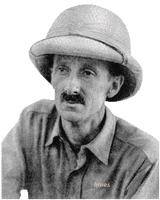
BeebeNaturalist William Beebe assembled a rich mix of talents and personalities for the Arcturus Expedition. His staff showed a focus on the practicalities of a scientific expedition, with skills and scientific knowledge in place to explore and gather for a range of interests from microscopic plankton to deep ocean animals to sea birds. But in the mix too were a few distinctly interesting people who may have been along in part because he knew them as gregarious, fun, and adventurous.

The expedition staff numbered about eighteen. There were scientists, artists, a cinematographer, a historian, and several men brought along because they could build, fix and catch things. Some of the scientists were guest professors from universities, and others were from the New York Zoological Society staff.

Two staff were avid pirate enthusiasts. More on them [here]. Another became the president of the University of Miami. Two others later helped make make King Kong.

Here is the rundown, in places with an insight on their colleagues from William Beebe, expedition artist Isabel Cooper, or 12-year-old David Putnam.

John Tee VanJohn and Helen Tee Van

Beebe’s close assistant was John Tee Van of the New York Zoological Society. John had started working at the New York Zoological Society at age 14. He later became its general director.

Helen Tee Van, married to John, was one of the scientific artists. She was the daughter of Walter Damrosch, conductor of the New York Symphony. She and John were long friends of Isabel Cooper’s after her scientific work ended. Isabel wrote in 1928, that Helen was one of her dearest friends.i The Tee Vans had also been part of the earlier Department of Tropical Research expeditions with Cooper.

William Merriam

William Merriam is variously described on Beebe’s expeditions as “Chief Hunter” and “Field Technician.” In Galapagos: World’s End, about the earlier expedition to the Galapagos, Beebe calls him “Our hunter in chief…the most enthusiastic and ingenious worker who ever outwitted fish, flesh or fowl…ii

David Putnam, the teenager who traveled on part of the journey, wrote that “In the forward part of the ship there are two rooms fitted out as shops, one belonging to Bill Merriam, the general handy man, who always mends the nets, shapes a new dredge, puts another seat in one of the rowboats, makes a lobster pot, or fixes the motor boats.iii

Dwight FranklinDwight Franklin

Dwight Franklin, a trained artist, is noted as “Assistant in Fish Preparation,” modeling plaster casts of some of the specimens, and painting them in their natural colors. Dwight Franklin was a sculptor and model maker. David Putnam summed up Franklin’s Arcturus work: “Dwight makes wax moulds and plaster casts of fishes and preserves them, as well as making drawings and paintings.vi” [Image: Dwight Franklinv]

Elizabeth Trotter

Elizabeth Trotter, “Assistant in Fish Problems,” was also an expedition artist. She was from a wealthy Philadelphia family and Beebe acknowledged William Trotter, her father, as an expedition benefactor. Isabel wrote Charles about Elizabeth from Newport News before she got on the ship, “I have been very bright and have arranged to room with the nicest girl in the outfit, the Philadelphia ‘horse-woman,’ as the papers say, who has a nice look-neat, intelligent, and all that sort of thing.iv

dickermanrevDon Dickerman

Don Dickerman was an artist, entrepreneur and a noted personality in the Greenwich Village community of the late 1910s and 1920s. Dickerman continued a long career after the journey as an entrepreneur, with pirate themed clubs in multiple U.S. cities.


Otis_Skinner_&_Ruth_Rose_in_PietroRuth Rose

Ruth Rose was a former stage actress. She served multiple roles for William Beebe, but chiefly was an recorder, historian and wrote about the journey for Beebe, authoring several chapters in his books. [Image: Ruth Rose with Otis Skinner in Pietro, Criterion Theater, 1920]


Ernest SchoedsackErnest Schoedsack

Ernest Schoedsack upgraded the Department of Tropical Research’s film capability to a full documentarian’s level, serving as cinematographer. The year after the journey, Ruth Rose and Schoedsack married, and she joined him in filmmaking, working as a screenwriter. He was an established documentarian, but went on to make King Kong (1933), Mighty Joe Young (1949), and other films. [Image: Ernest Schoedsackvii]


Jay Pearson 1925Jay F. W. Pearson

Jay F. W. Pearson was a 23-year-old ichthyologist who later was the second president of the University of Miami (1952-62). His expedition title was “Assistant in Microplankton”.

William K. Gregory

Dr. William K. Gregory was noted as “Associate in Vertebrates”. He was with the American Museum of Natural History in New York, and also taught at Columbia.

Gregory BatesonGregory Bateson

Gregory Bateson was British, a 20-year-old, freshly degreed in biology from Cambridge, who later was noted for his work in Anthropology, and studied by most undergraduate anthropology majors. [Image: Gregory Batesonviii]

Serge Chetyrkin

Serge Chetyrkin was an immigrant from Russia, who joined as the taxidermist and “preparateur”. Isabel wrote: “The old Russian…Eats no meat, eggs, milk or butter. Used to act like that last year in South America, but we thought it was just his little way of avoiding monkey stew.” The real reason, she noted, was that the expedition’s perishables were in an increasingly unreliable chiller.

Lillian Segal

Dr. Lillian Segal was a biological chemist. She was on the trip “for the specific purpose of studying the methods by which the light [of deep sea fish] was produced…”x. Her expedition job title was “Assistant in Special Problems.” [Image: Dr. Lillian Segal (L) with Mrs. C. J. Fish, inspect the fruits of a dredgingix]

Marie Poland Fish

On the staff list for the Arcturus expedition, Marie Poland Fish is listed as “Assistant in Larval Fish,” though her husband C. J. Fish was on the ship, she was a marine scientist in her own right.

C. J. Fish

Dr. Fish was “Associate in Diatoms and Crustacea,” on loan from the United States Bureau of Fisheries.

D. W. Cady

Cady was the expedition’s doctor, but participated also in the exploring and collecting. Isabel Cooper wrote that he let her help with some of the ministering to cuts and scrapes the staff got during their work.

DBPutnam St Lucie Co Hist SocDorothy Putnam

Dorothy B. Putnam, the wife of Beebe’s publicist George Palmer Putnam, and her 12-year-old son David, joined the expedition in Panama for its exploration of the Galapagos Islands, Cocos, and the Humboldt Current in the Pacific. They were noted as among a small number of “Guests of Honor” who joined for part of the journey. [Image: Dorothy Putnam]


David B. Putnam

David Putnam, was the son of Dorothy and George Palmer Putnam. His publisher father sent him on the journey in part so he could publish a children’s account by David, which was published soon after the trip as David Goes Voyaging. [Image: David B. Putnam from David Goes Voyaging]


i Letter IC to CDM, February 18, 1928.

ii William Beebe, Galapagos: World’s End, 1924.

iii David Binney Putnam, David Goes Voyaging, New York, G. P. Putman and Sons, 1925, p. 7.

iv Letter, IC to CDM, February 13, 1925.

v Image from askart.com

vi David Binney Putnam, David Goes Voyaging, New York, G. P. Putman and Sons, 1925, p. 7.

vii Image: Findagrave.com

viii Image: http://www.genmedhist.info/reports/bateson_album/3200.jpg/view 

ix Wild Things, Blog of the World Conservation Society, www.wcsarchivesblog.org

x The Literary Digest, Vol. 86, 1925


“I let too many girl pictures get by me”

This entry is post 5 of 21 in the ongoing series Isabel Cooper

Rising to a crescendo with the Arcturus Expedition in 1925, press stories spilled out about the women naturalist William Beebe had with him on his Department of Tropical Research expeditions. George Palmer Putnam, who headed the Putnam publishing company, led in driving publicity for Beebe, and he was good at it. He was married to a strong, independent woman himself, and later promoted, and then also married Amelia Earhart. Both men recognized the value and potential of women.

Beebe women staff 072124 B Daily Eagle
Brooklyn Daily Eagle, July 21, 1924

The wrong kind of publicity?

In early 1925, the publicity for Beebe may have gone too far, making his work look less than scientific. One researcher, Gary Kroll, interpreted exchanges between Beebe and Putnam as showing Beebe was upset, or at least that George Putnam thought so:

“The extent to which Beebe made [the Arcturus sensationalism] an issue is unclear. Beyond doubt, however, was Putnam’s almost paranoid perception of Beebe’s concern. As the Arcturus neared home, Putnam sent a telling letter to Beebe that describes to what lengths the two might have gone to preserve the professional representation of the expedition.”

‘You are tremendously nice in your attitude towards me in this whole matter and I appreciate it. I know perfectly well that often I blunder and do things which don’t altogether please you. But in the long run I think you are in reasonably good hands. In the first place, I grant that I let too many girl pictures get by me in that first batch and I know you didn’t like it. Anyway, henceforward the feminine element has been soft-pedaled satisfactorily. Perhaps we will smuggle say Dorothy and David and one girl ashore in the tug. If that does not prove practicable I think a stern order should go out from you, the commander, that the women are to be as little in evidence as possible at the landing. Certainly that none of them is to talk beyond the absolute necessities. The girls should say to the reporters ‘Dr. Beebe will give out all the information.’ And then poor Dr. Beebe, whether he wants to or not, will have to calmly take half an hour and sit down with the reporters and answer every damn question they want to ask. You may as well face the realization of that necessity. And then the young ladies can all disburse in their several directions and we will all be there to cooperate in soft pedaling them as much as can be. Not that there is anything reprehensible in it, but that from your standpoint is wisdom.’i

Gary Kroll took this letter at face value, but it looks more like Putnam was exaggerating, or having a bit of fun. Most signs in Beebe’s actions and further publicity and publishing show that he not only held high the accomplishments of his women’s staff, he celebrated them, with exhibitions of Cooper’s art, and chapters in his books by Ruth Rose. They did not sneak the women (and the boy, David Putnam) ashore.

i Gary Kroll, Exploration in the Mare Incognita: Natural History and Conservation in Early-Twentieth Century America, PhD. dissertation, University of Oklahoma, Norman Oklahoma, 2000, p. 212.

Grown men, scientific artists, pirates

This entry is post 3 of 21 in the ongoing series Isabel Cooper

dickermanrev

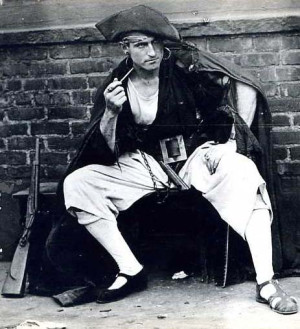
Don Dickerman in the late 1920s, dressed, as was his habit, as a pirate.i

Somehow in all her long letters to Charles Mahaffie, Isabel Cooper failed to mention the presence of not one, but two men on the Arcturus Expedition who were obsessed with pirates. Don Dickerman and Dwight Franklin were pirate-obsessed. And along for part of the journey was David Putnam, 12-year-old son of the publisher George Palmer Putnam. David joined the grown men in reveling in the world of pirates.

Dickerman was a painter and illustrator, and Franklin an expert at modeling and sculpting. They were surely valuable to Beebe’s work, and likely went as proper paid staff on the Arcturus, but from their histories, it seems either would have leapt aboard the Arcturus on the first word that the ship would visit Cocos Island, a famed Pacific Ocean treasure island.

Don Dickerman

Dickerman was an artist, but more so a Greenwich Village personality. He gained multiple wry mentions in the gossip pages of The Quill, which tracked and spoofed, and celebrated the characters of the Village in the late 1910s.

Dickerman attended Andover and Yale, and studied art in New York. He had tried toy designing and worked in illustrating children’s books. Doing poorly at those, he opened a tea room in Greenwich Village, mainly as a place to try to sell his hand-painted toys. It did well, and by 1917, he had turned it into a pirate-themed, make-believe lair called “The Pirates’ Den.ii

He joined the Arcturus Expedition as an artist, but seems to have distinguished himself there too as a personality and adventurer, celebrating David Putnam’s 13th birthday with a pirate-themed costume party and a special pirate song.

David wrote: “The night of the birthday party Don Dickerman wore his ‘Marooned man’ costume. It is entirely rags and tatters and mended with bits of old string and leather. With a wig of tangled hair all knotted and a bandanna and a cutlass he looks pretty awful. John Tee Van [an assistant to the project’s director William Beebe] had torn trousers, bare body, a frightful long black wig and he painted on a terrible scar across his face, and slashes of blood on his insteps. Some of the others had fine clothes of velvet with old lace, the rich pirates or those who had stolen booty from some recent captive. And the girls looked like pirates’ wives or sweethearts, except Mother [Dorothy Binney Putnam] who came as a wild woman, my captive, all bound up with ropes and being dragged along.”

Pirate birthday_David Goes Voyaging

David Putnam’s 13th birthday party aboard the Arcturusiii

“About the grandest birthday present one could get was given me by Don. It was his favorite sword, a real old time cutlass which perhaps was used by pirates. He called it ‘Fury’ and got up an awfully funny card to go with it.iv

William Beebe wrote about Dickerman’s zeal in looking for pirate treasure on Cocos Island: “Our atavistic pirate threw his tiny Panama dugout and paddle overboard, dived after, baled it, crawled in, and sped shoreward, in the same spirit with which a pilgrim comes within sight of the Kaaba. No devotee ever climbed the 72 steps of St. Anne de Beaupre with more reverence than Don Dickerman, tumbled ashore by the breakers, crept up the pebbly beach.v

Dwight Franklin

Like Don Dickerman, the artist and sculptor Dwight Franklin was interested in pirates. A profile of Franklin in a theater magazine wrote of his modeling of pirates and other figures:

“Pirates have come into their own this season…For any lover of pirates and the Jolly Roger, there is one experience which is beyond all others. That is a visit to Dwight Franklin’s studio, which lies hidden on the fourth floor of a ramshackle old theatre building on Lincoln Square, New York City. here, with a switching on of the current, small scenes of gory adventure pop at you from the dark. Franklin has a facility for character and grace in modeling that are uncanny. One of his new groups, which is on the deck of a pirate ship, peopled with red-sashed and cutlassed gentlemen, so takes you back into the pages of your Stevenson, that you’ll be able to stand their for hours, dreaming of Long John Silver, and Jim Hawksvi….”

Dwight Franklin diorama 1933 eBay listing

Dwight Franklin pirate Diorama, 1933. This piece sold for just under $3,000 on eBay in 2015

Franklin was on the expedition to make plaster models of specimens. But he joined in the pirate fun. He had begun his career with the American Museum of Natural History, as a taxidermist. He later consulted on Hollywood movies and designed sets, including for Douglas Fairbanks’ The Black Pirate (1926). His work also included museum exhibit design, costume design, and theater set work.

Dwight Franklin at work on ship_Arcturus Adventure

Dwight Franklin, from The Arcturus Adventure

 Franklin drew a pirate scene for David Putnam’s birthday and it became one of the pictures in the boy’s book, David Goes Voyaging, which also had “decorations” by Isabel Cooper and Don Dickerman.

D Franklin Pirate Scene_David Goes Voyaging

From David Goes Voyaging.

Another pirate party

After the Arcturus Expedition the two men, in the Fall of 1925, joined in throwing a pirate-themed costume ball.vii Among the other named hosts, with the men each listed as “Captain,” were “Capt. and Mrs. George Putnam,” the Normal Rockwells, and the muralist Ezra Winter whom Isabel Cooper soon began to work for.

Though she hadn’t mentioned pirates or Dickerman in her letters to Charles, Isabel attended the costume dance.viii And later, in 1926, she and Charles spent time at Dickerman’s “camp” at Kezar Lake in Maine.ix


i Image: http://restaurant-ingthroughhistory.com/2008/12/09/anatomy-of-a-restaurateur-don-dickerman/

ii ”Don Dickerman and His Blue Horse Pills Cigarettes” http://www.freewebs.com/cigpack/bluehorsepills.htm

iii David Putnam, David Goes Voyaging.

iv David Putnam, David Goes Voyaging, pp. 100-101.

v William Beebe, The Arcturus Adventure.

vi “The Gossip Shop,” The Bookman, December 1921, Vol. 54, p. 415.

vii Advertisement, Columbia Spectator, November 23, 1925.

viii Letter, IC to CDM, November 25, 1925.

ix Letter, CDM to IC, July 21, 1926.

Isabel Cooper at work in the Galapagos

This entry is post 1 of 21 in the ongoing series Isabel Cooper
Scanned from WCS Photo Collection (DTR)

Here is Isabel Cooper, my grandmother, at work on one of the Galapagos Islands, or possibly on Cocos Island, which is in the Pacific five hundred miles northeast of the Galapagos. Madeleine Thompson of the World Conservation Society shared this picture after I visited her at the Bronx Zoo last week.

Isabel is drawing or painting a frigatebird. This is from when she worked for the naturalist William Beebe on his 1925 Arcturus Expedition as a scientific artist. Most of her scientific art was done shipboard, drawing and painting hundreds of animals, mainly fish, pulled out of nets or caught by the expedition’s staff.

The Arcturus sailed on February 10, 1925, and Isabel boarded the ship in Newport News, a few days later. The expedition’s work included investigating the Sargasso Sea in the central Atlantic, and the Galapagos Islands and Cocos Island and the seas around them, including the Humboldt Current, in the Pacific. Isabel returned home to New York from Panama on July 1, 1925 after almost five months at sea. It was her second ship-based scientific expedition, and her seventh overall. The others took her to the jungle of British Guiana.

In her letters and other writing, it’s clear she liked sitting on a rock or stump, and drawing or painting her subjects. She wrote to Charles from off Indefatigable Island (Santa Cruz), “My procedure in this harbor is to go ashore early and mess around with feeble landscape sketching ‘till it gets too hot even for my sun-helmet, then return to the ship and work all day, except when I play hooky and read or talk or just keep cool in a bathing suit.” [Letter, Isabel Cooper to Charles D. Mahaffie, Sr., from Indefatigable Island, Galapagos, April 10, 1925.]

With the intense work she did over several months on board the Steam Yacht Arcturus, this may be a picture of her taking a break from illustrations of fish, her main work.

For a nice balance, here is a casual painting Isabel made for herself on the Arcturus Expedition also of frigatebirds. This is from the scrapbook she put together on her career.

ICM Frigate Birds Cocos 1925

[Our family curator, my niece Joanna Church, of the Baltimore Jewish Museum, likely will now clutch at her heart having noted the Scotch tape across the top and bottom of this family artefact. Born in 1892, Isabel thought Scotch tape, paper towels, and, of course, sliced bread, were marvels of civilization. I think she would have quite liked PostIt notes, too.]

Follow by Email
Instagram