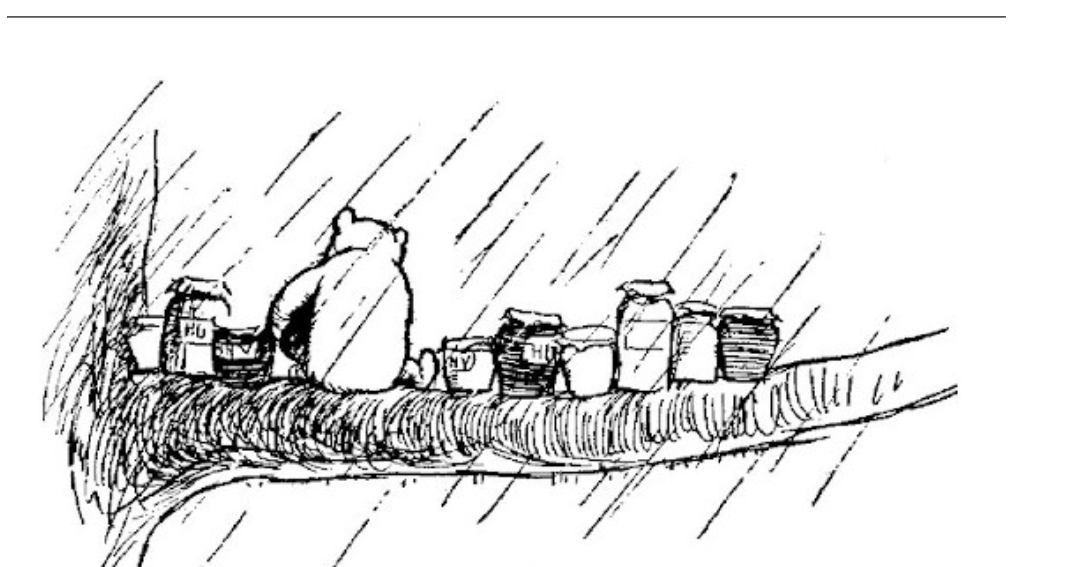
A. A. Milne and his illustrator E. H. Shephard, in creating Winnie the Pooh (1926) and its illustrations, did an OK job, at least in terms of showing bees in a tree cavity. They were less solid on bears and their point of view on bees. Bears, most of all, go after bee larvae. But larvae aren’t cute.
Images from Winnie the Pooh (1926)1)Public domain, https://www.gutenberg.org/ebooks/67098
But then things got further out of whack.
It was no fault of Shepard or A. A. Milne when certain Disney media started to show Winnie the Pooh trying to get honey from what is either a paper wasp nest or a bee skep hive hanging in a tree. Neither plan will work.
Cover of the 2012 edition of Pooh’s Honey Trouble
They inadvertently hinted at greater truths with the titling of this children’s book (2012 and earlier editions), Pooh’s Honey Trouble. Pooh’s plan here would lead to failure one way or another.
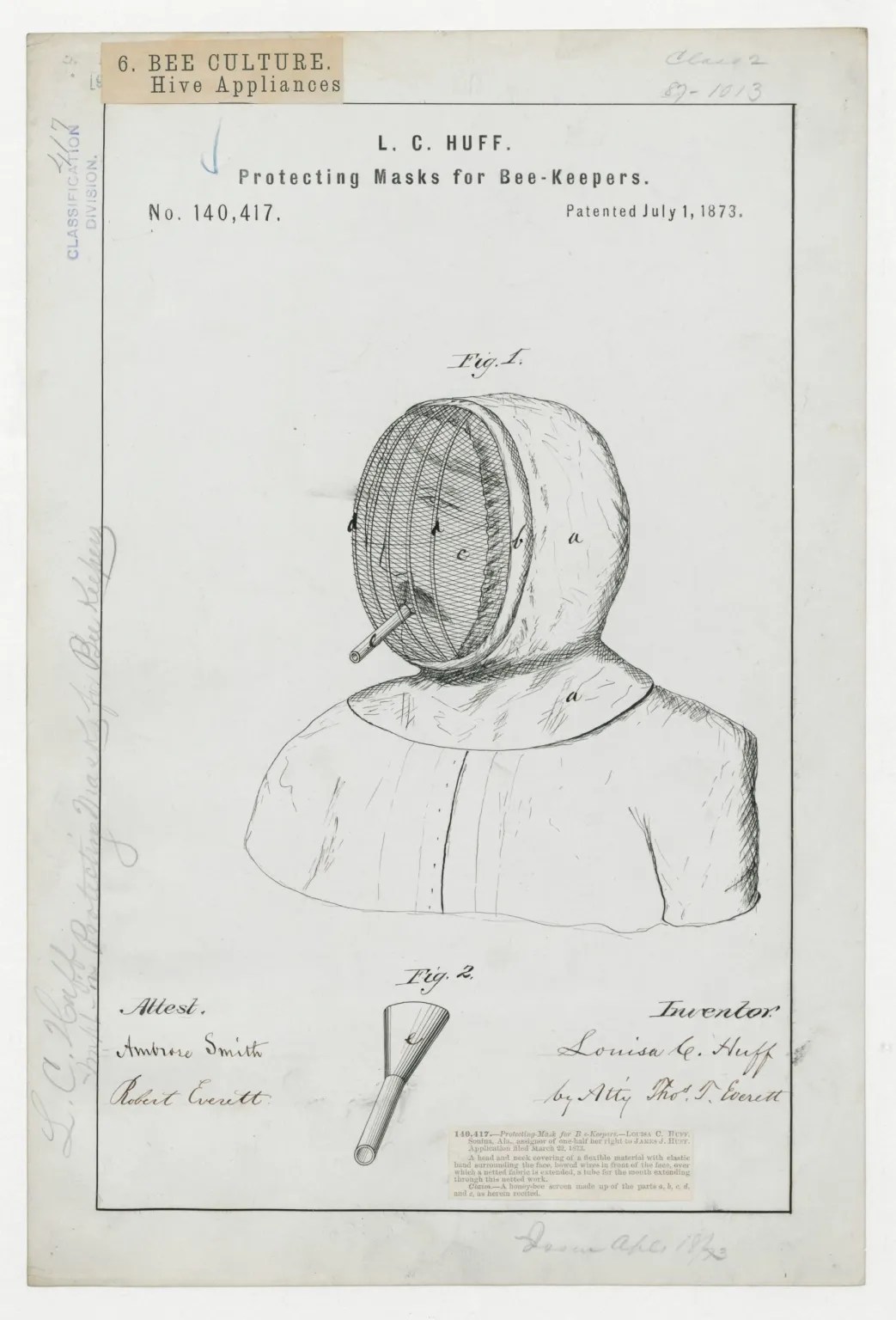
The motivation of avoiding stings has meant a long history of protective equipment innovation. One of many many designs that came along was the protective mask shown below which included, per the patent:1)US Patent US140417A “Improvement in Protecting-Masks for Beekeepers, https://patents.google.com/patent/US140417A/en
An expectorating-tube, 0, passes through the gauze in the line of the mouth and properly fastened to the gauze. This device is more for the convenience of tobacco chewers than others.
A protective system for beekeepers who smoke or chew tobacco from 18732)US Patent US140417A “Improvement in Protecting-Masks for Beekeepers, https://patents.google.com/patent/US140417A/en
The image shows a narrow expectorating tube protruding and the illustration appears to show an alternative device with a large funnel end.
The Flow Hive is a hive form in which honey frames are designed to, at the turn of a crank, release their honey which then flows out a tap.
They were invented by a father-son team in Australia and have had relative success, prompted by the appeal of tapping honey directly from a hive.
While Cedar (the son) and Stuart (the father) Anderson have had success with their invention, it wasn’t the first to try for this outcome.
A 1940 American patent1)U.S. Patent no. 2,223,561, https://patents.google.com/patent/US2223561A/en was issued for a hive technology that did almost exactly the same thing. The U.S. patent award went to Juan Bizcarro Garriga of Barcelona, Spain. Bizcarro Garriga’s design never saw commercial production, however.
Drawing from a 1940 patent2)U.S. patent 2,223,561, https://patents.google.com/patent/US2223561A/en for a hive closely similar to the Flow Hivefor a hive closely similar to the Flow Hive
The user would turn a lever to shift the movable parts vertically. This would opening the cells, capped with bees wax, and allowed honey to flow out. This is almost exactly how the Flow Hive works. The 1940 patent hive had aluminum cells. The Flow Hive uses plastic cells.
Beekeeping will forever chase easy, instant, and automated methods. It’s worth the case, but progress is often slow. Honey Flow, the makers of the Flow Hive, say that 130,000 customers worldwide are using their technology.
As my family and I prepare to do our annual honey harvest, the care we take to preserve both bees and beeswax comb stand out in contrast to what used to be. The long-standing use of basket skep hives, for example, meant each year, the colony established in one faced a crush and strain process for wax recovery. And it could be worse than that.
Joseph Warder, in his 1716 treatise on bees, shared a method for harvesting honey and wax. He acknowledge it was destructive, so he suggested only using the method with the weaker hives.
When you have poiz’d them all, and marked which of them you resolve to take, then proceed after this Manner. Have in Readiness some split Sticks about 6 Inches long, and some Rags dipt in Brimstone*, and put in each of these split Sticks, then dig as many Holes in the Ground near your Bees, as you design to take Hives, then in the Evening stick in each Hole one of your Matches, and lighting one at a time, fetch the Hive and set over it, immediately with some of the Earth top the Hive all round to keep in the Smoak, and keep in the Bees, they will be all dead in half a quarter of an Hour; so giving the Hive two or three Knocks with your Hand to shake down the Bees that hang about the Combs. Take it into your House for your use.1)Joseph Warder, The true Amazons : or, The monarchy of bees : being a new discovery and improvement of those wonderful creatures … : also how to make the English wine or mead, equal, if not superior to the best of other wines, London: J. Pemberton and W. Taylor, 1716, p. 76.
*brimstone is sulfur
In the context of a farm family, deciding to make mead, and needing to take honey from the bees to do it, Warder wrote the above. 2)Joseph Warder, The true Amazons : or, The monarchy of bees : being a new discovery and improvement of those wonderful creatures … : also how to make the English wine or mead, equal, if not superior to the best of other wines, London: J. Pemberton and W. Taylor, 1716, p. 24.
It was the destructiveness of this and other methods of harvest that led innovators, including Reverend Langstroth, to promote movable combs and honey supers. The use of basket skeps and other one-use technologies, went deservedly into decline.
Joseph Warder, The true Amazons : or, The monarchy of bees : being a new discovery and improvement of those wonderful creatures … : also how to make the English wine or mead, equal, if not superior to the best of other wines, London: J. Pemberton and W. Taylor, 1716, p. 76.
Joseph Warder, The true Amazons : or, The monarchy of bees : being a new discovery and improvement of those wonderful creatures … : also how to make the English wine or mead, equal, if not superior to the best of other wines, London: J. Pemberton and W. Taylor, 1716, p. 24.
With no judgment on how you and yours may be planning to spend this Independence Day, I share the following, a story of drunken bees and Prohibition.
If bees gather juices from over-ripe fruit or the fermenting mash of moonshiners, they may fly impaired.
A few times during Prohibition, this led revenuers straight to the moonshiners’ stills. Recognizing this, in 1930, a police department in Wichita, Kansas, added a bee colony to its law enforcement equipment. The stories here are too brief to say whether the detectives mastered some reverse form of beelining to find the stills.
The Times-Union (Rochester, NY), May 23, 1930.
Newspapers had fun with this tale, and it was reported as far away as Tasmania, Australia (where there was no prohibition).
The Advocate (Burnie, Tasmania, Australia), August 16, 1930
The Industrial Revolution eventually reached beekeeping. In the 19th century, as agriculture and production mechanized, and saw the arrival of all sorts of innovations, so did beekeeping.
It was not just Reverend Langstroth’s patented hive – which beekeepers still use – that emerged. And as with today’s trade in beekeeping innovations, some had merit, perhaps many did not. The critic quoted below made perhaps wise points about the phenomenon in general, whether or not he was right about the specific example he pilloried, Bevan’s Cross Bar Hive.
Thomas Miner wrote in 1849:
During the last twenty years, many new and useless bee-hives have been palmed off on the ignorant and too confiding bee-keepers of our country. Men who have had sufficient brains to devise some new plan and style of hive that did not before exist — who never understood a single principle of the management of bees correctly, have, by dint of unblushing falsehood and impudence, bled the bee-keeping community pretty freely. There seems to be a greater cloud of darkness hanging over the management of bees, than over any other branch of rural economy.1)Thomas B. Miner, The American bee keeper’s manual: being a practical treatise on the history and domestic economy of the honey-bee, embracing a full illustration of the whole subject, with the most approved methods of managing this insect through every branch of its culture, the result of many years’ experience, New York: C. M. Saxton, 1849, p. 117.
One of many inventions Miner denounced: Bevan’s cross bar design of which he wrote: “This is all very well, provided the bees will follow these bars; but they will not.”2)Thomas B. Miner, The American bee keeper’s manual : being a practical treatise on the history and domestic economy of the honey-bee, embracing a full illustration of the whole subject, with the most approved methods of managing this insect through every branch of its culture, the result of many years’ experience, New York: C. M. Saxton, 1849, p. 138.
Thomas Miner did not like Thomas Bevan’s top bars, and suggested not using such.
Every new-fangled ”patent” hive that is brought along, is represented as the ne plus ultra of improvement, and the very acme of perfection ; and the lesson that is so glibly recited by their vendors, of the wonderful and astonishing merits of their inventions, often causes one to become duped again and again, until he gives up in despair, and returns to his first love — the simple box and brimstone management of ages past. 3)Source: Thomas B. Miner, The American bee keeper’s manual : being a practical treatise on the history and domestic economy of the honey-bee, embracing a full illustration of the whole subject, with the most approved methods of managing this insect through every branch of its culture, the result of many years’ experience, New York: C. M. Saxton, 1849, pp. 117-8.
His view on the proliferation of beekeeping and hive gizmos, gadgets and purported improvements:
But a wise Providence has so ordered, that the bee requires merely the simplest tenement. Screens, ventilators, valves, &c., are but hindrances to their natural prosperity, and the thousand and one complicated inventions of the day are but so many deceptive tricks of the astute and keen, to filch our pockets of a few spare dollars.
Thomas B. Miner, The American bee keeper’s manual: being a practical treatise on the history and domestic economy of the honey-bee, embracing a full illustration of the whole subject, with the most approved methods of managing this insect through every branch of its culture, the result of many years’ experience, New York: C. M. Saxton, 1849, p. 117.
Thomas B. Miner, The American bee keeper’s manual : being a practical treatise on the history and domestic economy of the honey-bee, embracing a full illustration of the whole subject, with the most approved methods of managing this insect through every branch of its culture, the result of many years’ experience, New York: C. M. Saxton, 1849, p. 138.
Source: Thomas B. Miner, The American bee keeper’s manual : being a practical treatise on the history and domestic economy of the honey-bee, embracing a full illustration of the whole subject, with the most approved methods of managing this insect through every branch of its culture, the result of many years’ experience, New York: C. M. Saxton, 1849, pp. 117-8.
In the 1800s, realizing how wasteful using sulfur to kills bees to harvest honey was – then the common practice – beekeepers tried methods that instead temporarily anesthetized bees.
Chloroform inhaler for putting patients under for medical treatments 1)Creative Commons 4.0 license, Wellcome Collection Gallery, https://wellcomecollection.org/works/wfnkdcut
Ways of subduing bees have evolved over the years. Beekeepers in the past tried ether and chloroform, both of which were also used as anesthesia for humans.
Mr. Jones finds that chloroform is very useful in quieting bees. He puts a dry sponge in the tube of the smoker, then a sponge wet in chloroform–it takes but a few drops–then puts in another dry sponge. These dry sponges prevent the escape of the chloroform except when the bellows is worked. Mr. Jones finds that bees partially stupefied with chloroform receive queens without any show of ill will. As soon as the bees begin to fall, the queen is put into the hive, and no more of the vapor added. I tried this last summer with perfect success. This was recommended years ago in Germany, but its use seems to have been abandoned. It is more than likely that Mr. Jones’s method of applying the anesthetic is what makes it more valuable. The smoker diffuses the vapor, so that all bees receive it and none get too much. I should use ether instead of chloroform, as with higher animals it is a little more mild and safe.2)Albert John Cook, The Bee-keeper’s Guide, Or, Manual of the Apiary, 14th Edition, Lansing, Michigan: 1891 pp. 299-300.
A similar approach reported in 1850 involved ether.
An experimenter, blowing ether as a vapor into a colony, saw:
at first, for a second or two, there was a great disturbance in the hive, attended with a loud buzzing, but this gradually subsided, until it ceased at the end of a minute. … the bees were found lying on [the table under the hive] in a torpid condition. … The time of their revival was not noted, but the following day the bees were as lively as ever.3)The Courier Journal, august 21, 1850.
Dried puff ball mushrooms (various species), were sometimes a smoker fuel. Hydrogen sulfide emitted when the mushroom was burned had a mild, anesthetizing effect on bees.4)Wood, William F. 1983. “Anaesthesia of Honey bees by Smoke from the Pyrolysis of Puffballs and Keratin.” Journal of Apicultural Research 22 (2): 107–10. doi:10.1080/00218839.1983.11100569.]
Burning puff balls is a traditional practice among native Americans of the Great Lakes region.
Giant puff ball mushroom with a GPS device to show scale5)Public Domain image CC BY-SA 3.0, https://commons.wikimedia.org/w/index.php?curid=15551527
One account of a great lakes Native American practice noted the burning of several varieties of mushrooms in readying hives for honey taking and then:
Puffball mushrooms impaled on sticks were put around the hive and ignited. As the smoke from these burning mushrooms wafted into the hive, the bees were effectively anesthetized…6)“Could the Bee Man Shaman Be More Than We Thought?” All Things Fungi blog at: https://fungiacademy.com/could-the-bee-man-shaman-be-more-than-we-thought-ethnomycology-investigation/
Regarding its use as an anesthetic, a 19th century natural history compendium noted:
Cats and dogs having been submitted to the action of smoke from the burning fungus, they were found to be narcotized, in the same manner as if under the influence of ether or chloroform.7)Charles Knight, Natural History, Or, Second Division of “The English Encyclopedia” · Volume 1, London: Bradbury, Evans & Co., 1866, p. 632.
Giant puffball mushrooms are available for sale on the Internet. Let me know if you try this!
Wood, William F. 1983. “Anaesthesia of Honey bees by Smoke from the Pyrolysis of Puffballs and Keratin.” Journal of Apicultural Research 22 (2): 107–10. doi:10.1080/00218839.1983.11100569.]
“Could the Bee Man Shaman Be More Than We Thought?” All Things Fungi blog at: https://fungiacademy.com/could-the-bee-man-shaman-be-more-than-we-thought-ethnomycology-investigation/
Maryland beekeeper and author Frank Linton is a strong advocate for beekeepers having an observation hive, so they can learn about bees and become better at beekeeping. His book on the subject is a great source for more on that.1)https://www.amazon.com/Observation-Hive-Handbook-Studying-Honey/dp/1501707264
Frank Linton, Bethesda, MD, EAS Master Beekeeper and authorJoseph Warder from his 1716 book
Frank and Joseph Warder (1655-1724) would find much to agree on. Warder, like Frank, urged beekeepers to watch and wonder at what bees do.
Warder wrote in 1716:
When-ever there comes a warm rainy Day, that they are totally hindered from going out to gather Food, these curious Contrivers set apart that time for the Solemnizing the Funerals of the Dead; and let any who are curious but observe it, and they shall hear them very busy within the Hive, and see them dragging out their white dead young Bees, those that have them in boxes with glass Windows, may with more Satisfaction gratify their Curiousity.2)Joseph Warder, The true amazons: or, the monarchy of bees: being a new discovery and improvement of those wonderful creatures, London, J. Pemberton and W. Taylor, 1716.
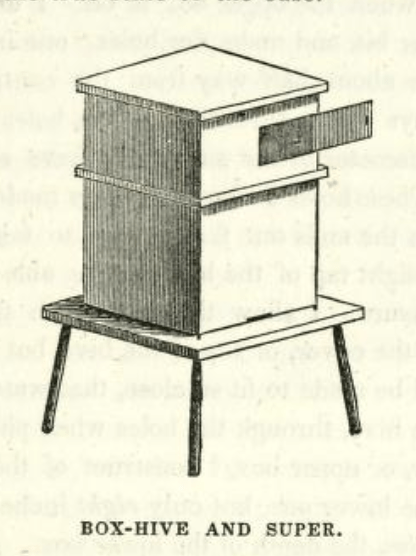
A hive from the mid 1800s. It was common advice to construct hives with glass windows for observation through the 18th and 19th centuries3)Thomas B. Miner, The American bee keeper’s manual : being a practical treatise on the history and domestic economy of the honey-bee, embracing a full illustration of the whole subject, with the most approved methods of managing this insect through every branch of its culture, the result of many years’ experience, New York: C. M. Saxton, 1849, p. 153.
It’s in fact common in the old beekeeping literature to see advocates for observation hives, often in suggestions in hive designs to include a glass window to see into the hive. We should do more of this today. There is much still to learn.
Joseph Warder, The true amazons: or, the monarchy of bees: being a new discovery and improvement of those wonderful creatures, London, J. Pemberton and W. Taylor, 1716.
Thomas B. Miner, The American bee keeper’s manual : being a practical treatise on the history and domestic economy of the honey-bee, embracing a full illustration of the whole subject, with the most approved methods of managing this insect through every branch of its culture, the result of many years’ experience, New York: C. M. Saxton, 1849, p. 153.
While it is expensive and dangerous to attempt to summit Mt. Everest (29,032 feet), it could boost your honey sales.
Sir Edmund Hillary found this out after he and his sherpa guide Tensing Norgay ascended as the presumed first people to summit the world’s tallest peak. They did this on May 29, 1953, seventy-three years ago yesterday.
Sir Edmund Hillary and Tensing Norgay, first men to summit Everest, 19531)Public Domain image [https://commons.wikimedia.org/wiki/File:Edmund_Hillary_and_Tenzing_Norgay.jpgFor Hillary, a New Zealand beekeeper, a side-benefit came with increased honey sales. Norgay’s payoff was likely shared with other Sherpas, who became the essential guides for Everest attempts, and I believe remain so.
After their feat, an American firm, in June 1953, ordered two tons of Hillary Honey. Part of the post-summit furor was based on the idea that not only could you enjoy honey from a famous explorer, but it was possible that Hillary’s honey contributed to what made him succeed.
“It is futile for dietitians to disagree on whether honey has special strength-giving qualities,” one story noted. “The proof of the honey is in the climbing.”2)The Sydney Morning Herald, June 13, 1953.
The Evening Star (Washington, DC), July 16, 1953.
Strangely, it looks like Hillary sold his honey in paper cups.
A waxed cardboard honey container from the apiary of Sir Edmund Hillary and family3)“150 years of quirky Kiwi collectibles,” RNZ online.
An earlier post reported the rising alarm about artificial and adulterated honey during the late 1800s. But for a time, artificial honey was a celebrated new product.
Probably this was rooted in the excitement about the industrialization of everything. Corn syrup was invented in 1811, and before long was sold by the barrelful. Margarine came in 1869 to challenge butter. It’s not surprising that a fake honey, ‘just as good’ as the real thing, took its turn.
The Baltimore Sun, September 24, 1868
How to make artificial honey:
How to make artificial honey. Note alum is readily available today in the spice aisle at groceries, so is essence of peppermint. The Republican, December 29, 1877
War years are a time for making do with artificial forms of products, which in the US have included ersatz coffee and margarine, supplied with a packet of yellow dye you could stir in the better simulate butter. Perhaps focused on it because of World War I shortages, and under the title “Making Honey at Home,” the Evening Sun shared this:
Artificial honey has been manufactured for many years in Europe. It gives satisfaction in cakes, etc. These recipes will give excellent results, and the finished article can scarcely be told from the genuine.
The recipes laid down used glucose and some pure honey.1)The Evening Sun, April 7, 1919.