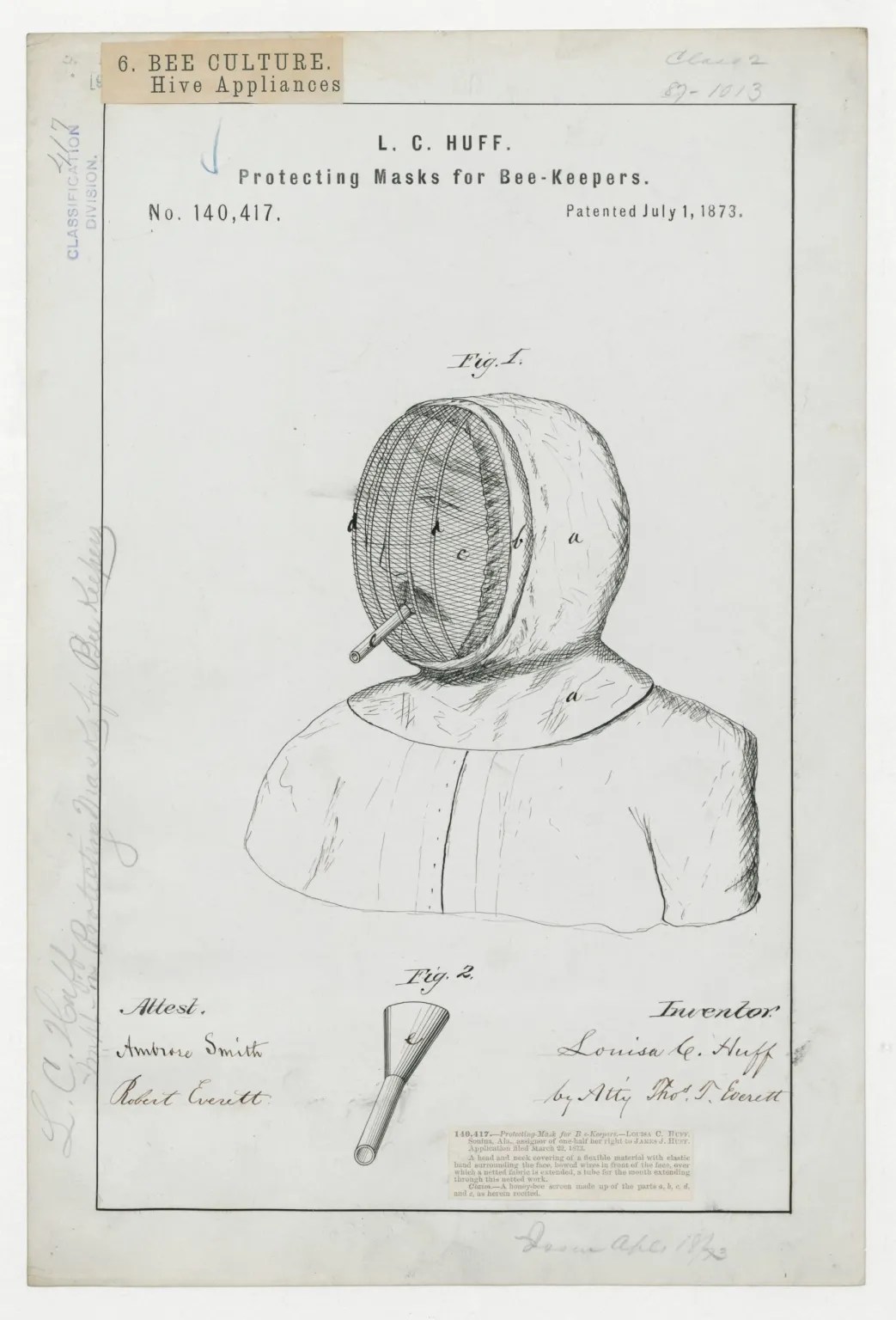
The motivation of avoiding stings has meant a long history of protective equipment innovation. One of many many designs that came along was the protective mask shown below which included, per the patent:1)US Patent US140417A “Improvement in Protecting-Masks for Beekeepers, https://patents.google.com/patent/US140417A/en
An expectorating-tube, 0, passes through the gauze in the line of the mouth and properly fastened to the gauze. This device is more for the convenience of tobacco chewers than others.
A protective system for beekeepers who smoke or chew tobacco from 18732)US Patent US140417A “Improvement in Protecting-Masks for Beekeepers, https://patents.google.com/patent/US140417A/en
The image shows a narrow expectorating tube protruding and the illustration appears to show an alternative device with a large funnel end.
The Industrial Revolution eventually reached beekeeping. In the 19th century, as agriculture and production mechanized, and saw the arrival of all sorts of innovations, so did beekeeping.
It was not just Reverend Langstroth’s patented hive – which beekeepers still use – that emerged. And as with today’s trade in beekeeping innovations, some had merit, perhaps many did not. The critic quoted below made perhaps wise points about the phenomenon in general, whether or not he was right about the specific example he pilloried, Bevan’s Cross Bar Hive.
Thomas Miner wrote in 1849:
During the last twenty years, many new and useless bee-hives have been palmed off on the ignorant and too confiding bee-keepers of our country. Men who have had sufficient brains to devise some new plan and style of hive that did not before exist — who never understood a single principle of the management of bees correctly, have, by dint of unblushing falsehood and impudence, bled the bee-keeping community pretty freely. There seems to be a greater cloud of darkness hanging over the management of bees, than over any other branch of rural economy.1)Thomas B. Miner, The American bee keeper’s manual: being a practical treatise on the history and domestic economy of the honey-bee, embracing a full illustration of the whole subject, with the most approved methods of managing this insect through every branch of its culture, the result of many years’ experience, New York: C. M. Saxton, 1849, p. 117.
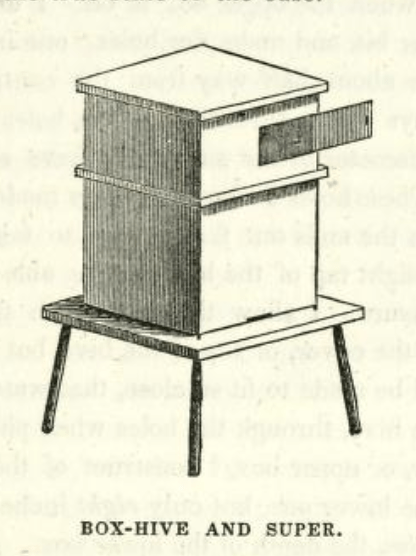
One of many inventions Miner denounced: Bevan’s cross bar design of which he wrote: “This is all very well, provided the bees will follow these bars; but they will not.”2)Thomas B. Miner, The American bee keeper’s manual : being a practical treatise on the history and domestic economy of the honey-bee, embracing a full illustration of the whole subject, with the most approved methods of managing this insect through every branch of its culture, the result of many years’ experience, New York: C. M. Saxton, 1849, p. 138.
Thomas Miner did not like Thomas Bevan’s top bars, and suggested not using such.
Every new-fangled ”patent” hive that is brought along, is represented as the ne plus ultra of improvement, and the very acme of perfection ; and the lesson that is so glibly recited by their vendors, of the wonderful and astonishing merits of their inventions, often causes one to become duped again and again, until he gives up in despair, and returns to his first love — the simple box and brimstone management of ages past. 3)Source: Thomas B. Miner, The American bee keeper’s manual : being a practical treatise on the history and domestic economy of the honey-bee, embracing a full illustration of the whole subject, with the most approved methods of managing this insect through every branch of its culture, the result of many years’ experience, New York: C. M. Saxton, 1849, pp. 117-8.
His view on the proliferation of beekeeping and hive gizmos, gadgets and purported improvements:
But a wise Providence has so ordered, that the bee requires merely the simplest tenement. Screens, ventilators, valves, &c., are but hindrances to their natural prosperity, and the thousand and one complicated inventions of the day are but so many deceptive tricks of the astute and keen, to filch our pockets of a few spare dollars.
Thomas B. Miner, The American bee keeper’s manual: being a practical treatise on the history and domestic economy of the honey-bee, embracing a full illustration of the whole subject, with the most approved methods of managing this insect through every branch of its culture, the result of many years’ experience, New York: C. M. Saxton, 1849, p. 117.
Thomas B. Miner, The American bee keeper’s manual : being a practical treatise on the history and domestic economy of the honey-bee, embracing a full illustration of the whole subject, with the most approved methods of managing this insect through every branch of its culture, the result of many years’ experience, New York: C. M. Saxton, 1849, p. 138.
Source: Thomas B. Miner, The American bee keeper’s manual : being a practical treatise on the history and domestic economy of the honey-bee, embracing a full illustration of the whole subject, with the most approved methods of managing this insect through every branch of its culture, the result of many years’ experience, New York: C. M. Saxton, 1849, pp. 117-8.
In the 1800s, realizing how wasteful using sulfur to kills bees to harvest honey was – then the common practice – beekeepers tried methods that instead temporarily anesthetized bees.
Chloroform inhaler for putting patients under for medical treatments 1)Creative Commons 4.0 license, Wellcome Collection Gallery, https://wellcomecollection.org/works/wfnkdcut
Ways of subduing bees have evolved over the years. Beekeepers in the past tried ether and chloroform, both of which were also used as anesthesia for humans.
Mr. Jones finds that chloroform is very useful in quieting bees. He puts a dry sponge in the tube of the smoker, then a sponge wet in chloroform–it takes but a few drops–then puts in another dry sponge. These dry sponges prevent the escape of the chloroform except when the bellows is worked. Mr. Jones finds that bees partially stupefied with chloroform receive queens without any show of ill will. As soon as the bees begin to fall, the queen is put into the hive, and no more of the vapor added. I tried this last summer with perfect success. This was recommended years ago in Germany, but its use seems to have been abandoned. It is more than likely that Mr. Jones’s method of applying the anesthetic is what makes it more valuable. The smoker diffuses the vapor, so that all bees receive it and none get too much. I should use ether instead of chloroform, as with higher animals it is a little more mild and safe.2)Albert John Cook, The Bee-keeper’s Guide, Or, Manual of the Apiary, 14th Edition, Lansing, Michigan: 1891 pp. 299-300.
A similar approach reported in 1850 involved ether.
An experimenter, blowing ether as a vapor into a colony, saw:
at first, for a second or two, there was a great disturbance in the hive, attended with a loud buzzing, but this gradually subsided, until it ceased at the end of a minute. … the bees were found lying on [the table under the hive] in a torpid condition. … The time of their revival was not noted, but the following day the bees were as lively as ever.3)The Courier Journal, august 21, 1850.
Dried puff ball mushrooms (various species), were sometimes a smoker fuel. Hydrogen sulfide emitted when the mushroom was burned had a mild, anesthetizing effect on bees.4)Wood, William F. 1983. “Anaesthesia of Honey bees by Smoke from the Pyrolysis of Puffballs and Keratin.” Journal of Apicultural Research 22 (2): 107–10. doi:10.1080/00218839.1983.11100569.]
Burning puff balls is a traditional practice among native Americans of the Great Lakes region.
Giant puff ball mushroom with a GPS device to show scale5)Public Domain image CC BY-SA 3.0, https://commons.wikimedia.org/w/index.php?curid=15551527
One account of a great lakes Native American practice noted the burning of several varieties of mushrooms in readying hives for honey taking and then:
Puffball mushrooms impaled on sticks were put around the hive and ignited. As the smoke from these burning mushrooms wafted into the hive, the bees were effectively anesthetized…6)“Could the Bee Man Shaman Be More Than We Thought?” All Things Fungi blog at: https://fungiacademy.com/could-the-bee-man-shaman-be-more-than-we-thought-ethnomycology-investigation/
Regarding its use as an anesthetic, a 19th century natural history compendium noted:
Cats and dogs having been submitted to the action of smoke from the burning fungus, they were found to be narcotized, in the same manner as if under the influence of ether or chloroform.7)Charles Knight, Natural History, Or, Second Division of “The English Encyclopedia” · Volume 1, London: Bradbury, Evans & Co., 1866, p. 632.
Giant puffball mushrooms are available for sale on the Internet. Let me know if you try this!
Wood, William F. 1983. “Anaesthesia of Honey bees by Smoke from the Pyrolysis of Puffballs and Keratin.” Journal of Apicultural Research 22 (2): 107–10. doi:10.1080/00218839.1983.11100569.]
“Could the Bee Man Shaman Be More Than We Thought?” All Things Fungi blog at: https://fungiacademy.com/could-the-bee-man-shaman-be-more-than-we-thought-ethnomycology-investigation/
Maryland beekeeper and author Frank Linton is a strong advocate for beekeepers having an observation hive, so they can learn about bees and become better at beekeeping. His book on the subject is a great source for more on that.1)https://www.amazon.com/Observation-Hive-Handbook-Studying-Honey/dp/1501707264
Frank Linton, Bethesda, MD, EAS Master Beekeeper and authorJoseph Warder from his 1716 book
Frank and Joseph Warder (1655-1724) would find much to agree on. Warder, like Frank, urged beekeepers to watch and wonder at what bees do.
Warder wrote in 1716:
When-ever there comes a warm rainy Day, that they are totally hindered from going out to gather Food, these curious Contrivers set apart that time for the Solemnizing the Funerals of the Dead; and let any who are curious but observe it, and they shall hear them very busy within the Hive, and see them dragging out their white dead young Bees, those that have them in boxes with glass Windows, may with more Satisfaction gratify their Curiousity.2)Joseph Warder, The true amazons: or, the monarchy of bees: being a new discovery and improvement of those wonderful creatures, London, J. Pemberton and W. Taylor, 1716.
A hive from the mid 1800s. It was common advice to construct hives with glass windows for observation through the 18th and 19th centuries3)Thomas B. Miner, The American bee keeper’s manual : being a practical treatise on the history and domestic economy of the honey-bee, embracing a full illustration of the whole subject, with the most approved methods of managing this insect through every branch of its culture, the result of many years’ experience, New York: C. M. Saxton, 1849, p. 153.
It’s in fact common in the old beekeeping literature to see advocates for observation hives, often in suggestions in hive designs to include a glass window to see into the hive. We should do more of this today. There is much still to learn.
Joseph Warder, The true amazons: or, the monarchy of bees: being a new discovery and improvement of those wonderful creatures, London, J. Pemberton and W. Taylor, 1716.
Thomas B. Miner, The American bee keeper’s manual : being a practical treatise on the history and domestic economy of the honey-bee, embracing a full illustration of the whole subject, with the most approved methods of managing this insect through every branch of its culture, the result of many years’ experience, New York: C. M. Saxton, 1849, p. 153.
While it is expensive and dangerous to attempt to summit Mt. Everest (29,032 feet), it could boost your honey sales.
Sir Edmund Hillary found this out after he and his sherpa guide Tensing Norgay ascended as the presumed first people to summit the world’s tallest peak. They did this on May 29, 1953, seventy-three years ago yesterday.
Sir Edmund Hillary and Tensing Norgay, first men to summit Everest, 19531)Public Domain image [https://commons.wikimedia.org/wiki/File:Edmund_Hillary_and_Tenzing_Norgay.jpgFor Hillary, a New Zealand beekeeper, a side-benefit came with increased honey sales. Norgay’s payoff was likely shared with other Sherpas, who became the essential guides for Everest attempts, and I believe remain so.
After their feat, an American firm, in June 1953, ordered two tons of Hillary Honey. Part of the post-summit furor was based on the idea that not only could you enjoy honey from a famous explorer, but it was possible that Hillary’s honey contributed to what made him succeed.
“It is futile for dietitians to disagree on whether honey has special strength-giving qualities,” one story noted. “The proof of the honey is in the climbing.”2)The Sydney Morning Herald, June 13, 1953.
The Evening Star (Washington, DC), July 16, 1953.
Strangely, it looks like Hillary sold his honey in paper cups.
A waxed cardboard honey container from the apiary of Sir Edmund Hillary and family3)“150 years of quirky Kiwi collectibles,” RNZ online.
As swarm season in the Northern hemisphere continues, it seems timely to look in on tanging.
Tanging means making loud noises to induce a honey bee swarm to return or settle on a bush or similar for recovery. If there’s any efficacy of doing this, it may be in that sometimes the bees think there is a thunder storm arriving and want to return to the hive because of that.
The practice or belief is ancient. Pliny the Elder (Roman naturalist and military general of the first century CE) wrote:
BEES JOY in the clapping of hands, and ringing of brasen basons: at the sound thereof they will assemble and come together.1)Philemon Holland, translator (1601): C. Plinius Secundus The Historie of the World. Book XI. (Pages 310-356)
A woman tanging (banging a pot to get her bees to return or settle)2)William Hetherington Harris, The Honey-bee: Its Nature, Homes and Products, London: The Religious Tract Society, 1884, , p. 174.
It’s not clear if too many people still practice tanging, but modern beekeepers might do so, but not tell anyone.
Tomorrow, as I write this, is Mother’s Day. So I thought we might look in on thoughts about women in beekeeping, 124 years ago.
Below is a view from 1902 on who might be the ideal “bee woman”. Note that: A “Bee Woman” who would succeed must have lots of energy and push, and, above all, must not be easily discouraged.” (For easier reading, the full text of the clipping is HERE.
The advice, however, fits any beekeeper aspirant. The quoted beekeeper here in 1902 is simply urging more women to take up the practice.
Others writing in the late 1800s and early 1900s had similar thoughts. In part, they were about giving women who were bound to home and family work, or those supporting themselves entirely, an income stream of their own, from their own labor, and, hopefully, in their control. Below is the clipping, for For easier reading, find the full text of the article HERE.
In the later 1800s, beekeepers induced honey bees to make and fill comb in glass jars, set atop hives, where we put supers. The jars made an elegant display and salable form of comb honey.
Example of a hive topped with glass jars for producing, and containing comb and honey1)Alfred Neighbour, The Apiary; Or, Bees, Bee-hives, and Bee Culture Being a Familiar Account of the Habits of Bees, and the Most Improved Methods of Management, with Full Directions, Adapted for the Cottager, Farmer, Or Scientific Apiarian, London: Kent & Co., 1865, p. 28.Front and back of a hive enclosure fitting 12 hives, and showing bell jars for honey2)Alfred Neighbour, The Apiary; Or, Bees, Bee-hives, and Bee Culture Being a Familiar Account of the Habits of Bees, and the Most Improved Methods of Management, with Full Directions, Adapted for the Cottager, Farmer, Or Scientific Apiarian, London: Kent & Co., 1865, p. 55.Apiary with a mix of skeps and wood hives with bell jars for comb honey3)“Homes of the Honey Bee: The Apiaries of our Readers,” British Bee Journal, November 19, 1898, p. 445.
Today, some beekeepers set up an array of mason jars atop their hives, and the bees build comb and cap honey inside. They top the jar off with extracted honey, and sell them as chunk comb honey.
This practice today may be a grey area in the law of some states. Most states require bees be kept in movable frames. A movable super containing jars may pass the test, but it is unclear if all apiary inspectors would accept the practice.
Alfred Neighbour, The Apiary; Or, Bees, Bee-hives, and Bee Culture Being a Familiar Account of the Habits of Bees, and the Most Improved Methods of Management, with Full Directions, Adapted for the Cottager, Farmer, Or Scientific Apiarian, London: Kent & Co., 1865, p. 28.
Alfred Neighbour, The Apiary; Or, Bees, Bee-hives, and Bee Culture Being a Familiar Account of the Habits of Bees, and the Most Improved Methods of Management, with Full Directions, Adapted for the Cottager, Farmer, Or Scientific Apiarian, London: Kent & Co., 1865, p. 55.
The Boy Scouts, Girls Scouts, and Girl Guides all had merit badges for beekeeping (originally “bee farming” in the Boy Scout handbook.) The badges turn up on eBay and collectors have them bid up sometimes to several hundred dollars.
Bee farming merit badge information fell in the Boy Scout handbook between Aviation and Blacksmithing1)Boy Scouts of America. The Official Handbook for Boys. 4th ed. Garden City: Doubleday, Page & company, 1911.
There was a 53-page merit badge guide for this skill:
The Boy Scouts beekeeping merit badge guide from 1925. Versions of this were published into the 1980s2)Bee Keeping …. United States, Boy scouts of America, 1925.
The Boy Scouts merit badge for beekeeping was discontinued in 1995 due to lack of interest. The blacksmithing badge was discontinued in 1952. In 2014, an Oklahoma scout lobbied the Boy Scouts of America to reinstate beekeeping for badge-earning. That did not happen, but the organization incorporated beekeeping into areas including insects,, nature studies, forestry, gardening, plant science, and other environmental science studies.3)Bryan Wendell, “Gone but not forgotten: Beekeeping and 9 other discontinued merit badges,” Scouting Magazine Blog, April 28, 2014. The Girls Scouts have taken a similar approach, with no free-standing merit badge for beekeeping.