Mr. Personality

Post 3 of 3 on Charles D. Mahaffie, Jr. at Camp Wachusett

Charlie amongst the counselors and campers, 1946

When we last saw Charlie, he was a boy of 11 years. With the United States fully in the war, Camp Wachusett did not open for the summer of 1943 and stayed closed for the two summers after that.

In 1946, the camp reopened. Camp leaders Bill Triplett and Ward Bates were back from their military service. Charlie was back, now as a counselor. He was fifteen years old.

Dave “Slinger” Slingluff, unfortunately, was gone, also no longer at The Landon School after the school year of 1942-43. At some point during the war, his family had moved from Washington to Rhode Island, likely because of his father’s position in the U.S. Navy.

Charlie Mahaffie, on right, with his charges at Camp Wachusett

Counselor duties

Though Charlie was only fifteen, he was assigned to manage swimming. The boy who hadn’t liked “dips” was now one of the swimming counselors. He was also one of the editors of the Wachusett Log.

Among Charlie’s other duties was umpiring baseball. About his work at this the Log reported: “The rest of the campers participated in a hotly contested baseball game, hotly contested between the players and the decisions of the umpire who looked at baseball with a slightly jaundiced eye as the Senators plunged toward the basement. Who the umpire was is beyond the ken of this log but it was noticed that Charlie came home with a handful of empty Moxie bottles and a few scars.”

Charlie was also “inspector”, the counselor who checked each cabin after morning cleanup, and picked which one was tidiest. He was presumed biased in his cabin inspections. “Charles (Inspector) Mahaffie checked the cabins; as usual Kiowa won because Mahaffie lives there.”

Trouble with Beaman (there’s always one)

As one of its editors, the Log correspondents went after Charlie Mahaffie more than ever. An early Summer 1946 entry read: “The next noise [just before Reveille] was Charlie (’they don’t have to be beautiful; they don’t have to be cute; but they gotta have personality’) Mahaffie as he got an early morning start trying to figure out which foot Ralph Beaman’s shoes went on. Apparently he was unsuccessful for Ralph turned up for the third consecutive day with his shoes neatly tied but on the wrong feet.”

And built into that story was, with the “they gotta have personality” comment, the first in what would become a steady mocking of Charlie’s interest in girls. Before long he  becomes Mr. Personality, maybe not because of his own, but because he apparently wanted a girl with a personality, and, soon, he’s “Lovesick Charlie” because, allegedly, none of his attempts to woo ever worked.

The boys of Charlie’s cabin, Kiowa, do a banzai charge (1946)

Managing Ralph Beaman was a fixture of Charlie’s days as a counselor that summer. A Log entry has Charlie tagged as “Beaman-cut-that-out Mahaffie” (Beaman was the boy with the shoes on the wrong feet). I could not find out more about Ralph Beaman, but he didn’t return to the camp the next summer.

“Knock it off!” Even without Beaman

That next summer (1947), the Log tells us: “The rest period fumbled along, punctuated with ‘Knock it off!’, the favorite saying of Charlie Mahaffie, the hunchback of Camp Wachusett. Charlie had better watch out, or somebody may do just that to his head.” That evening, “as the story faded away, they fell into dream of Charlie, tied into a sack, slowly sinking beneath the waves with a cannon ball tied to his feet.”

Still entertaining the camp

As a counselor, Charlie was still, as he had become as a camper, part of the entertainment. One 1946 entry notes, “At night “Zoot” Mahaffie read the Log, his usual clowning getting the same old laugh.” (It’s hard to say what that fleeting nickname “Zoot” might be about).
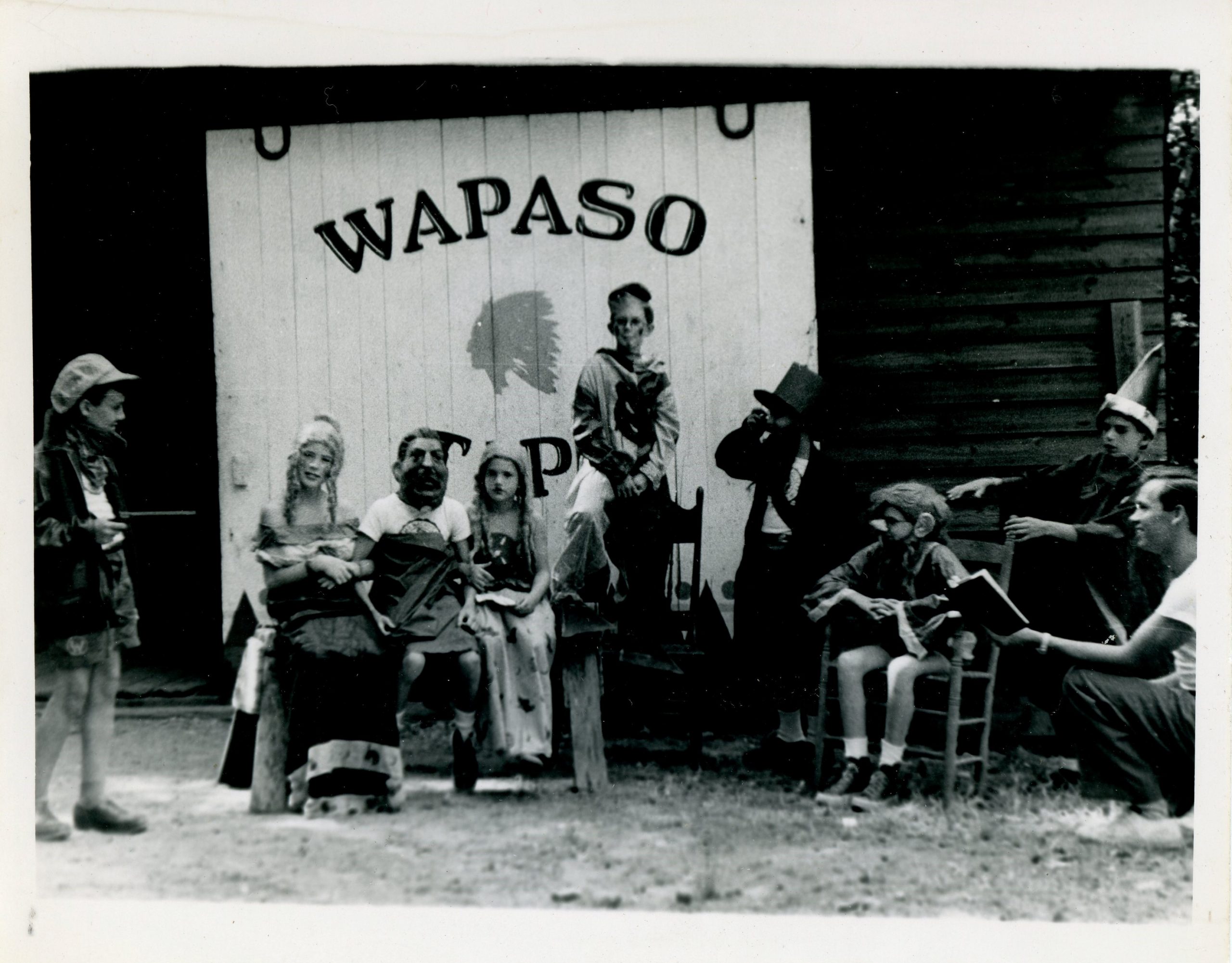
A Wachusett skit. Charlie appeared in a number of these

That Charlie was a camp ham is clear. The “What Would Happen If” list that summer put, after Charlie’s name, “told a funny joke?”

Charlie’s storytelling continued. On a 1947 overnight trip to Mt. Morgan, “Supper was succeeded by the customary story-telling around the campfire, Mahaffie contributing an endless tale of a raccoon coat containing exactly 999,999 hairs.”

Charlie continued also to be in the cast of camp plays and skits. In mid-July 1947, he was “Cousin Martin” in a play, donning a “crisp New Hampshire accent” and portraying a taciturn New Englander.

More Hijinx, even without Slingluff

“We deem it advisable to scotch any malicious rumors to the effect that that utter blackguard Win Wilson was pushed into the lake late Friday evening by that lovable lad, Charlie Mahaffie. Any careful consideration of the unblemished character of the lovable one will show that he is incapable of any such misdeed. Indeed, it was the evil intent of the prevaricator himself that brought about his own doom, for it was while vainly trying to dunk that paragon of integrity, Charlie Mahaffie, that his foot slipped and he himself slipped into the foaming brine.”

That 1947 Wachusett Log entry, which was unsigned, was clearly written by Charlie himself.

On the prowl off the grounds

A minor mystery from the summer of 1946 forward is exactly what Charlie and several of his fellow counselors did on periodic forays off grounds in the evening. They clearly had permission to leave the camp for off-duty adventures. What did Charlie get up to?

The Log noted for Monday, July 8, 1946 “Bright and early Monday morning we heard a disturbance down by the canoe slip: Casanova Sandy and Lovesick Charlie had returned from an evening of fun and frolic. It seems that Charlie met with failure (Louise). Sandy had his usual luck.” Poor Charlie (or perhaps poor Louise). Tuesday’s Log continued the ribbing: “Charlie was his usual jilted self as he appeared at breakfast.”

Then there was more. “The launching of the Chris Craft was a great thing, complete with its Moxie christening, but few noticed the unrestrained rejoicing of the Personality Kid for at last he had thought of a way to please his hard-to-please Juliet. We hold little hope for him, but here’s to you Charlie. Never say die.”

It’s possible the young men sometimes visited a girls camp nearby, or the Perkins Tourist Cabins up the lake, explaining why some outings were by canoe or rowboat. If the Log cartoons are to be believed, they had packed suits and ties in their footlockers for the occasion.

Yet another nighttime outing happened a week or so later. “Camp was quiet soon after taps, disturbed only by the noisy departure of Ward’s station-wagon filled with the camp gay-blades, accompanied by ‘Coke’ Mahaffie.” Charlie’s regard for Coca-Cola continued in his adult years.)

On a late July Saturday night in 1946 we learn: “It was 11:30 when the two sharply dressed characters returned in the shiny black Chevrolet after an evidently unsuccessful hunt. They were not disheartened, however. Realizing that it was personality they lacked, they set out once more for Center Harbor this time taking the old standby, ‘Personality Mahaffie’. I am not sure what time they returned, but Bob ‘Tums for the Toomey’; reported that on his way to church in the morning a shiny black Chevrolet sped past headed in the direction of camp.”

About an August Sunday morning the Log reported “We could also mention the strange coincidence of the lifeboat being tied up in front of Perkins’ cabins and Charley’s having visited a reputed beauty there the night before, but since it might embarrass Charley, we won’t say a word about it, nor will we even ask why he left so precipitately that the boat was forgotten completely.” A few days later, another Log correspondent was relating some story about the canoes and said, “The other canoes were under the charge of Charlie (I always forget to bring the rowboat back after a date) Mahaffie.”

Ideas of Charlie as a romeo lost out to his attempts at comedy on the “Wachusett Goes Hollywood” page that summer. No heartthrob, but rather Jack Benny was tapped as his Hollywood equivalent.

In his first counselor year (1946), the Log’s “Counselors at a Glance” page read:

Charlie Mahaffie
Nicknames: Muscles, Personality.
Favorite sport: Keeping up with Bates
Favorite haunt: Away from Eagle Lodge
Dislikes: Swimming beginners
Ambition: To be a character
Favorite saying: “Beaman, cut that out!”

Summer of 1947

In the summer of 1947, Charlie returned to Camp Wachusett as a counselor and again co-edited the Wachusett Log. Instead of swimming, he was assigned canoeing. He still had the role of inspector—the counselor who checked each cabin’s orderliness and tidiness.

Charlie the scribe

Charlie the scribe was by then well established. One Log note reported, “Charlie (Hunt and Peck) Mahaffie and Bob (Columbus system: discover a key and then land on it) Toomey spend the afternoon typing up their logs in the office between mouthfuls of marshmallows found hidden in a bottom drawer.”

Charlie’s log entries were long, sometimes erudite, and generally clever, full of word play, literary references, and entertaining asides. For example:

“Unlike Gaul, Wachusett is divided into two parts: those who are quiet during rest hour, and those who are not quiet during rest hour. The schism between these elements was made horribly evident during Monday rest hour as several of the counselors embarked on an ill-fated expedition into the realm of Morpheus, only to be cast back into reality by the whooping and hollering of such as Bubonic Buchanan or Antelope Anderson.”

As Log editor, he continued to add his remarks into the log entries of campers and other counselors. Phil Carr wrote: “Then we had a council fire in which all the boys that had not passed their Mt. Prospect story telling test told a story.” Having written it as “council fire in which,” Charlie added: “Ed. Note: All the boys who were compelled to tell their stories in the fire were immediately rushed to the infirmary where Mrs. Goodman made sure that their skin had been burnt off clear to the bone.”

In another log, a boy reporter explained a game: “Get fourteen boys and divide them in half.” Editor Charlie inserted, “(One at a time?)”

“Counselors at a Glance” from 1947:
Charlie Mahaffie
Nicknames: “Mahaff”, “Lovable”
Favorite sport: inspecting
Favorite haunt: infirmary
Dislikes: dips
Ambition: to write a log as well as Wilson
Favorite saying: “Knock it off.”
That summer, the “Wachusett goes Hollywood” page had him as Bob Hope.

Also that summer, the Log page of vital stats fails to report Charlie’s end-of-summer weight and height, but he started the summer at 165 and 5 foot 11.

A last summer at the camp

For the Summer of 1948, Charlie’s final one at Camp Wachusett, he had sole editorship of the Wachusett Log, and his only other official assignment was cabin inspector. With his past work on the Log, Charlie had proved he didn’t need adult oversight or help. He was 17 years old.

“Counselors at a Glance” in 1948:
Charlie Mahaffie
Nicknames: Muscles, Lovable
Favorite Sport: Typing
Favorite Haunt: Log-room
Dislikes: Late logs
Ambition: Virtually none
Favorite Saying: Shad ap on da porch

The Brothers Orchid reunited

At the end of July 1948, Charlie’s old school and camp pal, Dave Slingluff, who had not been there since 1942, came for a visit. Charlie recruited a Log entry from him. Slinger had not written once on his own for the Log when a camper. In his post he revived the nickname Brother Orchid.

Manhood upon Charlie

Charlie’s 1948 vital stats page, signed by camp nurse Ruth Goodman, R.N. had the following:

Weight at the start: 168 1/2
Weight at the end: 170
Net gain or loss: 1 1/2
Height at the start of the season: 6 feet
Height at the end of the season: 6 feet
Charlie was a grown man, and, to Mrs. Goodman’s satisfaction, was no longer wasting away.

And home

At the end of his last summer at the camp, Charlie took the train home with the campers. He wrote, in the final Log entry for the season, “. . . the train ground to a halt in the Union Station and disgorged its load of campers. The boys met their parents with memories of a swell summer at Camp in their heads and all sorts of souvenirs in their bags. Thus, as the Director sank into the arms of a kindly porter who carried him out to a waiting taxi, the nineteen forty-eight season came to an official end. (Signed) Charlie Mahaffie

_____________________________

Post 1: Charlie Mahaffie, the boy that became the man

Post 2: The Brothers Orchid

Photos from Charlie’s counselor years are here

The Brothers Orchid

Post 2 of 3 on Charles D. Mahaffie, Jr. at Camp Wachusett

David Slingluff, left, and Charlie Mahaffie, right, Landon Yearbook, 1943

Before they even arrived at Camp Wachusett for Charlie’s first summer at the camp, he and his school pal Dave Slingluff were dubbed the “Brothers Orchid”. That nickname appears in the first pages of the 1940 season Wachusett Log, in the account of the ship journey by some of the campers on the S. S. Dorchester from Baltimore to Boston.

The boys or their counselor escort on the trip came up with the name. “Brother Orchid” was an alias taken by a mobster in the 1940 film Brother Orchid, when he took refuge from his life of crime at a monastery that tended flowers. Played by Edward G. Robinson, Brother Orchid was street tough and wisecracking. Charlie and Dave Slingluff earned the nickname in their first days on the S.S. Dorchester.

Still from Brother Orchid 1940 starring Edward G. Robinson and Humphrey Bogart

At at stop in Virginia Beach, “The Brothers Orchid played beachcombers with Webb Abbott’s comb, returning it, needless to say, in a despicable condition.” They had decided to pretend you needed a comb to beach comb. Exactly that sort of gag is strung throughout the Wachusett Log. The Brothers Orchid were ready for life at the camp.

Converging on the camp

Wachusett campers worked their ways to New Hampshire at the end of June each summer. By ship, train, and station wagon, boys arrived at the camp on the shores of Little Squam at the beginning of July. Charlie’s group in 1940 arrived on the Merchants and Miners liner S.S. Dorchester sailing from Baltimore to Norfolk, visiting Virginia Beach, then sailing on to Boston.

The trip itself was an adventure, the sort of thing Charlie had probably never done before. The boys roughhoused their way north on the deck of the Dorchester. Other passengers were reportedly wary, if not alarmed.

Slinger — The Other Brother Orchid

David “Slinger” Slingluff, aboard the S.S. Dorchester

Dave Slingluff was a pal from school. He and Charlie were pals. Their antics, which became a feature of camp life, and having started even before their arrival at the camp, did not let up for three years.

From the Log: “Early risers the next morning found themselves on the blue Atlantic, well out of sight of land. They also found … Slingluff and Mahaffie slapping each other around on the deck. . .”

And the next day, “those on the foredeck were able to see such sights as Mahaffie borrowing Slingluff’s key, dropping it on the deck and booting Slingluff when he reach for it. . .”

Settling in and standing out

The Brothers Orchid settled in to camp life and quickly got to the task of becoming camp personalities. Wachusett had its own culture and ways, and it seems Mahaffie and Slingluff—generally called Slinger, took to it. In 1940, though only nine and new there, Charlie, with considerable help from Slingluff, became a notable camper . In most Log entries, it was Mahaffie and Slingluff together, wisetalking, no doubt like Edward G. Robinson’s Brother Orchid.

A Wachusett “war canoe” with Charlie seated third from the front

Camp life was all about hiking, camping, swimming, canoeing, kayaking, aquaplaning, and fishing, plus a lot of entertainment and rituals like the Council Fire, where the boys and the counselors read the Log out loud and told stories.

In a camper ballot, Charlie turns up under: “Talks most and says least” no doubt showing that show-offy, quick-witted trait ascribed to many a current generation of Mahaffies.

The Brothers Orchid (try to) report a typical day at the camp

Saturday, July 25, 1942

David Slingluff, on right, about 1942

The day started off by David Slingluff’s crackling voice singing to the cabin: “Sleepy lago-o-o-o-n, a tropical moon, and three on an island,” Mahaffie answered “Who is the third one?” The answer from Bat-face Slingluff was “The mother-in-law.” There was a deep silence for twenty minutes until Weir broke out into a loud giggle. (I still don’t see why.) When he stopped laughing, Slingluff started in again, but immediately three clocks, two tennis rackets, one bed-spring, and Bobby Griswold’s alarm clock were collected in his face.

The cabin from then on was in silence, until Bobby (I get up at seven o’clock and blow reveille) Griswold (author’s note: he does?) started to the main lodge at 7:15 and got there at 7:30. We still don’t know what he did between the Bears’ Den and the Main Lodge.Finally reveille was blown, and those mighty, husky Bears’ Denners went in for a dip. Meanwhile, the cabins could hear those stinkers in Kiowa throwing rocks off their dock, fulfilling their perfect dip record.

Pajamaed campers at morning “dip” time

First call found Bird (call me crow) Cromwell and Burke (I’m always up early) Mathews getting up. Second call found them just getting back from their dip, and cereal found them stumbling into the dining room. Chapel came right on the heels of breakfast, and then came that race between the flag and the bugle, or flag-raising. As usual the flag won. (That’s why it’s called flag-racing.) Next came cleanup, which those mighty, peppy, husky, muscular, gigantic, herculean, honest, truthful, clean, healthy, powerful, gargantuan, almighty, skillful, strong, fabulous, immense, enormous, handsome, brave, daring, smart, bright, tough, king, thoughtful, friendly, helpful, courageous, outstanding, respectable, famous, brilliant, unbeatable, zestful, ambitious, excellent, terrific supermen that are just brimming over with muscles — the Bears’ Denners — went to work so amiably and either won the shield or courteously gave it to another cabin. Next came assembly at which classes (ain’t they always) were signed up for. (Author’s note: we are rushed for time like the very dickens, so Bobby don’t think it’s too sketchy.) (Editor’s note: don’t worry about that; I’m rushed for time myself.) (Author’s note: not that those two literary geniuses Slingluff and Mahaffie could write anything that isn’t the best.) (Editor’s note: oh, of course.)

Charlie became known for his “goose-like swan dive”. Little Squam was known for how cold the water was.

During classes everything happened that ordinarily happens during classes and lots more but we forget what. Next came our weekly bath in the form of a soapy swim, in which we were supposed to wash ourselves, but most of it got into our eyes. After all this came lunch at which Clayton Triplett had a birthday, and we all profited from it in the form of ice cream and cake. We then carried each other down to the cabins for an hour of what we should not be doing during rest period. That afternoon everybody fished. Eddie did not catch any fish, but we are proud to announce that Eddie caught a fish on the White Oak Pond Trip — at least he says he did, and who would doubt Eddie’s word. (Author’s note; I would.)

Next came swim. Nothing happened during swim except everybody got wet (authors’ note: we pulled that one in our last log, but won’t you please laugh anyway.) Dinner came and we all et (that is, we all et dinner). Dinner in the diner was followed by boats and canoes, in which Irdie Superman Cromwell and Dick Columbine Coupland turned over and did practically everything to Wawa Patch’s kayak. Slinger’s super-baritone voice rang out for a good five minutes trying to catch Joe’s attention with a steady “Slingluff checking in, Slingluff checking in, Slingluff checking in, Slingluff checking in, Slingluff checking in, Slingluff checking in, Slingluff checking in, Slingluff checking in, Slingluff checking in.” Slingluff finally checked in.

After boats and canoes, everybody played In and Out, after which the camp had a midnight dip. After taps we had a story about a crazy man getting mixed up in a building with six corridors and a stupid girl who went around falling into cellars. Everybody was asleep for the other story, so we don’t know much about it, but we know it must have been good because Bobby Griswold told it. (Ed. Note: Am I crimson!) (Author’s note: No, you’re Griswold.) (Heh, heh.)

(Signed) Brothers Orchid

The boys and counselors of the Bears’ Den, Mahaffie 4th boy from left, Slinger 6th (1942)

Overnight camping, featuring the usual hijinx from Slinger and Mahaff

Counselor Bob Griswold (Oz-Griz) picked up one camping trip narrative:

On the water, “Slinger and Mahaff had rigged up an elaborate bit of paraphernalia consisting of two paddles, one sheet, and various and sundry bits of wire, string, shoe-laces, and adhesive tape; this intricate affair which was supposed to be a sail took fifteen minutes to arrange, then after three minutes in use it collapsed completely and dismally, and had to be rebuilt. . . . The stretch down to Potato Island was made without mishap, and Slinger and Mahaff finally got their so-called sail working again. It fact it was working beautifully, billowing out over the side of the canoe gracefully like a balloon spinnaker, but Mahaff began to lag on the job, and the balloon spinnaker was abruptly transformed into a plain old damp sheet as it trailed over the side gathering most of the lake into its folds. At this point the canoe began to look like an advertisement for Lux soap, were it not for the tattle-tale gray color of the sheet. What with the canoe leaking and Slinger and Mahaff arguing and the sheet dragging in the water, we wonder that they ever got to Loon. Get there they did, however, though not before Mahaff dropped his canoe paddle overboard, and Bobby Fleming — of all people — went back to pick it up for him.”

Mahaffie, we didn’t go fishing this morning

Per the Log, this was commonly overheard at camp: “The camp woke up as usual with Slinger saying to Mahaff: ‘We didn’t go fishing this morning, did we?’ Mahaff would say he didn’t know and then they would both go back to sleep.”

And one more morning: “The day started at 6:30 A.M. when Slinger whispered to Mahaffie: ‘Mahaffie, we didn’t go fishing this morning: I forgot to wind the alarm clock.’ Mahaffie poked his head out from under the covers and said, “We wouldn’t have caught any fish anyway.’ Slinger and Mahaff went under the covers for five minutes until Slinger poked his head out of the covers and said ‘Davey is going to be mad.’ There was a short mumble from Mahaffie’s bed, then silence ‘til reveille.

Starting his own ghost story tradition

Charlie took his turn telling Council Fire stories. It was only early July 1940, the first week of camp, when the Log notes, “Charlie Mahaffie uncorked one about a haunted pair of pants which hadn’t been sold for six months.”

The Council Fire by day, site of many a ghost story

A camp tradition were stories, often ghost stories, told around the. But the camp also used an in-house radio system to broadcast bedtime stories into the cabins.

The Log noted, about the first camp show of the summer, “broadcast down to the huts over the camp radio system, the more professional of our amateurs being Charley Mahaffie, Todd Noyes, Dick Boyce, and Pete Truit, whose performances at the microphone were polished and gongless.”

His performing extended beyond campfire stories, too. “Our second stunt night of the season proved even more amusing than the first, as Tommy (Houdini) Weir, Tommy Mangan, Pete Clapper, and a miniature combination of Superman and Sherlock Holmes with the rather weird little Floy-Joy the Wonder Boy (Charley Mahaffie) strutted their stuff before the Wachusett floodlights.” They may have used the 1938 song “Flat Feet Floogie” by Slim and Slam, which had “Floy Joy” in the lyrics.

The boys and counselors read the Wachusett Log

So Charlie was willing to ham it up, perform in front of others. That aligns with how we knew him later, always the toastmaster, the one with the song lyrics, telling stories with funny voices.

In 1942, late the first week there was a council fire atop Shepherd Hill across Little Squam lake. Charlie was among the boys who “sent chills down our backs (and, we suspect, down their own) with some of their choicest tales.” Some of the boys also read out Wachusett Log entries over the camp radio and council fire gatherings. Charlie was a part of that, getting plaudits for hamming up the readings. He also was part of the camp theater in skits and plays.

In early August, each cabin put on a play. “Dave Slingluff, Charley Mahaffie, Art Hall, and Jenkins Cromwell bringing down the house in a version of Cinderella which would have amazed Mother Goose.”

Charlie was ready to entertain in most any setting. On one camping trip, “The first sound to reach our ears Thursday morn was Mahaff’s fog-horn voice announcing to the assembled company (in Latin) the amazing fact that ‘the girl is a table.’”

The Brothers Orchid end as they started

A Wachusett Log “weather report” from Charlie’s final camper year draws things together for us: “Wind: violent, whole gale, in all directions, from Slingluff and Mahaffie.”

_____

Post 1 is at this link.

More photos from Charlie’s camper years are here.

Komalty: down on the old homestead

My son Robert and I passed through Kiowa County, Oklahoma on our way by car from Washington, DC to Colorado Springs in late May. We stopped to explore the country for a few hours, short to get a feel for the old home grounds of my Great Grandparents and their family.

Along a section road, Komalty, Oklahoma

The Komalty crossroads

The ranches today are mostly in wheat, the late winter crop during our visit was mature and some farmers were harvesting. The land also supports cattle, some oil and gas is pumped from the shale deposits under the ranchland, and now, in places, there are clusters of enormous wind turbines.

George B. “Doc” Mahaffie and Mary Frances Williams “Molly” Mahaffie, each at age 34, homesteaded in Oklahoma, at Kingfisher, just northwest of Oklahoma City. The Oklahoma Land Rush which started April 22, 1889, opened 2 million acres for homesteading, and 50,000 people lined up for the High Noon start. It was one of several openings and rushes in the late 1800s.

As best we know, the Mahaffies were not “Sooners.” They waited for the proper time to move in and find a homestead. George and Mary had begun their family 300 miles away in Olathe, Kansas where George’s father, James Beatty Mahaffie, had built his farm and stage coach stop.

Rose, Mary, Charles, Beatty, George, and Bart Mahaffie about 1903

In 1901, land further west that had been a Kiowa-Comanche-Apache reservation, in what become Kiowa County, opened to homesteaders. And the loss for Native Americans became the gain of thousands of homesteaders, including the Mahaffies. They moved one hundred miles further west and took claims at what became Komalty, Oklahoma. The county seat, Hobart, formed as a tent city with that 1901 land opening and before long the new homesteaders built the town.

Both land rushes were part of a wave of late 1800s/turn-of-the-century land confiscations by the U.S. Government which took treaty-promised plans from native peoples. Oklahoma, which had been Indian territory, became far less in the control of Native peoples, though there are still reservations spread through the state.

My grandfather, Charles D. Mahaffie, Sr., was about 4 years old when the Oklahoma land was opened to settlers. The family included his sister Rose who was 6. Their brothers George Barton “Bart”, and Oscar Beatty were not yet born, though Bart arrived that winter. Charles D. Senior was, if I recall right, with his father in a wagon for the Land Rush, and recalled hearing shots fired by homesteaders tussling over claims.

With each generation, the Mahaffies had homesteaded their way westward. Doc was born in Indiana, grew up in Olathe, Kansas where his father had settled. His father preceeding him was born in Pennsylvania and lived also in Indiana, before settling in Kansas. Picking up the pattern, Doc sought his fortune with his young family, further west, claiming his land in Kingfisher and then Kiowa County. The family prospered in Kiowas County, growing their holdings and becoming leading members of the community.

Robert Mahaffie deploying his drone

Robert and I explored the fields and section roads around Komalty, where the Mahaffie homestead was. Robert flew his drone out over the wheat fields towards Rainy Mountain and took in the scenery.

Komalty isn’t really a town now, if it ever was. The ranchers have assembled the old homesteads into larger parcels, and likely more often than not, they manage them from a home in town. Justin Krieger, who tenanted the land Charles D. Mahaffie, Jr. inherited and now owns it, lives in Hobart where he also has an insurance business on Main St.

Here is a little of the aerial video Robert shot:

The Mahaffie Headstone, Hobart Rose Cemetery
The Hobart resting place for George, Mary, and Bart Mahaffie

There are still scattered oil pumps in the Kiowa County fields, but there are also long arcs of wind turbines, adding power to the yield the area gets from wheat and cattle. Doc Mahaffie surely would have gone for turbines, anything to add to the productivity of his farm.

In Hobart, “town” for the Mahaffies, we saw a worn-out downtown, and not much in the way of commerce or energy. It is a big town, the county seat. There are fewer people in the county now than there once were, it takes far fewer to farm and ranch. Hobart shows the signs of a smaller population. There were 27,500 in Kiowa County in 1910. Today about 9,300 people live there.

A gravesite at Hobart Rose Cemetary has a Mahaffie headstone, and three small stones, for “Father” George, “Mother” Mary Mahaffie, and the youngest, which simply reads “Bart.” Bart is there because he died young, succumbing in 1919 to the influenza that killed millions. In his obituary, he is remembered as one of the favorite young men ever to live in Kiowa County.

George and Mary’s children kept up the established pattern of moving onward to find their own way, but now higher education shaped their prospects. Charles had gotten all the way to Oxford as a Rhodes Scholar and initially moved westward to Portland, Oregon, before taking a job in Washington, DC with the Federal Government. Rose married and also moved west. Oscar completed college and also took a government job. And Bart had started his ranch in southeastern Colorado when he died of the flu.

By the 1940s, no Mahaffie’s were left in Kiowa County, though Doc’s descendents still held land there until recently. Ranchers still thrive there, but much fewer in number.

Word of a Rhodes Scholarship and a Letter Home

Below is a piece previously shared only with family members. It’s part of a long series on the experiences of Charles Mahaffie as a Rhodes Scholar in 1906-8

Charles D. Mahaffie, Sr. was awarded a Rhodes scholarship in early 1905. Rhodes Scholarships were funded by a bequest from Cecil Rhodes, and Englishman who made a fortune in diamond mining. They enabled students to attend the colleges of Oxford University.

Charles was a brilliant, accomplished 21-year-old from a prominent farm family living outside Hobart Oklahoma. He was finishing his studies at Kingfisher College, Kingfisher, Oklahoma, where technically a junior, he was completing his degree early. He graduated on the last day of May in 1905.

At Kingfisher he had studied, among other things, Zoology, German, Trigonometry, and Public Speaking. In Latin, he completed full courses on two treatises by Cicero. And he’d been a fixture on the Kingfisher sports teams.

1905 was the second year that the Rhodes bequest scholarships became available to Americans. One young man from each U.S. state was awarded a scholarship each year, along with scholars from throughout the British Commonwealth.

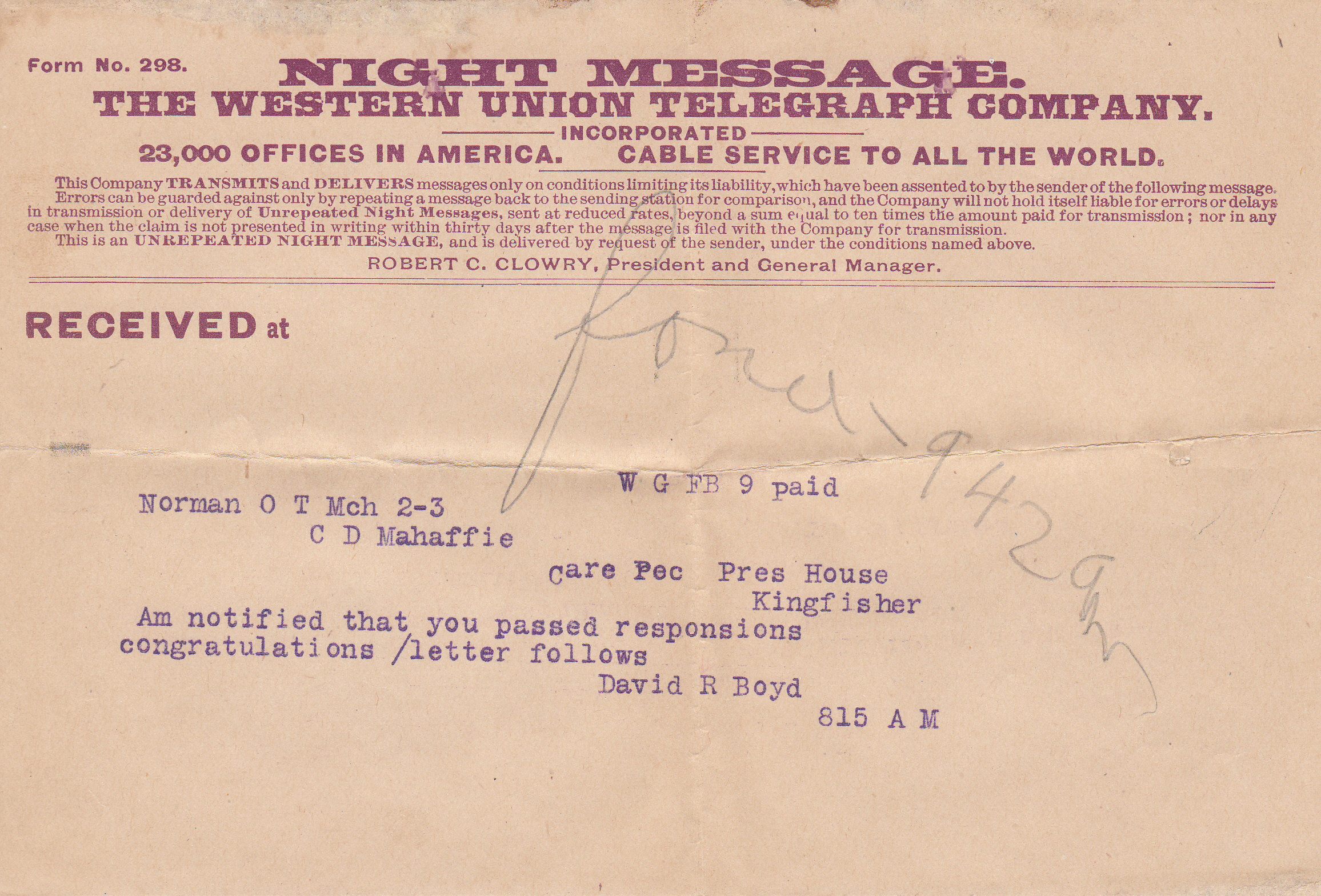
Here’s the telegram Charles got, telling him he’d passed:

In early March, on receiving the news, Charles wrote his family the letter below.

+-+-+-+-+

Kingfisher 3/3/05

Dear Home Folks:

I just got a telegram from Boyd that I passed in that exam alright. Prexy [President D. R. Boyd of Kingfisher College] is still having fits. I’m feeling pretty good myself you bet. Feel like celebrating. Don’t know but I’ll get drunk. I’ve got away from shaking hands and being tossed and am locked in my happy home to write a little.

I’ve got to have a certificate of birth right away to take to Norman [Oklahoma] and present with myself when the committee meets. I suppose I’ll have to go to Norman again, at least I have to go wherever they meet to be inspected.

About that birth certif. Can you get it from the County Clerk or Coroner or whoever keeps the record of Johnson County? Or the Doctor? I don’t know much about it except that it says there must be one.

I’m about out of money and am going to require a good deal this spring, ‘cause the last year [at Kingfisher College] is a lot more expensive than other years and then of course this [Rhodes] scholarship business will add somewhat to what I’ll be out. Now I reckon it’s about time for Papa to quit just giving me money and the best thing for me to do is to borrow about $50.

I guess I could get it here but if Papa is not too much afraid of the security—that’s a joke—has it to spare I mean, I’d rather get it from home.

Of course I don’t know yet how much I’m going to need but have got to have a new outfit of clothes before long and then by the time I pay my debts and take a trip to Norman there will be quite a hole in 50.

I’m feeling most too good to sit still and just write so will close with lots of love to all from your son and brother,

Charlie M.

P.S. Just happened to think maybe you won’t get this till Monday but hope you do anyhow.

Follow by Email
Instagram